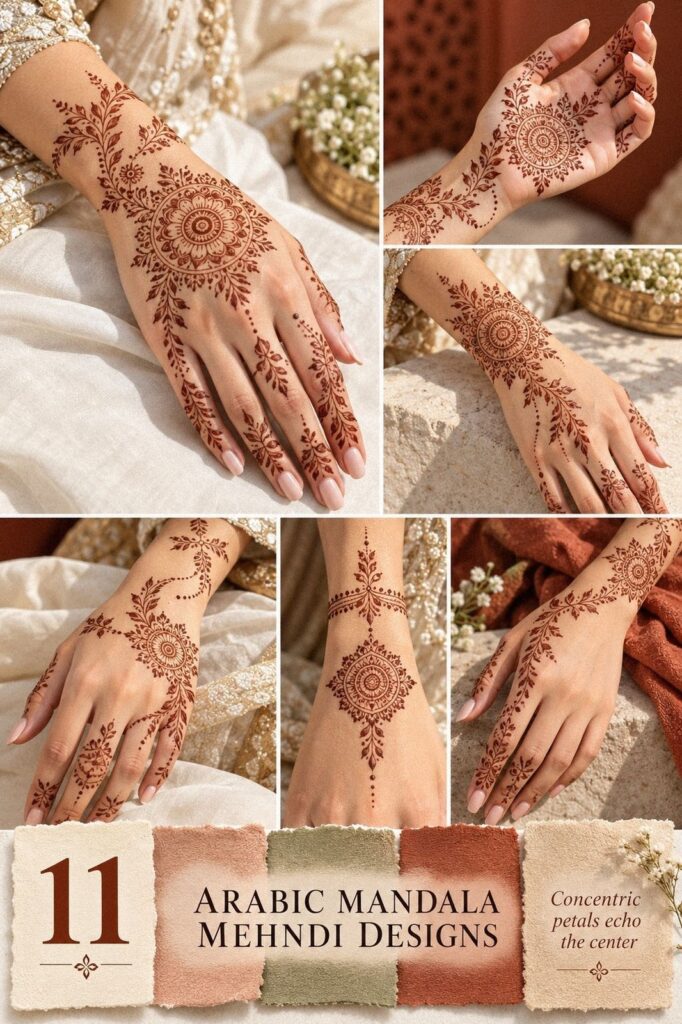
Arabic mandala mehndi designs usually take 1 to 2 hours to dry, deepen on the second day, and fade within 1 to 3 weeks. I once covered every gap with paste and regretted it. The pattern looked heavy, not graceful. These 11 Eid-ready ideas leave breathing space where your skin can speak!
Editor’s note: You don’t need the most intricate pattern to create a memorable result. I prefer a striking center, crisp spacing, and one personal detail that makes the design meaningful. If you’re comparing options before you spend, this simple mandala mehndi design collection is a useful starting point.
- Shape a Simple Arabic Mandala Mehndi Wrist Design
- Layer the Latest Arabic Mandala Mehndi Forearm Flow
- Use the Palm Echo Rule for Arabic Mandala Mehndi Hands
- Frame an Intricate Arabic Mandala Mehndi Finger Pattern
- Balance a Delicate Arabic Mandala Mehndi Ankle Design
- Choose a Bold Backhand Stain over a Busy Full-Hand Pattern
- Follow the Crescent-to-Rosette Path for Flowing Arabic Mandala Mehndi
- Keep a Minimal Arabic Mandala Mehndi Collarbone Motif
- Anchor an Ornate Arabic Mandala Mehndi Foot Design
- Can a Symbolic Arabic Mandala Mehndi Sternum Center Stay Minimal?
- Finish with Graceful Arabic Mandala Mehndi Hand Tracing
1Shape a Simple Arabic Mandala Mehndi Wrist Design

Start with a small circular center just above the wrist crease, then let three curved petals travel toward the back of your hand. The natural henna paste should look raised and smooth, with enough space between each stroke for the stain to stay crisp.
Your fingers can carry tiny dots and one pointed leaf each. That repetition makes the design feel polished without becoming ornate. I’d skip a full wrist band because it interrupts the graceful movement and makes a delicate pattern look boxed in.
Keep the fine cone tip narrow, but don’t chase microscopic details. A 2-millimeter gap between motifs gives your skin a striking role, especially when the stain deepens on the second day. If you’re drawing it yourself, test the pressure on paper first.
This is one of the best choices when you want a minimal design that still feels expressive. I’d call it a strong value for Eid because it takes less time, uses less paste, and remains easy to show when you’re greeting people. The natural reddish-brown stain lets you create a sleek outline without adding unnecessary detail.
If you’re deciding whether the placement is worth it, compare it with this simple mandala mehndi design collection. You’ll notice that the clearest patterns don’t need every inch filled. That open spacing can make a budget-friendly application look polished.
2Layer the Latest Arabic Mandala Mehndi Forearm Flow

This latest Arabic mandala mehndi design works because the pattern doesn’t stop at the wrist. Let one flowing forearm trail begin with a compact mandala, then widen gently through leaves, paisleys, and curved stems. Keep the natural stain warm and brown-red, even if your personal inspiration has a clay or brass mood.
The result should feel connected, not crowded.
3Use the Palm Echo Rule for Arabic Mandala Mehndi Hands

The Palm Echo Rule means your palm motif repeats one shape from the back of your hand, but in a smaller, lighter form. I like this approach because it creates connection without forcing both sides to match.
Choose one repeated element, such as a teardrop petal, crescent, or pointed leaf. Your palm might carry the full version, while the back of your hand gets only its outline. The smaller palm motif then feels intentional instead of crowded.
This rule works especially well when your hands will be moving during Eid. A small echo keeps the arrangement recognizable when you serve food or greet family. I’d keep the fingers lighter so the main symbol remains visible.
You can make the look more symbolic by repeating a paisley connected to your family tradition. A crescent may feel sacred to you, while a small rosette may simply be your favorite shape. Both choices are valid, and neither needs a long explanation.
If you’re comparing a handmade pattern with a ready reference, browse this traditional Arabic mehndi reference. I’d use it for structure, then ask your artist to change one detail so the result feels personal rather than copied.
For both hands, ask for a clear quote before the application begins. Some artists price each side separately, while others offer a paired rate. The paired application price can be worthwhile when the mirrored details are simple and the central motifs remain readable.

4Frame an Intricate Arabic Mandala Mehndi Finger Pattern

Finger mehndi needs a different rhythm because every surface bends and moves. Place one intricate flower across the base of your fingers, then let narrow vines climb toward the tips. The finger pattern should stay lighter than the main palm motif.
Your palm can hold a small mandala, but keep the finger work lighter than the center. That hierarchy makes the pattern look intentional, not busy. A deep reddish-brown stain can give the arrangement a fierce quality without overwhelming the delicate details.
I’d avoid filling every fingertip. Leave one fingertip mostly clear, and use it as a visual pause between the expressive bands. It’s a small decision, but it keeps the design dainty.
If you’re choosing between ornate fingers and a full palm, pick the fingers when you want something playful and easy to show during Eid. This traditional Arabic mehndi reference can help you compare density.
Finger work can be surprisingly affordable when the design stays narrow. Before you book, ask whether the quoted application price includes both hands or only one. That question protects your budget and prevents an awkward surprise at the end.
I’d choose a fine finger arrangement when you want a stylish detail that won’t dominate every gesture. The design can feel crisp at a glance and intricate when someone notices the details. Keep the outer edges clean, because smudged fingertips can make even an elegant motif look unfinished.
5Balance a Delicate Arabic Mandala Mehndi Ankle Design

For an ankle placement, begin with a delicate mandala on the top of the foot and let two curved stems travel toward the ankle bone. A small ankle mandala keeps the design graceful, especially when the natural stain has time to deepen. Add one pointed leaf near the edge, then stop before the pattern becomes too dense.
6Choose a Bold Backhand Stain over a Busy Full-Hand Pattern

A bold backhand stain can look more polished than a crowded full-hand pattern. Place one large mandala near the center of your hand, then use pointed leaves to pull the shape toward your wrist and index finger.
The negative-space center matters here. Leave a clear circle inside the rosette, because that open skin makes the surrounding petals look sharper. Your design will feel powerful, but it won’t become visually heavy.
I made the mistake of adding extra dots after the paste had started drying. They broke the clean rhythm and looked gritty once the color deepened. Stop when the pattern already has a strong edge.
If you love dense work, keep the intensity near the hand and let the wrist stay open. This mandala mehndi idea guide is best treated as a temporary stain, so you can test the scale without commitment.
A backhand design may cost more than a wrist design, but the value is easy to see when the center remains readable while you move. Ask your artist for a clear one-hand or two-hand price before the cone touches your skin.
I’d choose this for an empowering Eid look with a sharp silhouette. It’s bold without needing to be loud. If the design feels too intense, remove the outer dots before reducing the main mandala!
7Follow the Crescent-to-Rosette Path for Flowing Arabic Mandala Mehndi

The Crescent-to-Rosette Path begins with a curved crescent near the outer forearm, then narrows into a rosette as it approaches the wrist. Keep the stems flowing in one direction, with one romantic curve returning toward the hand. This gives the pattern movement without filling every gap.
8Keep a Minimal Arabic Mandala Mehndi Collarbone Motif

A minimal Arabic mandala mehndi collarbone motif should use fewer elements than a hand design. Start with one crisp circle, two outward petals, and a short vine that follows the natural curve beneath your collarbone.
The natural henna cone gives you control over the thickness, but your pressure matters just as much. Press lightly for the inner petals and slightly more firmly for the outer contour. That contrast keeps the result sleek and polished.
Your skin should remain visible around the design. If you fill the entire area, the motif can lose its dainty quality and look less personal. A small symbolic mark often feels more meaningful than a large arrangement.
Would you rather wear a pattern that shouts for one evening or one that stays quietly expressive through several days? I’d choose the latter here. The simple foot mehndi design guide has useful examples of restrained centers and clean outer spacing.
This is an affordable choice when you want a refined result without paying for a large application. Ask whether the quote covers a single collarbone motif or includes connecting vines. I’d spend on a clean cone and experienced hand before adding more elements.
The look can feel timeless, polished, and quietly empowering. It also suits someone who wants a personal design that won’t dominate every Eid outfit or gesture. Keep the motif small enough that your natural skin remains part of the arrangement.
9Anchor an Ornate Arabic Mandala Mehndi Foot Design

An ornate Arabic mandala mehndi foot design needs one strong anchor. Place a central foot motif near the top of the foot, then add symmetrical leaves toward the toes and a light trail toward the ankle. A vibrant stain can make the arrangement feel elegant without requiring every section to be filled.
10Can a Symbolic Arabic Mandala Mehndi Sternum Center Stay Minimal?

Yes, and it usually looks more expressive when it does.
Begin with a small rosette at the center, then add two symmetrical leaves that follow the natural line beneath your collarbones. The fresh mehndi paste should be applied in a controlled, even layer so the center remains recognizable after drying.
I’d avoid copying a large ceremonial arrangement onto this placement. A minimal crescent, one paisley, or three curved petals can feel more meaningful than a wide design. The result may look edgy at a glance and delicate when noticed closely.
This placement is personal, so choose a symbol you’ll still value after the color fades. I like a small crescent for renewal, but you might prefer a flower, initial-inspired curve, or family motif. The best choice is the one that means something to you.
If you’re concerned about price, ask for a single-center quote rather than a wider application. That keeps the budget manageable and gives your artist a clear boundary. A small, precise design can offer excellent value.
For a related sense of scale, review these latest mandala mehndi ideas. I’d use the references for proportions, then make the center more personal before you commit.
A meaningful symbol doesn’t need extra decoration to carry emotional weight. Keep the surrounding skin open, and let the central shape remain the first thing you notice!
11Finish with Graceful Arabic Mandala Mehndi Hand Tracing

Graceful hand tracing works when the design follows your anatomy instead of fighting it. Use curved hand tracing from the wrist toward the index finger, then interrupt the path with one paisley and a few crisp dots. The result can feel raw, classic, and personal without becoming dense.
The Two-Day Color Shift Tells You What to Expect
I used to judge mehndi the moment the dry paste lifted, and that was a mistake. Freshly revealed color can look pale orange or uneven, especially on the fingers and palms. The developing stain usually deepens during the second day, so your first glance isn’t the final result.
The application itself should stay comfortable and unhurried. A mehndi artist may use a fine cone for crisp Arabic curves, while a homemade cone can work if the paste is smooth and strained. I prefer a polished, expressive pattern with visible breathing space over a dense design that hides its own center.
Your care afterward matters. Keep the area dry while the paste is setting, avoid rubbing it away, and protect the finished stain from repeated washing when you can. The color may remain visible for 1 to 3 weeks, depending on placement, skin, friction, and how often you use that part of your body.
If you’re choosing between a wrist, palm, foot, or collarbone, think about how often that area gets washed or rubbed. Palms can develop a bold color, while feet may fade sooner from footwear. Your favorite placement should suit your actual plans, not just the reference.
This simple mandala mehndi collection is helpful when you want to compare how much open skin different patterns use. I’d save one reference before the application and avoid changing direction halfway through.
How to Match the Pattern to Your Eid Plans
Start by thinking about what you’ll actually do during the celebration. If you’ll be serving food, greeting guests, or washing your hands often, a wrist or forearm motif may be easier than dense palm work. Your practical schedule matters.
For a short gathering, I’d choose a minimal wrist, finger, or collarbone pattern. For a longer celebration, you might prefer an ornate foot design or a flowing forearm arrangement. The chosen placement should support your plans instead of creating extra care.
If you’re buying a cone for home application, check the ingredients and freshness first. A lower price isn’t good value if the paste produces weak color or irritates your skin. I’d rather buy one reliable cone than several questionable ones.
You can also ask whether your artist offers a simple, standard, or custom design. Those categories make it easier to compare cost. A custom arrangement may be worth the extra spend when you want a symbolic detail or a placement adjusted to your hand.
For a more traditional direction, browse this Arabic mehndi reference before choosing your size. I’d mark the one motif you love most, then let the artist build around it.
What Arabic Mandala Mehndi Usually Costs
Prices vary by region, artist experience, detail, and whether you’re booking one placement or several. The table below gives a practical starting range in U.S. dollars, not a fixed promise. Your local quote may be lower or higher.
Ask whether travel, both hands, extra fingers, or a second placement changes the price. A clear quote helps you protect your budget and compare value honestly.
I wouldn’t choose the cheapest option automatically. Look for clean lines, developed-stain examples, and clear ingredient information. A slightly higher cost can be worthwhile when the artist understands spacing and works confidently with your skin tone.
This mandala mehndi idea guide can help you decide whether your preferred pattern is compact or detail-heavy. I’d bring a realistic reference so the quote reflects the work you actually want.
A simple wrist design can be an excellent value when the center is clear and the paste is fresh. A custom foot or forearm arrangement costs more, but the extra time may be worthwhile if the placement and symbolism matter to you.
How to Compare Mehndi Artists Before You Book
Start with examples taken immediately after application and again after the stain develops. Fresh paste shows control, while the second image shows whether the color develops evenly. You’ll learn more from that pair than from a heavily edited reference.
Ask how long the drying process usually takes and what aftercare the artist recommends. A thoughtful answer tells you that the artist understands the difference between application, drying, and color development.
I’d also ask whether the artist works with natural henna and can explain the ingredients. Avoid products with unclear contents or artificial black color. Your skin deserves a safe, carefully prepared paste.
When you compare artists, notice whether every design looks identical. A strong artist can adapt the motif to your hand, foot, collarbone, or forearm. That flexibility often gives you better value than a fixed design menu.
Look for examples showing darker and lighter skin tones, narrow fingers, broad palms, and different placements. A graceful artist should be able to adjust spacing instead of forcing every person into the same template.
If you’re choosing between two artists, I’d ask each one how they would simplify your chosen reference. The answer reveals their judgment. A personal, well-edited design is usually more memorable than a copied arrangement with too many competing elements.
Why Arabic Mandala Mehndi Feels Right for Eid
Arabic mandala mehndi has returned to attention because it gives people both structure and freedom. The symbolic center offers meaning, while Arabic curves create movement around it. That combination can look classic, modern, feminine, or fierce depending on the spacing.
I’ve noticed that the most memorable patterns aren’t always the most intricate. They’re the ones with a clear focal point, one unusual curve, and enough open skin to make the stain breathe. That’s why a minimal wrist design can feel more iconic than a full palm packed with repeated petals.
Your choice also depends on the occasion. A dainty wrist or finger pattern suits a short gathering, while an ornate foot or full-hand arrangement feels more ceremonial. For Eid, I’d choose something personal and polished rather than copying every detail from a reference.
The best design leaves room for your own meaning. A crescent might mark renewal. A paisley might connect you to family tradition.
A small rosette might simply be the shape you’ve always loved. That’s enough.
If you’re still deciding, save this trendy Indo-Arabic mehndi reference and compare it with the bridal mandala mehndi collection. I’d choose the reference that gives you one clear idea, not ten competing ones.
Arabic curves also make room for personality. You can choose a raw, gritty outline, a refined classic center, or a playful trail of leaves. The design should feel like yours before the paste even touches your skin.
Before You Book an Eid Mehndi Session
Choose the placement first, then decide how much detail your time and budget can support. Your artist can simplify a design quickly when the boundary is clear. They can’t always rescue a plan that keeps expanding during the application.
Tell the artist about your event timing. Since the paste usually needs 1 to 2 hours to dry and the color deepens on the second day, a last-minute appointment may not give you the result you expect. I’d book early when the occasion matters.
Bring one or two references, not a huge folder. A single image for the center and another for the spacing can communicate more clearly than a collage of unrelated designs. Your final pattern should feel cohesive.
If you’re applying it yourself, practice the center and one border on paper. Then try the design on a small area before committing to the full placement. That small test can save paste, time, and frustration.
Ask about ingredients, drying time, aftercare, and the exact price before work begins. A thoughtful artist should answer clearly. If the application plan keeps changing, pause and decide what you actually want.
This simple mandala mehndi collection is a useful final reference because it shows how much impact a restrained center can have. Choose one direction and trust the open space!
A Few Things Worth Answering
Where can I buy supplies for an Arabic mandala mehndi design?
I’d buy fresh, skin-safe natural henna powder or a prepared cone from a reputable mehndi supplier. Check the ingredients, avoid suspicious pre-mixed products, and choose a cone with a fine tip. A practice sheet, tissues, and citrus-sugar seal are useful additions.
How much does an Arabic mandala mehndi design usually cost?
I wouldn’t expect one fixed price because mehndi artists charge according to detail, placement, occasion, and region. Ask for a quote before the application. Simple wrist work usually costs less than an ornate foot or full-hand arrangement, but the best value depends on the finish you want.
Is Arabic mandala mehndi a good idea for Eid?
Yes. I think it’s especially appealing when you want temporary color with a polished, meaningful look.
Choose a graceful wrist motif for a shorter application or a fuller palm pattern for a traditional celebration. The stain can remain visible for 1 to 3 weeks.
What color should Arabic mandala mehndi be in 2026?
I’d choose a rich reddish-brown stain because it remains recognizable and develops naturally over the second day. Deeper brown can create a bold, crisp effect. I’d avoid artificial black products with unclear ingredients and ask what’s inside the paste.
Can I make Arabic mandala mehndi at home on a budget?
Yes, I’d start with a simple pattern and a good cone. Practice the center on paper first, then use a few leaves, dots, and one paisley. Keep the paste on for 1 to 2 hours while it dries, and don’t add detail just to fill space.
How do I choose a mehndi artist?
I’d look for clear examples of fresh applications and developed stains, especially on hands, fingers, feet, and darker skin tones. Ask about ingredients and hygiene. A strong artist should explain drying time, care, and how the design will suit your placement.
Where I’d Start First
If I had to pick one, I’d start with the simple wrist mandala. Its open center stays readable as the stain deepens, and the placement won’t compete with your Eid clothes or jewelry. Pin this guide for later, then show your mehndi artist the spacing you want.
That choice gives you a polished result without an overwhelming cost. It’s delicate, personal, and easy to adapt if your plans change. If you want more coverage later, you can extend the same rosette toward your fingers or forearm.
For a final comparison, revisit this simple mandala mehndi collection and this simple leg mehndi reference. Choose the design that still feels like you after the first excitement fades.
My personal favorite is still the open wrist version. It feels meaningful without becoming too formal, and the breathing space lets the second-day color shift become part of the design. That balance is what makes an Arabic mandala mehndi pattern feel iconic, expressive, and truly yours.


