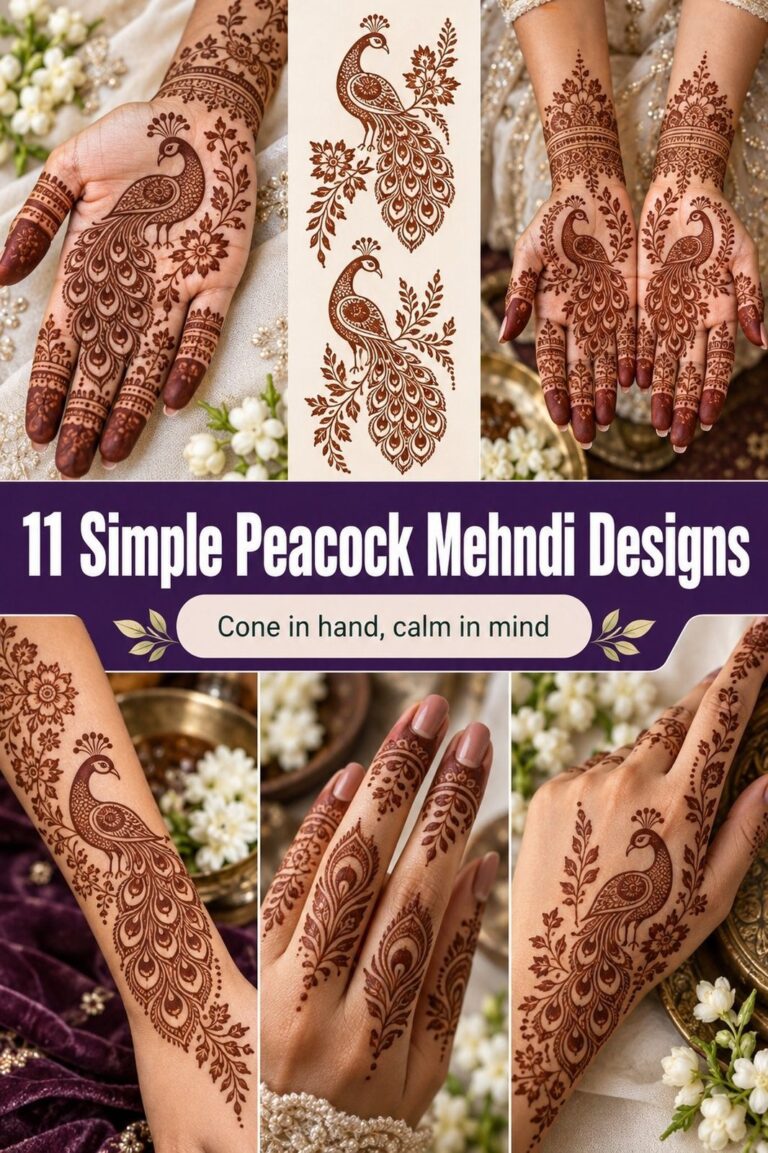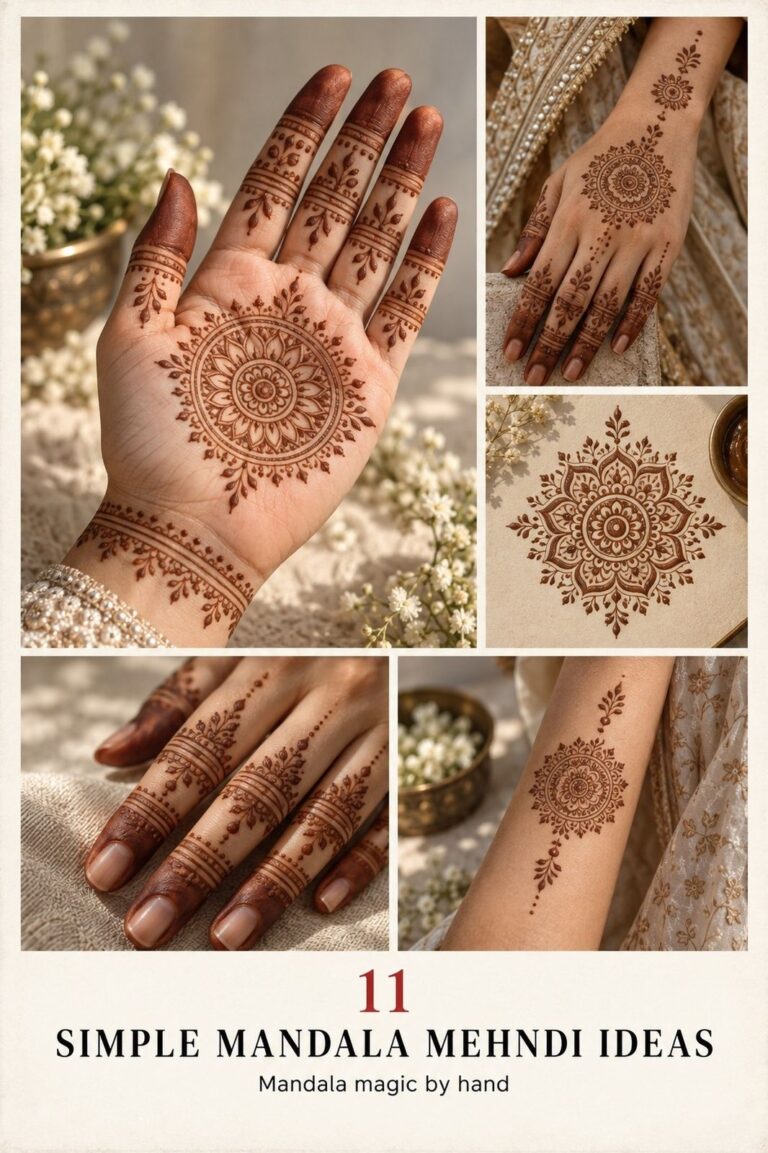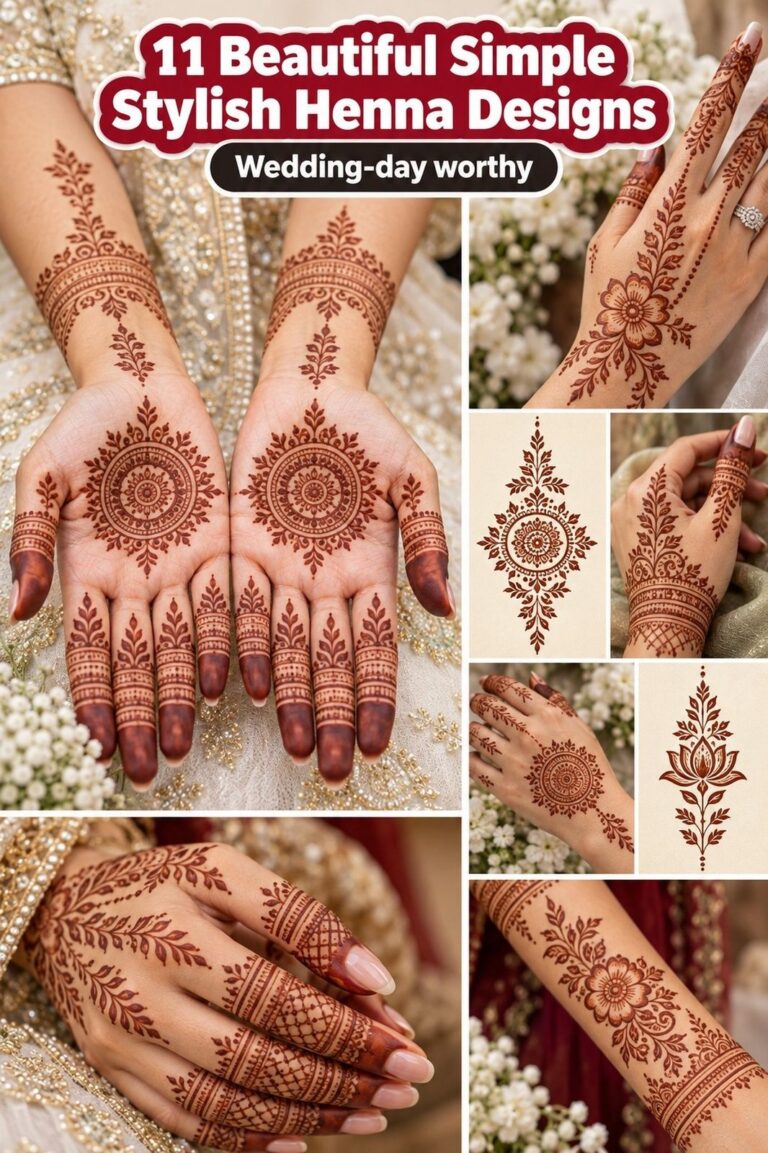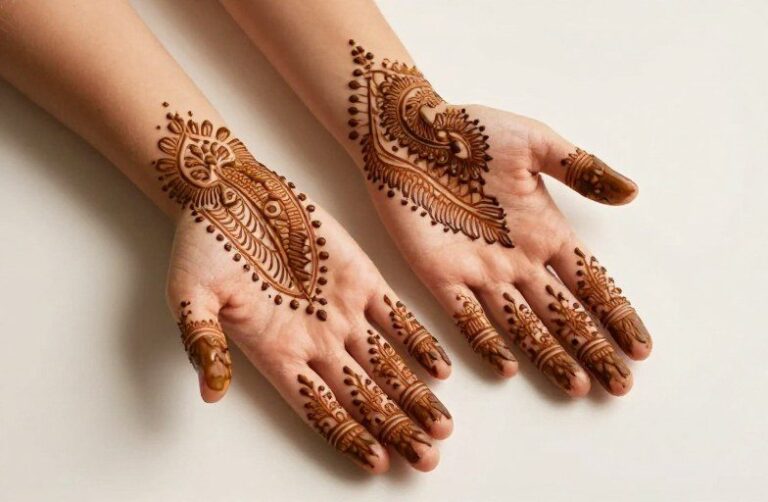
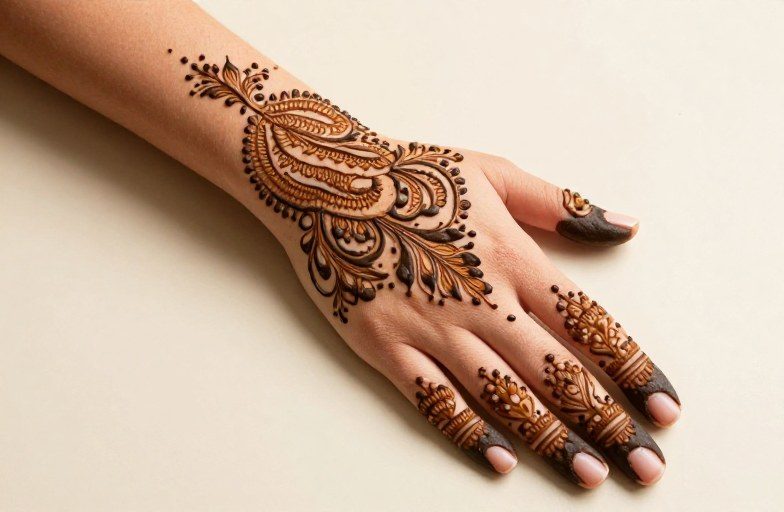
A peacock rendered in henna speaks of beauty that carries responsibility. The spread tail represents watchfulness and the all-seeing eye, while the bird’s ability to eat poisonous snakes without harm made it a symbol of incorruptibility and spiritual protection. In henna specifically, the peacock carries added weight because the medium itself is temporary, skin-stained for days rather than years, so the design often marks fleeting but significant moments: weddings, festivals, rites of passage.
How It Ages on Skin
Henna sits on the surface, staining keratin rather than depositing ink deep in dermis. A peacock’s fine lines, the delicate eye-spots, the thin neck, the feather barbs, blur faster than bold geometric work. The paste typically yields orange-brown initially, darkening to deep mahogany over 48 hours, then fading unevenly over two to three weeks.
What Fades First
The tail’s outer eyes usually go soft quickest. Palm and finger placement, despite being traditional, sheds fastest due to constant washing and skin turnover. A peacock across the back of the hand keeps its silhouette longer than one wrapped around fingertips. The bird’s body, if drawn with thicker paste lines, often outlasts the decorative surround by several days.
Contrast with Permanent Tattoo Aging
Permanent peacock tattoos face different erosion: blue and green inks, common for the bird’s coloring, are notoriously unstable. Teal shifts toward muddy gray within a decade; yellows disappear into skin tones. Henna sidesteps this entirely, its limitation is also its preservation of original intent. You see the design as conceived, then release it.
History & Cultural Roots
The peacock entered henna tradition through multiple gateways. In Mughal India, the bird appeared in miniature paintings and architecture before migrating onto skin. Persian traditions, often linked to the Simurgh mythology, treated the peacock as a guardian creature. Mediterranean and North African henna use adopted the motif more for its visual impact than strict symbolic continuity.
Regional Style Variations
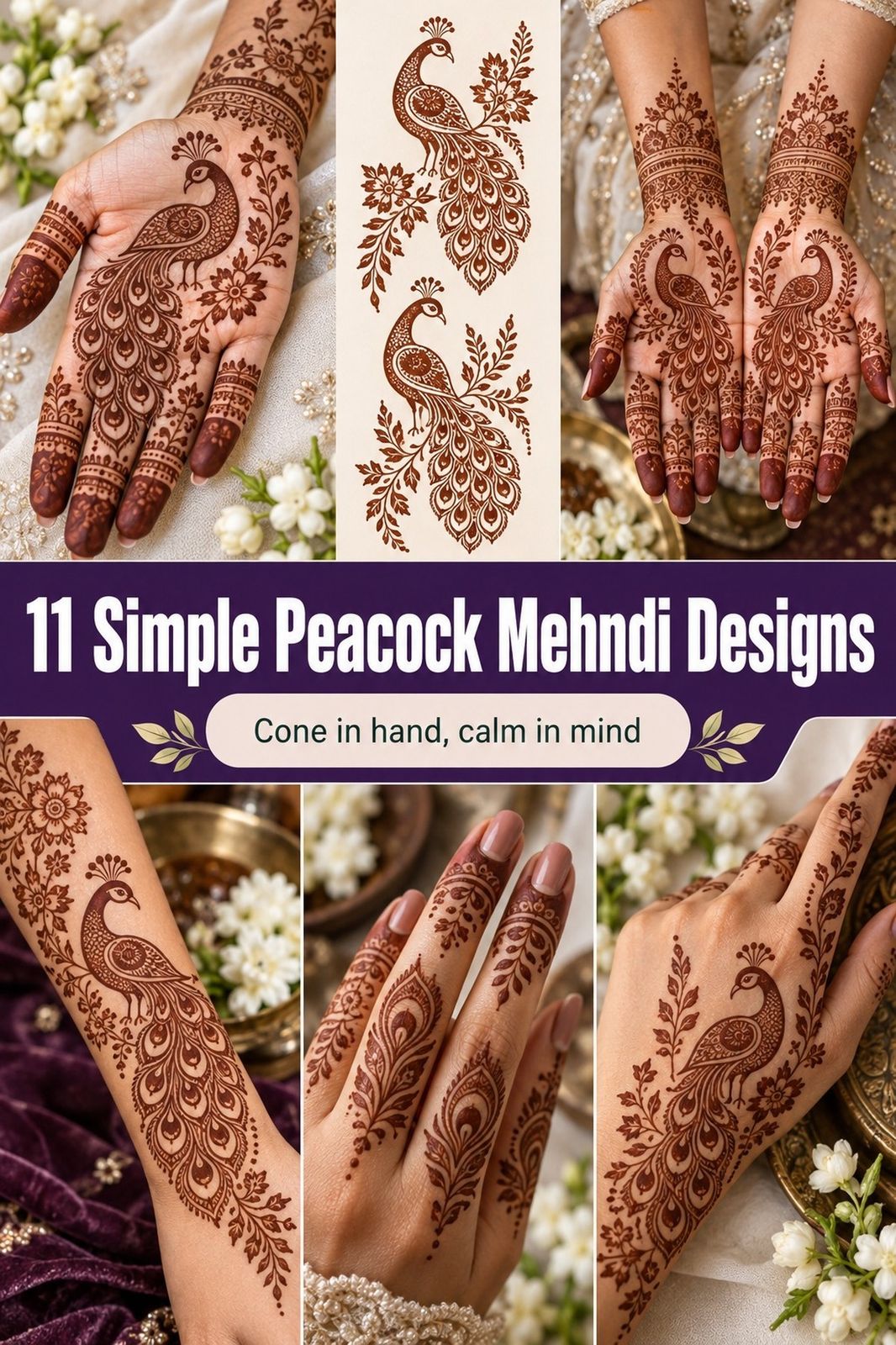
Rajasthani work favors the peacock in profile, tail a semicircular fan, filled with paisley-derived shapes. Moroccan artists often render the bird more geometrically, tail feathers becoming diamond grids. Persian-influenced designs sometimes show the peacock facing forward, symmetrical, almost heraldic. These aren’t arbitrary aesthetic choices, they reflect how each culture solved the problem of fitting a large, complex bird onto curved human skin.
Henna as Social Marker
Peacock henna at Indian weddings traditionally covered the bride’s hands and forearms; the groom might receive a smaller version. The density of the design signaled family investment and the bride’s transition to married status. In some communities, unmarried women wore simpler peacock motifs at Eid or Diwali, the bird’s beauty appropriate to celebratory display without the full bridal weight.
Design Tips & Pairings
The peacock demands space. A recognizable tail spread needs at least four inches in any direction; smaller work reduces to a generic bird shape. Successful henna peacocks balance negative space against fill, too dense, and the design becomes a brown blob; too sparse, and the bird loses its characteristic grandeur.
Complementary Motifs
- Mango/paisley shapes: Traditional fill inside tail feathers, their curved echo reinforcing the peacock’s own lines.
- Flowers, especially lotus: Ground the bird in natural setting; the lotus shares the peacock’s association with purity emerging from murky conditions.
- Geometric borders: Contain the composition; a peacock without framing tends to float awkwardly on larger skin canvases like the back or thigh.
- Single feather detail: For smaller placements, one dropped feather carries the symbolism without requiring full tail display.
Line Weight Strategy
The peacock’s body and head need heavier paste application to register against the tail’s complexity. Many artists outline the main form with a cone’s natural line, then switch to finer tips for eye-spot detail. The characteristic “eyes” on the tail, each a small circle with concentric rings, require steady pressure control; wobbly circles read as amateur immediately.
Best Placements
The peacock’s natural posture determines viable placement. The classic displayed tail suits flat or gently curved surfaces: upper back, sternum, outer thigh, calf. The bird’s profile, neck extended, follows the line of forearm or side ribcage more naturally than a frontal spread.
Hand and Foot Traditions
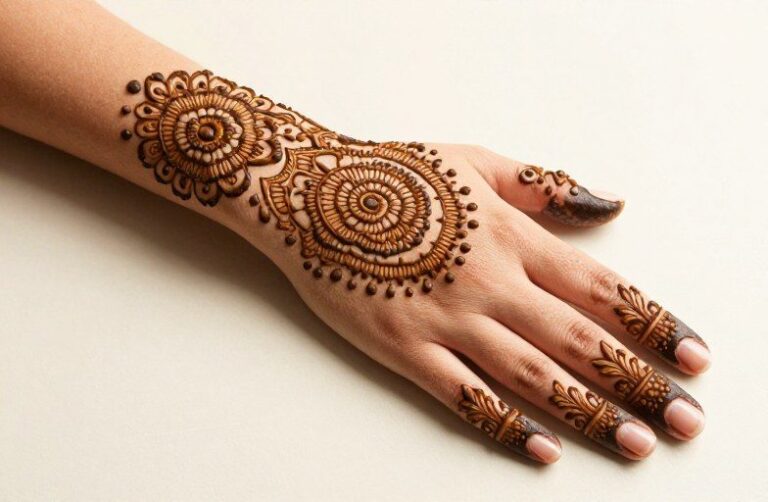
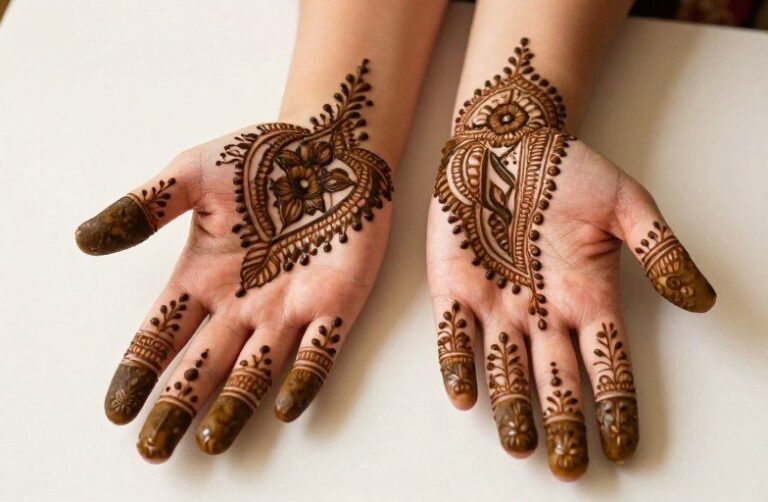
Bridal application often centers the peacock on the back of the hand, tail extending toward fingers, body toward wrist. On feet, the bird faces upward, as if ascending, auspicious directionality. These placements sacrifice longevity for visibility and traditional correctness. The paste cracks and flakes faster where skin flexes most.
Modern Placement Shifts
Contemporary wearers sometimes choose upper arm or shoulder blade for the peacock, allowing larger scale and slower fading. The side torso, following rib curvature, accommodates a full tail spread across multiple sessions. These departures from traditional hand/foot placement shift the work from ritual marker to personal ornament.
Mythology & Folklore
Greek accounts commonly associated the peacock with Hera, the bird’s tail eyes said to commemorate her hundred-eyed servant Argus. Some trace this to Near Eastern precedents, though the transmission remains debated. The peacock’s flesh, believed incorruptible, fed medieval European ideas about resurrection symbolism.
Indian Subcontinent Threads
Krishna wears a peacock feather in his hair across countless representations, the bird associated with his flute-playing, rain-dance, and romantic play. The peacock is also the mount of Kartikeya, god of war, suggesting vigilance and strategic sight. In henna, these layers compress: the feather alone can invoke Krishna; the full bird might reference broader protective presence.
Persian and Central Asian Strands
The Simurgh, mythical bird of Persian epic, sometimes borrowed peacock visual attributes in later artistic periods. The peacock throne of Mughal rulers literalized the bird as seat of power. Henna designs from these regions often show the peacock more stylized, less naturalistic, acknowledging its symbolic rather than ornithological identity.
Religious & Spiritual Angles
Peacock henna carries different spiritual weight depending on context. In Hindu practice, it often accompanies prayer or blessing ceremonies, the bird’s association with deities making it appropriate sacred decoration. Islamic contexts vary more widely, some traditions embrace the peacock’s beauty as divine creation, others avoid figurative representation entirely.
Christian Interpretations
Early Christian art adopted the peacock for resurrection and eternal life, the “incorruptible flesh” idea persisting. Modern Christian wearers of peacock henna sometimes reference this heritage, though the medium’s South Asian origins create interesting cross-cultural friction. The design becomes personal syncretism rather than strict doctrinal statement.
Contemporary Spiritual Use
Outside specific religious frameworks, the peacock in henna often signals personal transformation or self-actualization, the “showing your true colors” interpretation. This is newer, psychologized symbolism, less rooted in traditional practice. Whether this constitutes appropriation or natural evolution depends on who’s applying, who’s wearing, and what cultural preparation preceded the choice.
The Bottom Line
Peacock henna means multiple things simultaneously: beauty, vigilance, protection, spiritual aspiration, social status, personal transformation. The specific weighting depends on cultural context, placement, accompanying motifs, and the wearer’s own intention. What remains constant is the design’s demand for technical skill, this is not a beginner’s motif. The tail’s geometry, the eye-spots’ precision, the body’s proportion all expose sloppy work instantly. If you’re drawn to this symbol, invest in an artist who understands its structural requirements, not merely its cultural cachet. The peacock deserves that rigor.
Frequently Asked Questions
Does a peacock henna tattoo have different meaning if I use black henna instead of natural brown?
Black henna often contains PPD, a hair dye chemical that can cause severe allergic reactions and permanent scarring. Beyond safety concerns, the color itself carries no additional traditional meaning, natural henna’s brown-red is the historically significant tone.
Can men wear peacock henna, or is it strictly for women?
Men have worn peacock henna in specific contexts: grooms in some South Asian traditions receive smaller designs, and certain spiritual practitioners regardless of gender use the motif. Contemporary Western adoption is generally gender-neutral, though full bridal-style application remains culturally coded feminine.
How long should I keep the henna paste on for the darkest peacock result?
Leave paste intact for 6-12 hours minimum; some artists recommend overnight wrapping with tissue and medical tape. Scrape rather than wash off, avoid water for 24 hours, and apply lemon-sugar sealant to deepen the stain. The peacock’s fine details benefit especially from maximum color development.
Is it disrespectful to get a peacock henna tattoo if I’m not South Asian?
Context matters: wearing it to a South Asian wedding as invited guest differs from casual festival appropriation. Research the specific tradition you’re borrowing from, credit your artist’s heritage, and avoid claiming spiritual significance you haven’t been taught. The peacock itself appears across enough cultures to resist single-origin ownership.