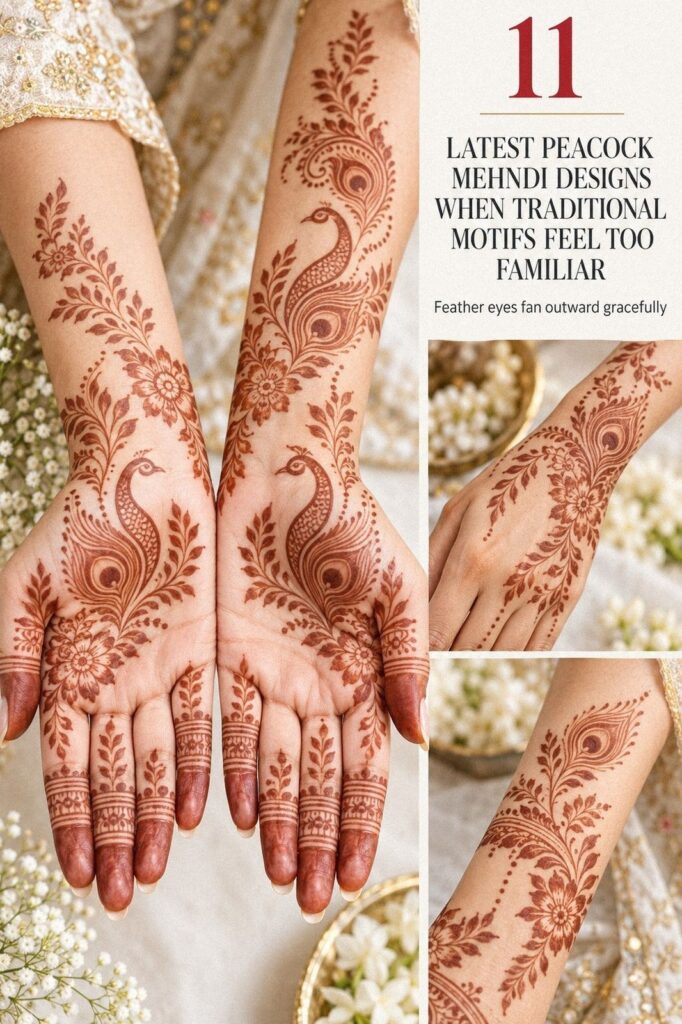
Latest peacock mehndi designs can look intricate without becoming difficult to apply. I learned that after one Eid design turned into a crowded brown-red stain because I started with details instead of flow. This guide gives you an orderly path from simple shapes to personal feather elements. You’ll work with the cone, the paste, and the second-day color shift!
Editor’s note: If you’re short on time, build one clear peacock motif first. Everything else can grow from that shape.
- Start With Simple Latest Peacock Mehndi Designs
- Build Intricate Peacock Feather Linework
- Which Hand Placement Suits Latest Peacock Mehndi Designs?
- Finger Details: Delicate and Crisp
- Shape a Flowing Wrist Peacock Composition
- Peacock Eye Accents
- Lotus and Feather Motifs
- When Does Dainty Linework Suit Your Style?
- The Palm Peacock
- Ornate Details, Minimal Space
- Personal Feather Elements
1Start With Simple Latest Peacock Mehndi Designs
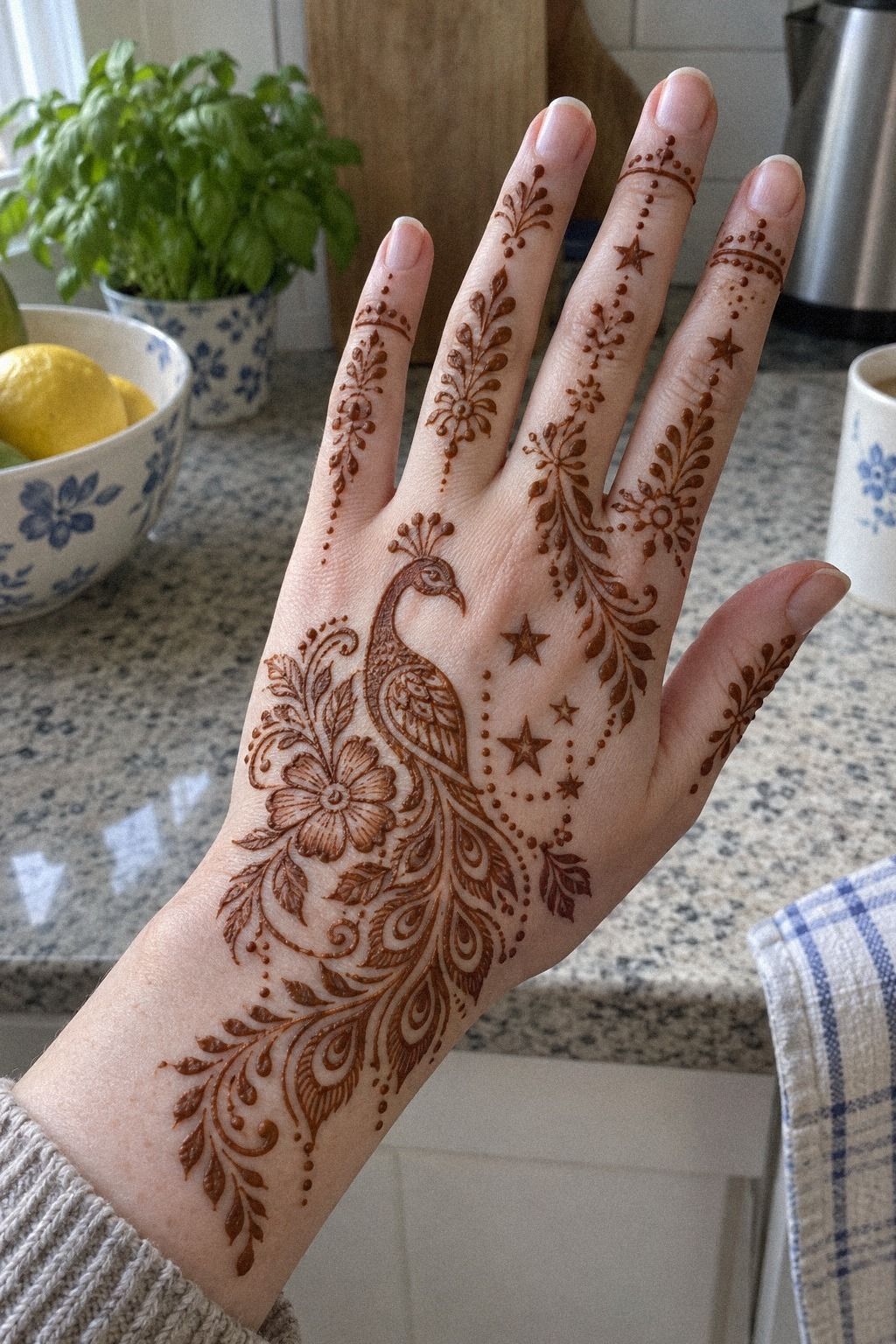
Begin with a peacock body on the back of your hand, then let one curved feather trail toward your index finger. Your first outline should stay minimal and crisp, with enough room for the pattern to breathe. Use a fine-tip henna cone with a steady opening, because your paste needs to form a narrow ridge rather than a thick mound.
For your first attempt, sketch the body as a small paisley with a curved neck and one expressive eye. You don’t need ten feathers yet. A bold neck, two leafy shapes, and three dots can already look symbolic and polished when your spacing is deliberate.
That restrained approach is usually worth the extra time.
I’d keep the palm mostly open at this stage. That negative space makes your personal motif feel sleek instead of crowded, and you’ll have room to add details later. If you’re comparing layouts, save these simple peacock mehndi designs before you choose your direction.
And don’t rush the cone. Rest your lower hand on a folded towel, breathe out while you draw, and turn your wrist instead of dragging your fingers across wet paste. A dainty start is more forgiving than a large, ornate pattern that loses its shape halfway through.
2Build Intricate Peacock Feather Linework
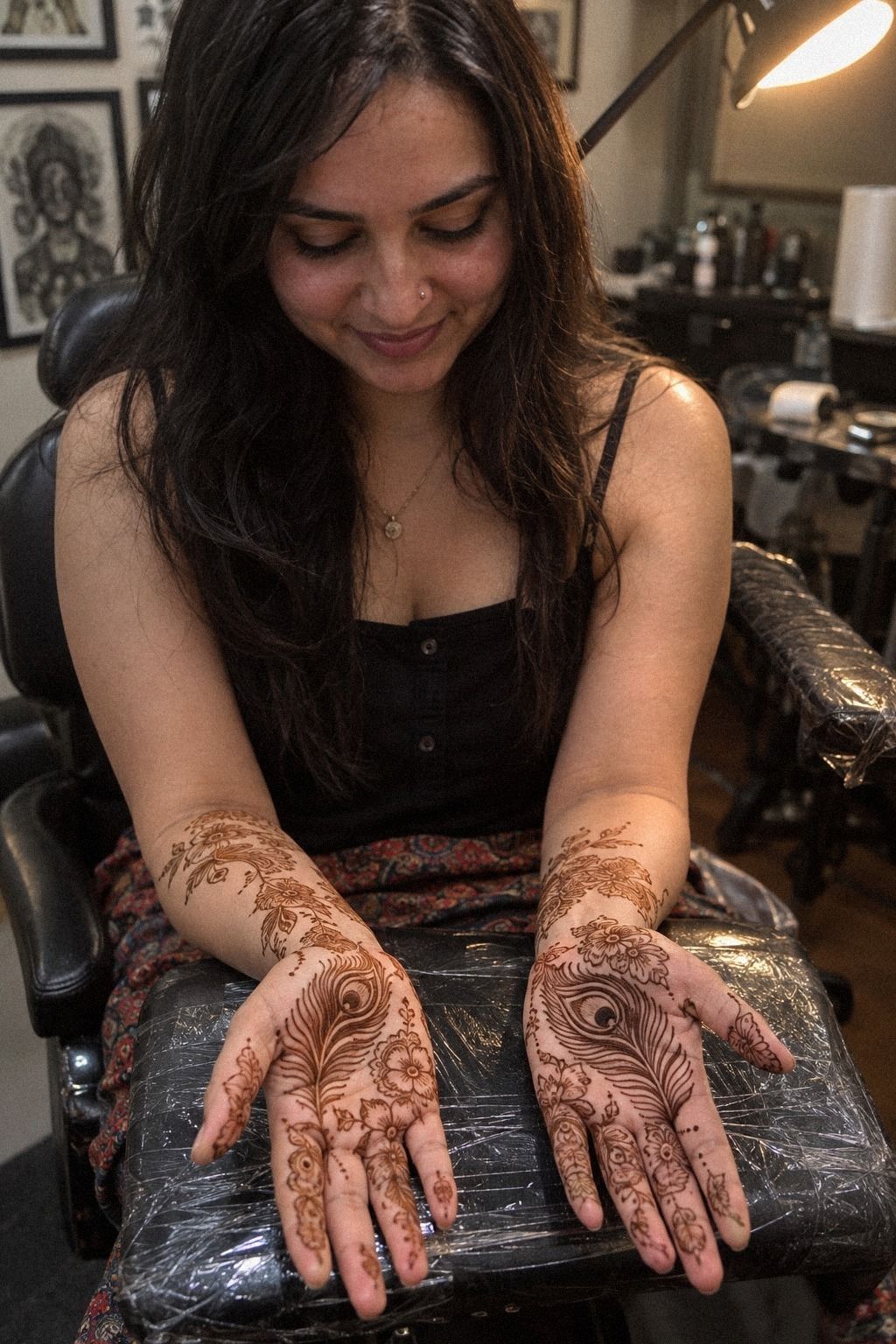
Once your basic peacock reads clearly, build the feather fan with repeated almond shapes. Each feather can hold a small teardrop, dot, or curved vein.
Your goal is intricate rhythm, not maximum density. If every space is filled, the eye can’t follow the bird.
Use sifted henna powder for a smooth paste, especially when your design depends on narrow curves. A gritty mixture will interrupt your lines and leave rough edges around the feather eyes. I’ve made that mistake before, and the pattern looked raw even though the composition was good.
Place the largest feather near the peacock’s back, then reduce each shape as it travels toward the wrist. This gives your design a flowing direction. You’ll want the feather tips to point toward open skin, because that makes the whole composition feel longer and more graceful.
But don’t copy every detail from a reference image. Choose two or three elements you can repeat confidently: curled veins, small scallops, or paired dots. For more variations, compare these latest stylish mehndi designs for front hand and notice how the lines breathe between motifs.
3Which Hand Placement Suits Latest Peacock Mehndi Designs?

Now decide whether your peacock belongs on the back of the hand, across the palm, or near the wrist. Your back-of-hand placement gives the motif strong visibility and makes the feather fan easy to display during Eid.
A palm design offers more room for a powerful centerpiece, especially if you want a lotus, paisley, or extended feather trail. Keep the face and main eye away from deep creases so the design remains readable as your hand moves.
The wrist works well when you want a long, elegant extension. A smaller wrist placement also suits a tighter budget because it uses less paste and usually takes less time. Compare these simple peacock mehndi designs with latest stylish mehndi designs for front hand before committing.
If you prefer a larger composition, feet and ankles can carry a vibrant feather trail. These simple foot mehndi designs may help you judge how a peacock changes when the available skin is longer and narrower.
4Finger Details: Delicate and Crisp
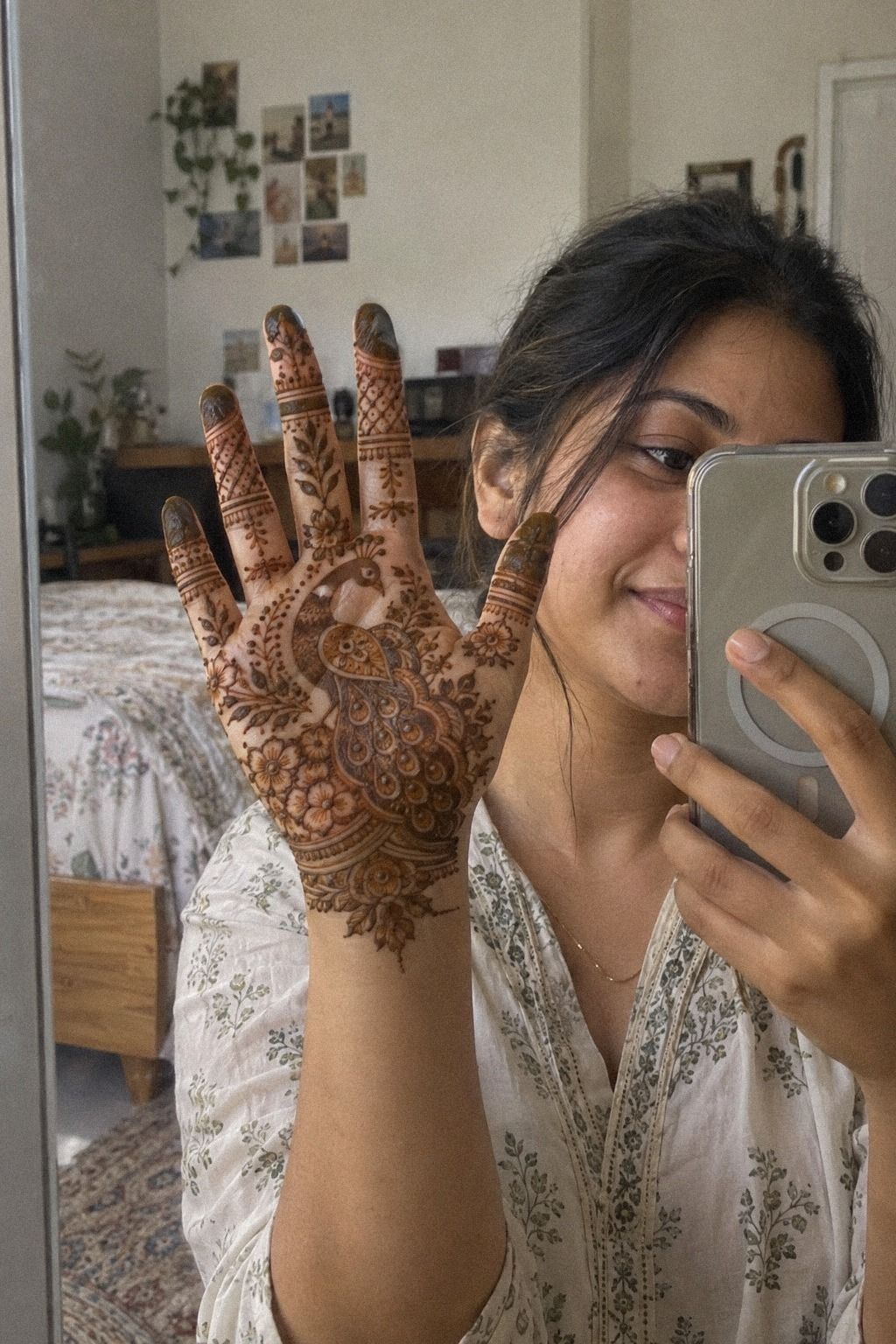
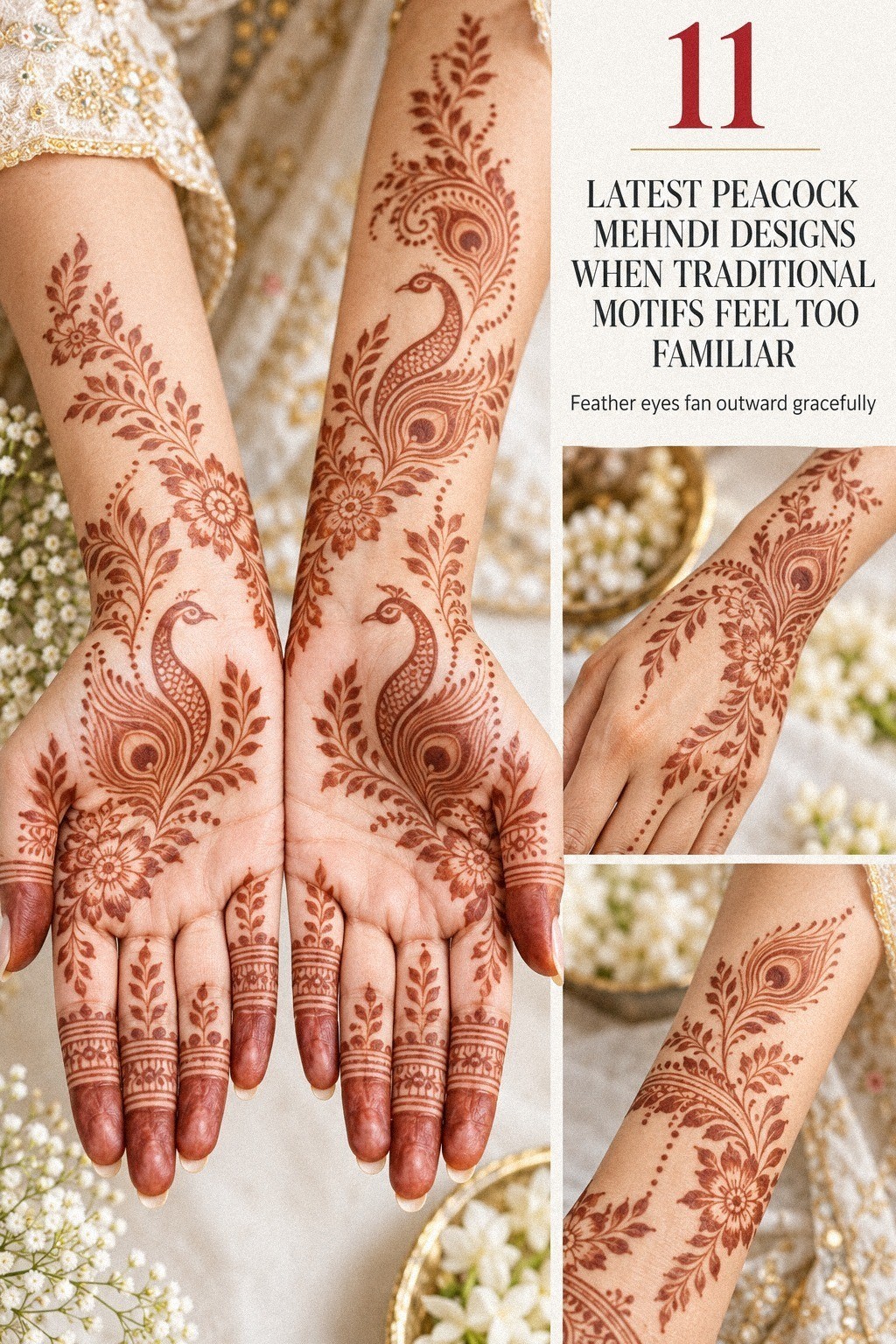
Treat your fingers as small frames, not empty strips waiting for decoration.
5Shape a Flowing Wrist Peacock Composition

For a wrist composition, imagine the peacock moving rather than sitting still. Let the neck curve toward your forearm, then carry two feathers down the wrist in a soft S-shape. Your wrist composition should feel flowing when your hand is relaxed and still readable when you turn your palm.
A lemon-sugar sealant can help the dried paste stay attached while the stain develops, but use only a light layer. Too much liquid can blur your fine curves and make the design uncomfortable to keep in place. Dab gently rather than brushing across the surface.
Place the widest part of the feather near the hand, then taper toward the forearm. That proportion creates a graceful transition instead of a sudden stop.
If your wrist is narrow, choose three feathers rather than seven. A smaller composition can look understated and personal, and it may be worth the cost of a longer application.
I’d skip a dense cuff around the entire wrist. It’s ornate, but it can hide the movement that makes a peacock motif special.
Leave small windows of skin between curls, leaves, and feather eyes. Your simple trendy mehndi designs references can help you compare open wrist layouts before you commit.
6Peacock Eye Accents
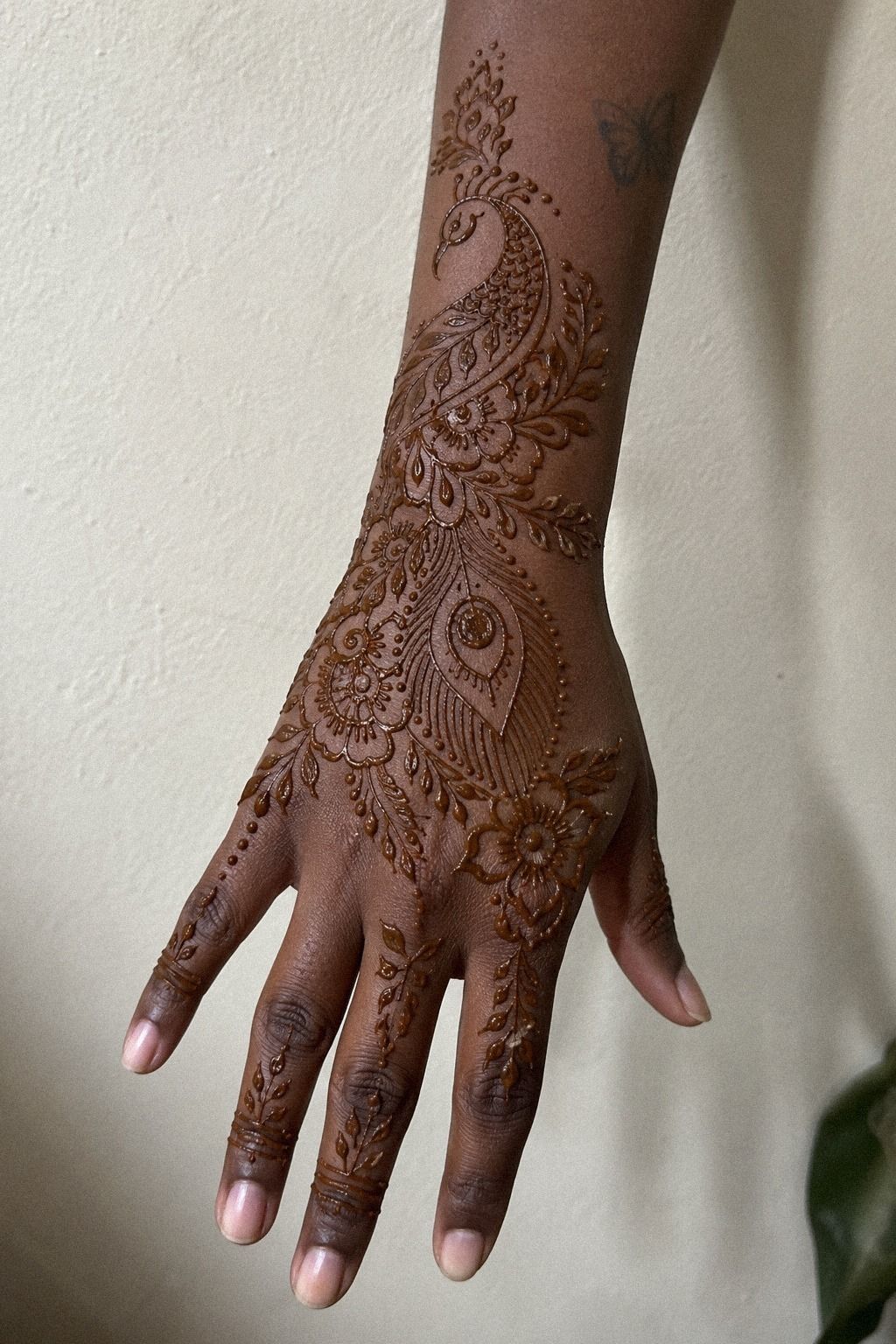
The eye inside each feather gives the design its strongest visual punctuation. Make your main peacock eye larger and darker than the surrounding veins, then let the smaller eyes fade in scale as they move toward your forearm.
Use a thick paste ridge for the central teardrop and a thinner cone line for the surrounding loops. You don’t want every mark to compete. One bold accent can make an otherwise delicate fan feel expressive and sharp.
Try a pointed almond shape first, then add a small dot or curled hook inside it. This creates a sacred or symbolic center without requiring complicated geometry. If your hand is deep brown or ebony, the developing stain will offer warm contrast.
But don’t fill every feather eye completely. Solid paste can turn a charming motif into a heavy block once the stain darkens on the second day. I’d choose three bold eyes and leave the rest outlined.
That balance feels fierce without losing the soft movement of the feathers.
For another direction, compare simple latest simple mehndi designs and notice how small eye shapes can change the whole mood of a pattern.
7Lotus and Feather Motifs

A lotus can give your peacock composition a meaningful center, especially for Eid designs that carry personal or family symbolism.
8When Does Dainty Linework Suit Your Style?
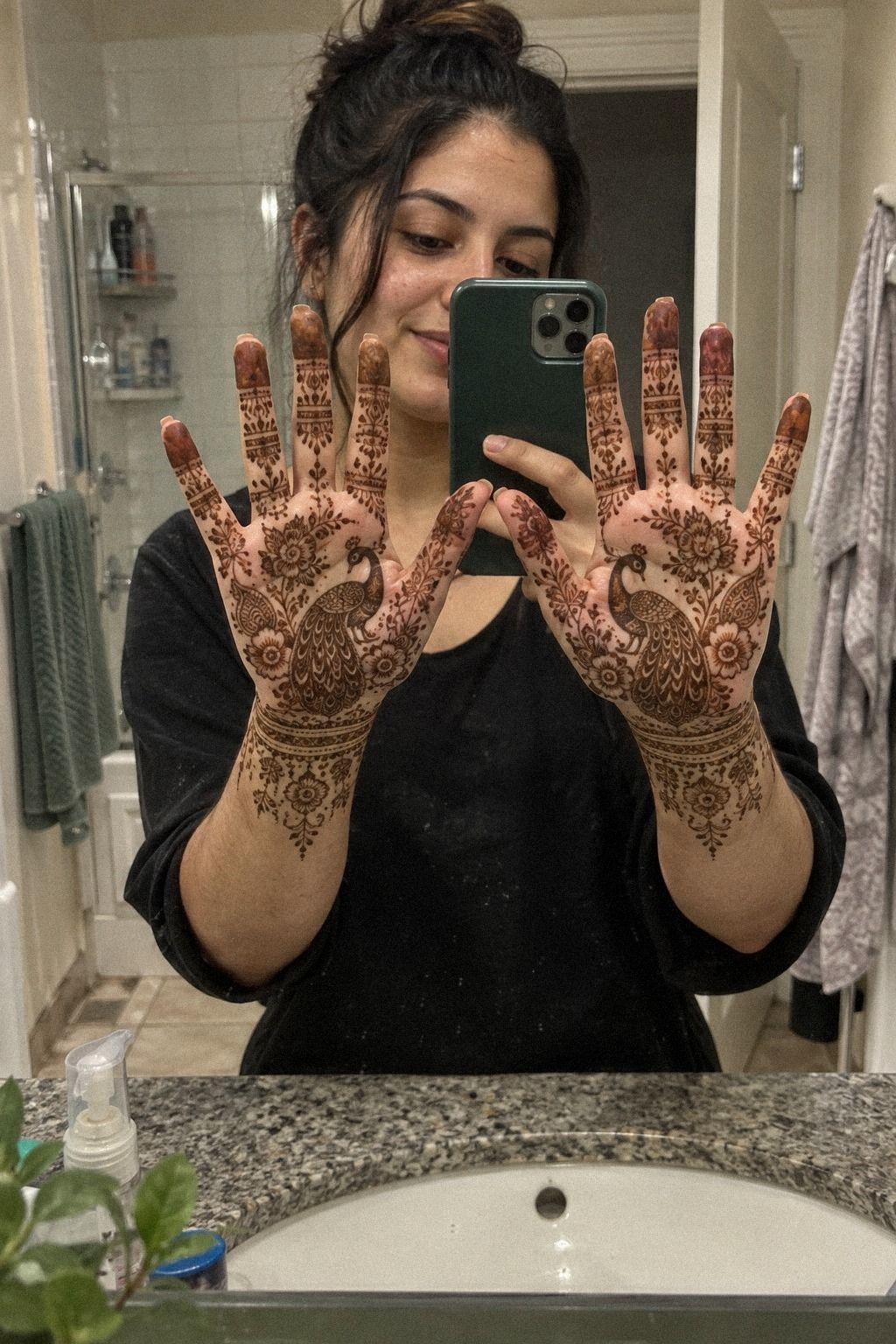
Dainty linework suits you if you like quiet detail, narrow curves, and designs that don’t cover every inch of skin. Start with a small peacock body, one feather arc, and a few dots. Your result can still look romantic without becoming elaborate.
Choose a micro-tip cone only if your paste is smooth enough to pass through it. A narrow opening won’t rescue a lumpy mixture. Strain the paste well, test two lines on paper, and adjust the cone before you touch your hand.
If you prefer a more feminine look, soften the tail with tiny scallops and leaf shapes. If your style is edgy, use sharper feather points and stronger brown contrast after the stain develops. The same peacock can feel vintage or daring depending on your line rhythm.
I’d avoid copying a dainty design onto a large area. Fine details can disappear when they’re spread too far apart. Keep the main motif compact, then let one or two lines extend outward.
These simple stylish mehndi designs for front hand show how compact compositions stay graceful.
9The Palm Peacock

The palm gives your peacock a naturally striking setting, but it also demands careful planning. Begin with the bird’s body near the center, then curve the tail toward the heel of your hand. Your palm design shouldn’t place the main face or feather eyes directly across deep creases.
Use smooth henna paste with enough body to hold a raised line. If the mixture spreads, your peacock can lose its profile before it dries. Keep a tissue nearby, and support your hand on a clean towel so you’re not balancing the cone in midair.
A palm design can include a lotus under the bird, small arches along the thumb, and a fan reaching toward the fingers. That gives you a powerful centerpiece with delicate framing. You’ll want the most detailed area near the middle, while the outer edges stay simpler.
But don’t force symmetry if your palm shape doesn’t support it. A slightly playful angled bird often looks more lively than a stiff centered one.
I went back and forth on this with my own designs, and the angled composition always felt more expressive. For additional references, compare these simple latest simple mehndi designs before choosing your palm direction.
10Ornate Details, Minimal Space

Ornate mehndi needs empty areas to stay readable. After you draw the peacock, step back and look at your hand as a whole. Your eye should travel from the head to the feather fan without getting trapped in a wall of dots.
Leave bare skin windows between the larger shapes. These spaces aren’t unfinished; they make the warm stain look crisp and let each motif keep its identity. A few open sections can make your composition feel sleek and polished.
Use repeated details only where they support the flow. Three matching curls can connect the wrist to the palm, while twelve curls may flatten the design. Your hand will move throughout Eid, so the pattern needs visual pauses that survive different angles.
I’d remove one detail before adding another. That’s the best way to keep a bold design timeless.
You don’t need to prove how much paste you can use. A refined peacock with clear spacing will stay graceful rather than overcrowded.
11Personal Feather Elements

Finish by choosing one feather detail that belongs specifically to you.
Placement: Back of Hand, Palm, or Wrist?
Your placement choice affects visibility, drying comfort, and the amount of paste you’ll need. The back of the hand is easy to show, the palm gives you a traditional focal point, and the wrist creates a graceful trail.
Think about your Eid plans before choosing. If you’ll be greeting guests or carrying plates, the palm may brush against more surfaces while the paste is fresh. A wrist or back-of-hand design may offer better practical value when you need freedom of movement.
You can also combine placements without making the result feel crowded. A small peacock on the back of the hand with one feather reaching toward the wrist creates a classic connection. Review simple peacock mehndi designs before deciding how far your motif should travel.
Eid Details That Carry Meaning
The best Eid designs usually include one detail that feels connected to the occasion. You might add a moon-shaped curve, a paisley detail, a family symbol, or a repeated pattern shared with a sister or friend.
Keep that personal reference small. A hidden initial inside the tail can feel more meaningful than a large letter that dominates the composition. Your peacock eye can also hold a tiny dot pattern linked to a celebration or family tradition.
If your style is more whimsical, use small scallops or a playful feather tilt. If you prefer something classic, repeat three clean arches and leave the rest open.
The choice should feel like you, not like a checklist copied from someone else. These simple stylish mehndi designs for front hand offer useful ideas for personal details.
Compare Cost, Value, and Timing
Before booking, decide what matters most: a larger area, finer details, a well-known artist, or a shorter application. A higher design budget can be worthwhile when you want intricate symmetry, but a simple motif may deliver better value for a small Eid gathering.
Ask what the quoted price includes. Some artists charge by size, while others use time or complexity. A natural cone and careful preparation matter more than a low headline price if the paste is inconsistent or the application feels rushed.
Review the artist’s portfolio for clean lines, balanced spacing, and natural stain results. If the work matches your preferred style, the cost may be worth it.
If every example is dense and ornate while you want something minimal, keep looking. Compare timing ideas with simple trendy mehndi designs.
Follow the Two-Flow Rule for Eid Mehndi
I keep returning to two kinds of flow: the visual flow of the peacock and the practical flow of the application. If your design looks beautiful in a reference image but forces you to bend your hand awkwardly, you’ll smudge it before the paste dries. Start with the hand position you’ll actually maintain, then build the composition around it.
The visual flow should move from a clear body toward a lighter feather fan. The practical flow should move from the least reachable area to the easiest one, so your palm or wrist doesn’t brush across fresh paste. I learned this after drawing the center first and then ruining the edge while reaching for my cone.
That first curve matters!
For most people, the back of the hand is easier to display than the palm, while the wrist gives you the longest graceful extension. Fingers need restraint. Feet and ankles can hold a larger flowing composition, but the skin may require extra patience while the paste dries.
The paste itself should remain smooth, fresh, and easy to control. A natural henna cone with a clean tip gives you more authority over every curve. I’d rather see a simple, meaningful design with confident lines than an intricate pattern that looks hurried.
That choice feels personal and right for an Eid celebration.
For a longer ankle composition, compare these simple foot mehndi designs before extending the peacock beyond your hand.
Track the Second-Day Color Shift
Your henna isn’t finished when the paste comes off. The stain usually continues to deepen after removal, often reaching a richer brown on the second day.
That shift is dramatic! Plan your application early enough that the design has time to settle before your Eid gathering.
Keep your dried henna paste on for the time recommended by your artist or trusted recipe, and avoid scraping aggressively. A gentle removal protects the developing stain. Your skin may show different color intensity on the palm, fingers, wrist, and feet, so don’t compare every area as if it should match perfectly.
Avoid swimming and prolonged sun exposure while the color is developing. Wash gently, moisturize when the paste has been removed, and let your skin settle. You’ll get a more even result when you don’t keep rubbing or soaking the design.
But don’t chase the darkest possible stain with unknown additives. Your skin matters more than a dramatic photograph.
Choose a reputable mehndi artist or a carefully prepared natural cone, and ask what’s in the paste before it touches your hand. That simple question is both sensible and empowering.
These simple latest simple mehndi designs can help you judge how fine details may fade.
The Questions I Get Asked Most
How much does a latest peacock mehndi design application usually cost?
A typical US application may cost about $50 to $100 at a small boutique minimum, or about $100 to $300 for a larger, more detailed design. Hourly bookings may run around $100 to $250. The final price varies by artist, region, size, and occasion.
Are latest peacock mehndi designs a good choice for Eid?
Yes, they’re a meaningful choice because the peacock offers flowing feathers, symbolic eyes, and flexible placement. A temporary design lets you choose a bold palm, delicate fingers, or a wrist composition without a permanent commitment. You can also match your detail level to your celebration outfit and budget.
How do I choose a mehndi artist for latest peacock mehndi designs?
Review photos of clean, even paste lines and ask whether the artist uses natural henna. A trustworthy artist should explain the ingredients, drying time, and aftercare clearly.
Look for experience with peacock motifs, palms, fingers, and the type of composition you want. More latest stylish mehndi designs for front hand can help you identify a compatible style.
Does applying latest peacock mehndi designs feel uncomfortable?
Natural henna paste usually feels cool and slightly raised while it dries. The main challenge is staying still for about 1 to 2 hours so your design doesn’t smudge. If the paste burns, blisters, or causes strong irritation, remove it and seek medical advice.
How long does a latest peacock mehndi design stain take to fade?
The visible stain usually lasts about 1 to 3 weeks, while the skin underneath continues renewing over about 2 to 3 months. Gentle aftercare helps the design fade evenly. Wash softly, moisturize, and limit prolonged sun and swimming while the color develops.
What’s the best placement for latest peacock mehndi designs?
The back of your hand offers clear visibility, the palm creates a traditional centerpiece, and the wrist supports a long flowing composition. Your best placement depends on the look you want, how long you can keep the paste still, and whether you prefer a bold or understated result.
Where I’d Start With One Step
If I had to pick one step, I’d start with the peacock’s body on the back of your hand. It gives every feather a direction, and you can still keep the fingers delicate.
Save your favorite reference, test your cone, and let the design grow from that first confident curve. Before you begin, revisit simple peacock mehndi designs and choose the shape that feels most like you.