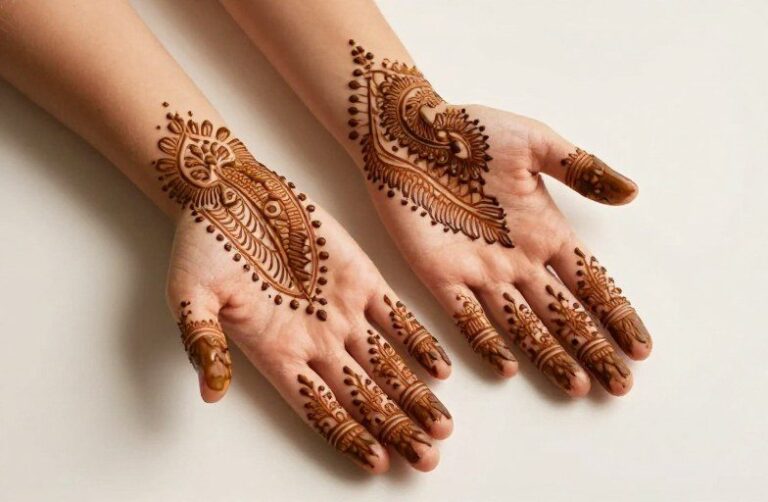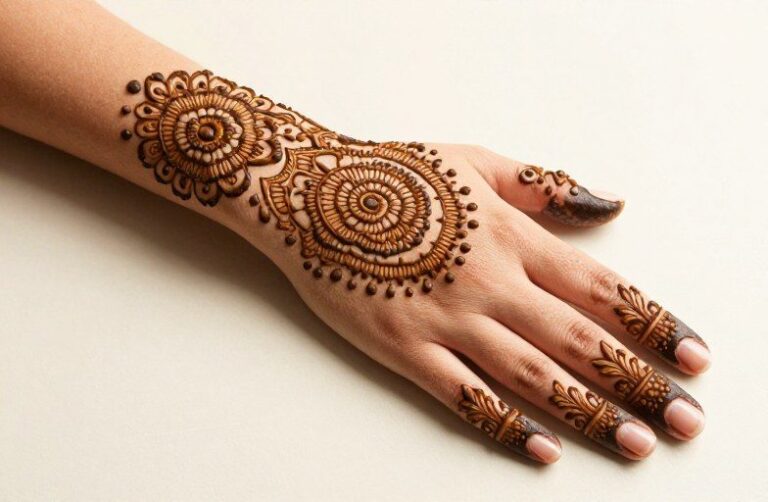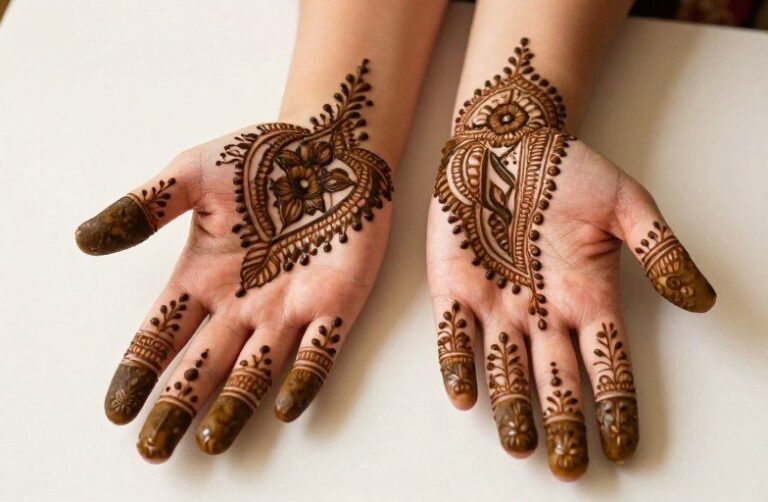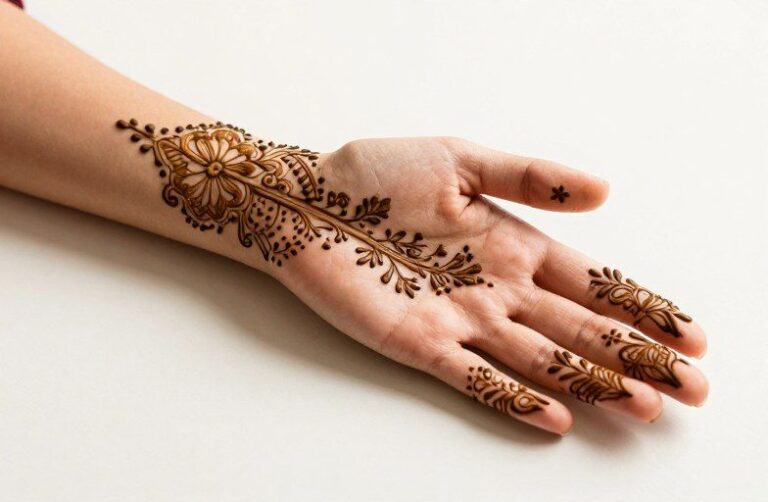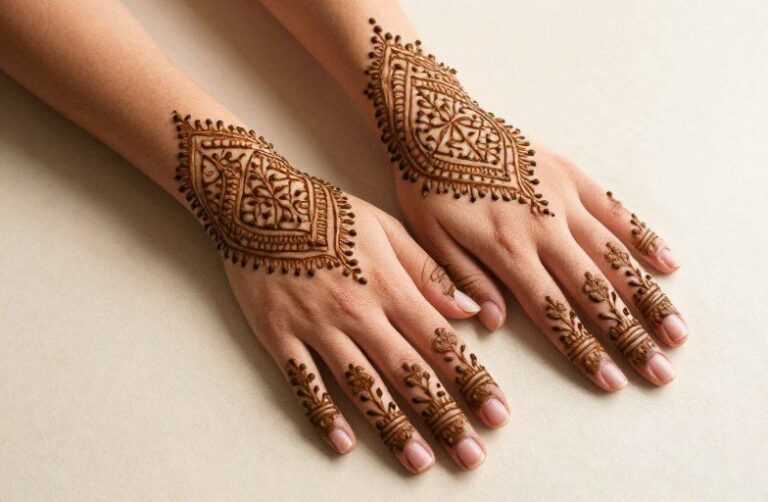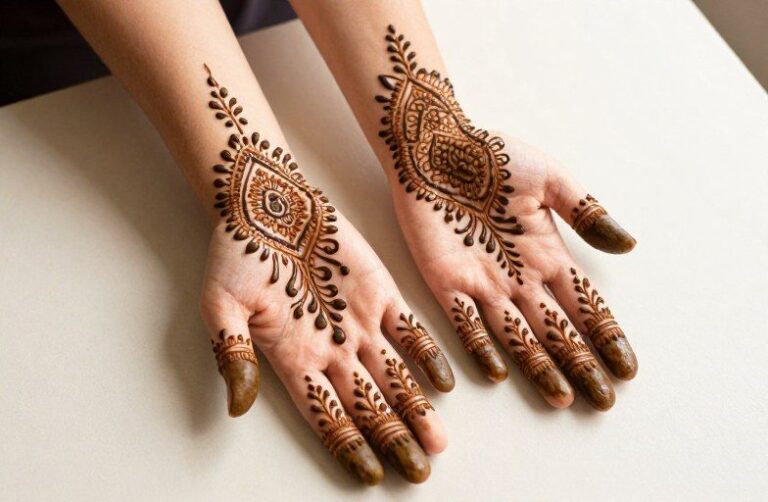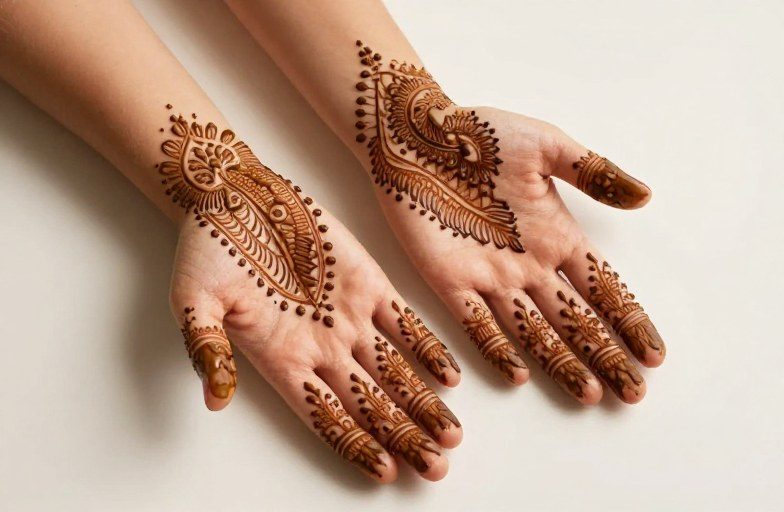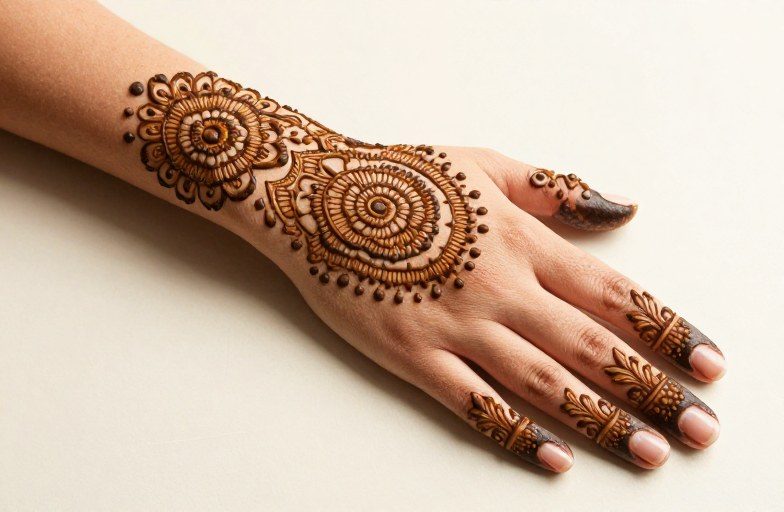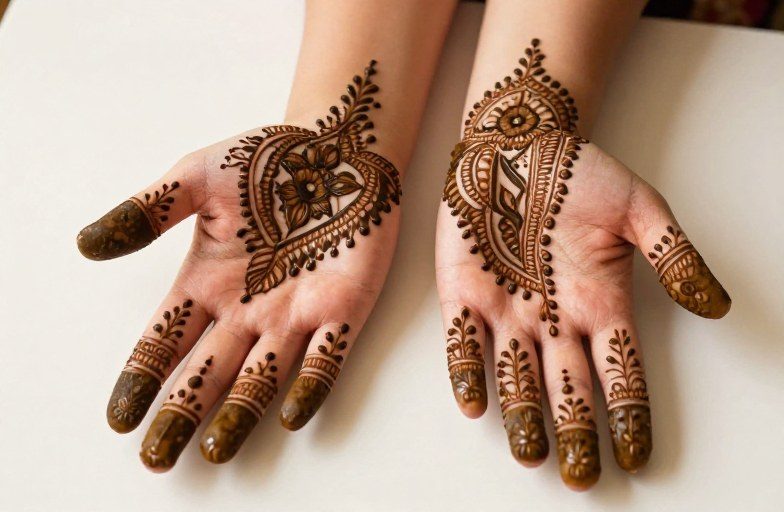
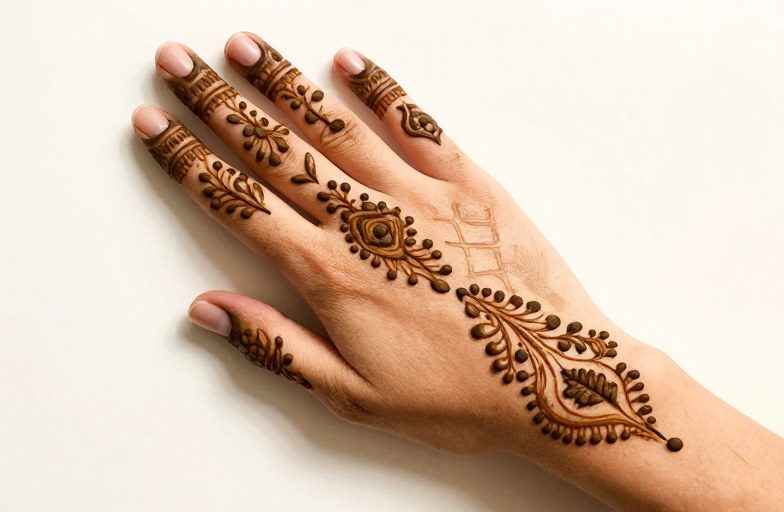
Simple finger mehndi designs strip the traditional full-hand henna down to its most elegant elements: thin lines, delicate dots, and small geometric shapes that follow the natural contours of each finger. These patterns translate beautifully to permanent tattoo work, offering a low-commitment placement with high visual impact. The narrow canvas forces restraint, which often produces the most striking results.
Matching & Pairing Ideas
Single-finger mehndi rarely exists in isolation. The most successful designs consider how each finger relates to the next, creating rhythm across the hand.
Symmetrical Pairs
Matching patterns on both index fingers, or both ring fingers, create intentional balance. This works particularly well with wedding-adjacent symbolism, where paired ring fingers carry natural significance. The designs need not be identical, mirror images or complementary patterns (one finger with lines leading toward the palm, the other leading toward the nail) often look more sophisticated than perfect duplicates.
Progressive Sequences
Running a single motif across multiple fingers transforms individual decorations into a cohesive system. A vine that starts at the base of the pinky and curves across to the index finger, or dot patterns that increase in density from thumb to pinky, reward close inspection. This approach demands precise spacing; fingers move independently, so the design must read clearly whether the hand is relaxed or gripping something.
- Pair ring fingers with matching band-style patterns for subtle commitment symbolism
- Frame a central finger (usually middle or ring) with simpler patterns on adjacent fingers
- Alternate solid bands with negative-space bands across four fingers, leaving the thumb bare
Trending Variations
Contemporary mehndi tattooing borrows from several living traditions while adapting to the permanence of needle work. Current preferences lean toward reduction rather than ornament.
Single-Line Contours
One continuous line tracing the finger’s length, sometimes branching into small V-shapes at the knuckle or ending in a tiny spiral at the fingertip. This variation ages exceptionally well because it avoids the clustered ink that can blur together over years. The line weight matters: too thin and it disappears; too thick and it loses elegance. Most artists settle between 0.5mm and 1mm for the primary stroke.
Negative Space Bands
Rather than filling a band with pattern, the design becomes the space between two solid lines. The skin shows through as the “pattern,” creating a lighter visual weight that suits professional environments. These require touch-ups more frequently than solid work because the edges soften unevenly, but the fresh appearance is unmistakably modern.
Popular Styles
Understanding the stylistic origins helps in selecting appropriate detail levels for the finger’s limited space.
Rajasthani Minimalism
Characterized by fine parallel lines, tiny leaf shapes, and dot clusters. The traditional full-hand version covers palms and wrists, but reduced to finger scale, it becomes a series of delicate bands and fingertip caps. The leaf motif, called a “bel,” curves naturally around the cylindrical finger shape. This style tolerates some line spread over time because the patterns are inherently repetitive.
Indo-Arabic Fusion
Combines the floral fluidity of Arabic mehndi with the geometric precision of Indian work, as seen in Indo-Arabic mehndi tattoo designs. On fingers, this typically manifests as a single flowing vine with occasional geometric checkpoints, small diamonds or hexagons where the vine changes direction. The contrast between organic and structured elements prevents monotony in a narrow format.
Contemporary Abstract
Breaking from traditional motifs entirely, some artists treat the finger as a pure design challenge: parallel lines that follow the finger’s taper, dot grids that shift density, or simple chevrons at knuckle points. These read as mehndi-inspired rather than traditional, which appeals to wearers without South Asian heritage who appreciate the aesthetic language.
Best Placements
Finger skin differs significantly from other tattoo locations, and mehndi patterns must account for these constraints.
Side Placement vs. Top Placement
The outer side of the finger (pinky side, visible when hands rest at sides) offers more stable skin than the top surface, which stretches and compresses dramatically with grip. Side-placed bands stay sharper longer. Top-placed designs, however, face the viewer directly and photograph more clearly. For mehndi specifically, the traditional placement is the top/inner hand surface, so deviation reads as a deliberate modern choice.
Knuckle Proximity
Patterns crossing knuckle creases blur predictably. The most durable finger mehndi either sits entirely between knuckles (the phalangeal segments) or floats above the main knuckle without crossing the fold. Some artists embrace the crease by placing a single dot or tiny mark directly on the knuckle itself, letting the movement animate the design rather than fighting the anatomy.
- Proximal phalanx (base segment): widest canvas, best for bands and starting points of vines
- Middle phalanx: narrowest segment, suited to single lines or small isolated motifs
- Fingertip area: delicate cap patterns, prone to faster fading due to use and regeneration
How to Personalize It
Generic mehndi patterns abound; distinction comes from adaptation to individual hands and preferences.
Scaling to Finger Proportion
Long, slender fingers carry vertical patterns elegantly, lines that draw the eye lengthwise. Shorter, wider fingers benefit from horizontal emphasis: bands that create visual width, or patterns that wrap around to utilize the side surfaces. The same motif scaled identically to two different hands will read differently; personalization requires proportional adjustment, not just size change.
Incorporating Existing Tattoos
Finger mehndi often accompanies wrist or hand work. A simple wrist mehndi tattoo as a cuff ending in a small motif that a finger vine picks up, or deliberate separation where two independent designs respect each other’s space. For guidance on the palm side of this equation, see simple palm mehndi tattoo ideas. Crowding the hand with competing patterns diminishes all of them; the mehndi either extends an existing system or defines its own territory clearly.
Color Choices
Traditional mehndi is henna-derived: reddish-brown, temporary, and organic. Permanent tattoo adaptations must choose differently.
Black Ink Adaptation
Black linework most directly translates the visual contrast of fresh henna. Over decades, black finger ink typically fades to a soft blue-gray as the dermis scatters the pigment particles. This aged appearance actually approximates the natural oxidation of henna stains, creating an unintentional but pleasant authenticity. Solid black bands will blur at edges; stippled or hatched fills maintain definition longer.
Brown and Red Pigments
Some artists mix custom browns or use red-leaning blacks to closer approximate henna’s natural color. This requires experienced pigment selection, cheap reds can shift to pink or orange unpredictably. Brown-based inks generally age more stably than bright reds, though they lack the depth of true black. The trade-off is immediate color accuracy versus long-term consistency.
White and Negative Space
White ink on finger skin presents particular challenges: it yellows, fades rapidly, and often disappears entirely into the skin’s natural tone. For mehndi-inspired work, white functions best as a highlight within black patterns or as the deliberate absence of ink (true negative space). Attempting white as the primary design color on fingers rarely satisfies long-term expectations.
Final Thoughts
Simple finger mehndi designs succeed through restraint and placement intelligence. The narrow format demands that every mark justify its presence; traditional patterns evolved under similar constraints, which is why they reduce so effectively. Whether approached as permanent tattoo or as reference for henna application, the principles remain: respect the finger’s movement, anticipate the ink’s aging, and let the design’s simplicity carry the weight that complexity cannot.
Frequently Asked Questions
How long do finger mehndi tattoos typically last before needing touch-ups?
Finger tattoos generally require first touch-ups within 1-3 years due to constant use, sun exposure, and faster skin regeneration. Mehndi-style linework may need attention sooner if the original lines were very fine, while slightly bolder work holds longer. Budget for periodic maintenance rather than expecting permanence without it.
Can mehndi patterns be placed on the sides of fingers rather than the top?
Yes, side placement is often more durable because the skin stretches less with grip movement. However, it reads as a modern adaptation rather than traditional placement, and visibility depends on how you naturally hold your hands. Discuss with your artist whether your daily hand positioning makes side placement worthwhile.
Do finger mehndi tattoos hurt more than other locations?
Finger skin is thin with minimal fat padding, and the bone proximity increases sensation. The small size of simple mehndi designs means the session is brief, often 15-30 minutes, which most people find manageable. The discomfort is concentrated but short-lived compared to larger pieces.
Will a finger mehndi tattoo affect professional opportunities?
Visibility varies by exact placement and hand position. Side-of-finger or inner-finger designs often go unnoticed in casual interaction; top-of-finger bands are immediately apparent. Some fields remain conservative about visible hand tattoos, so consider your specific industry and whether the design’s cultural associations might prompt questions in your workplace.