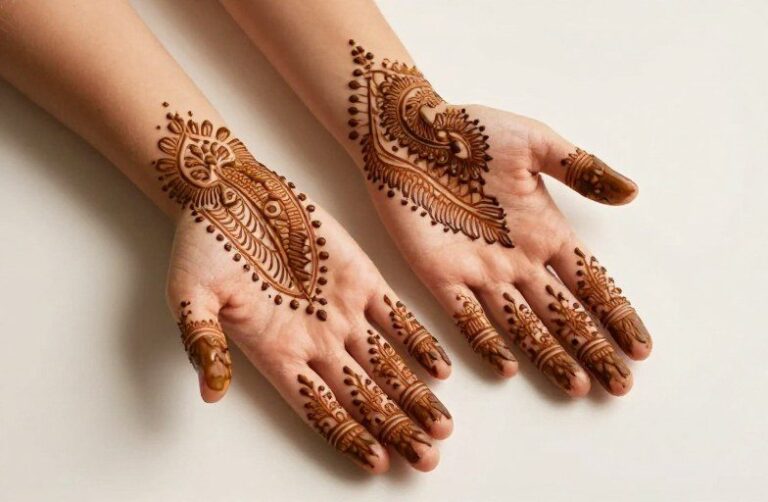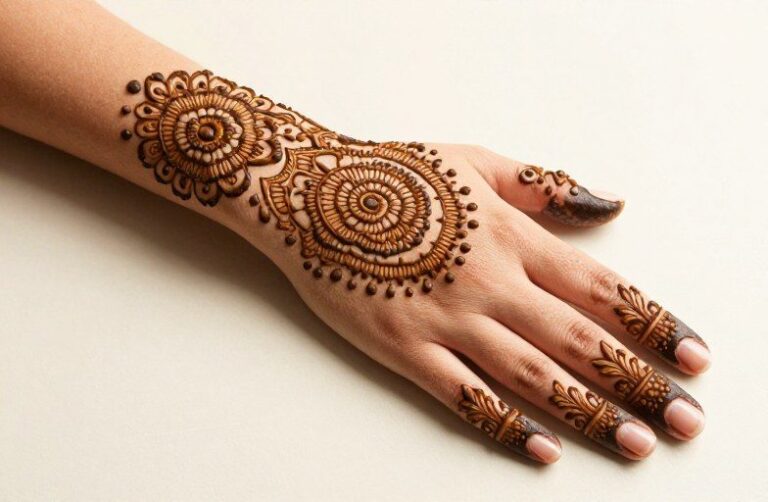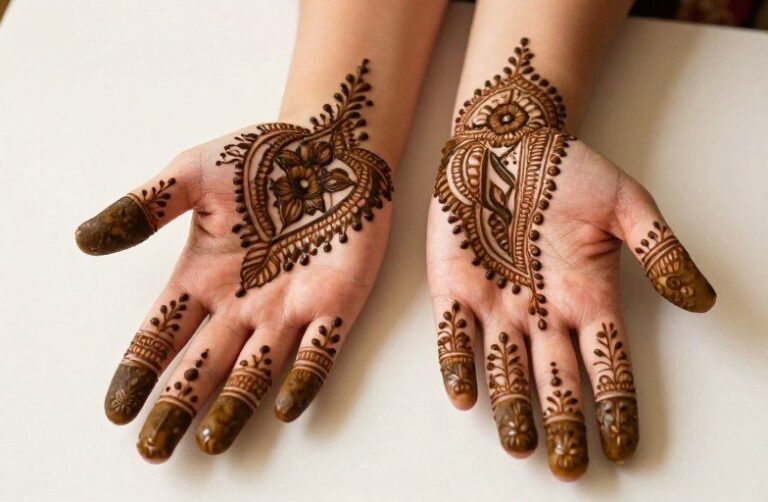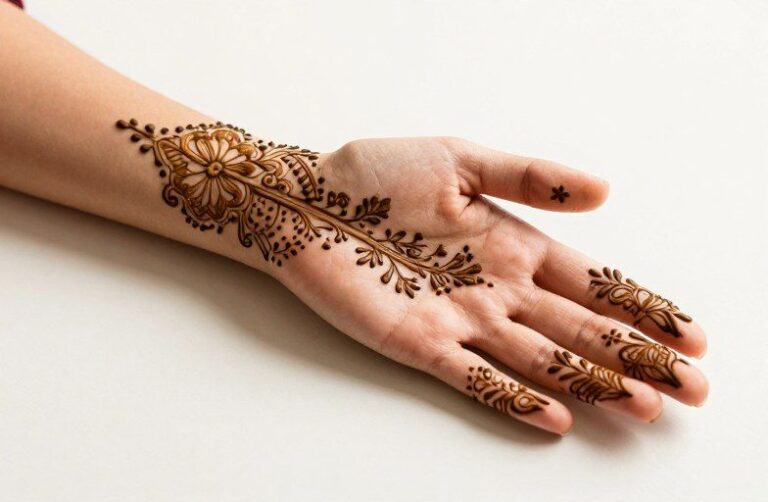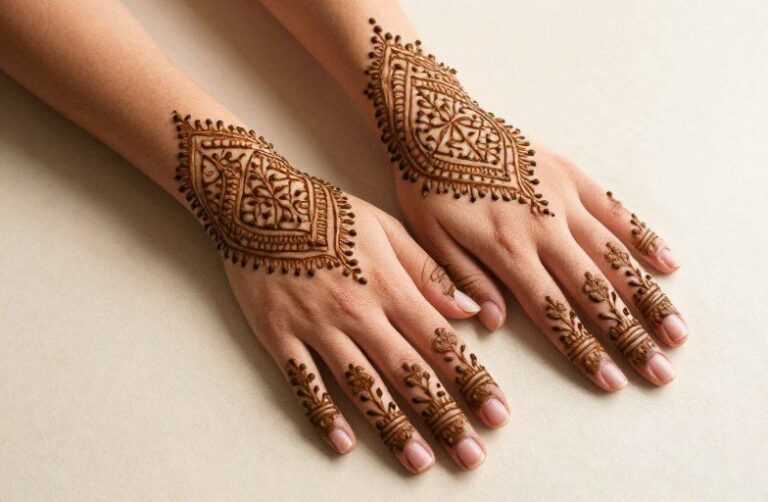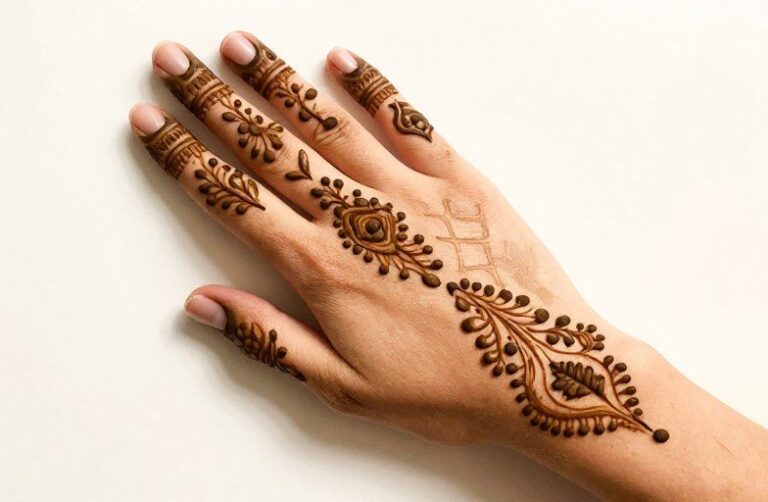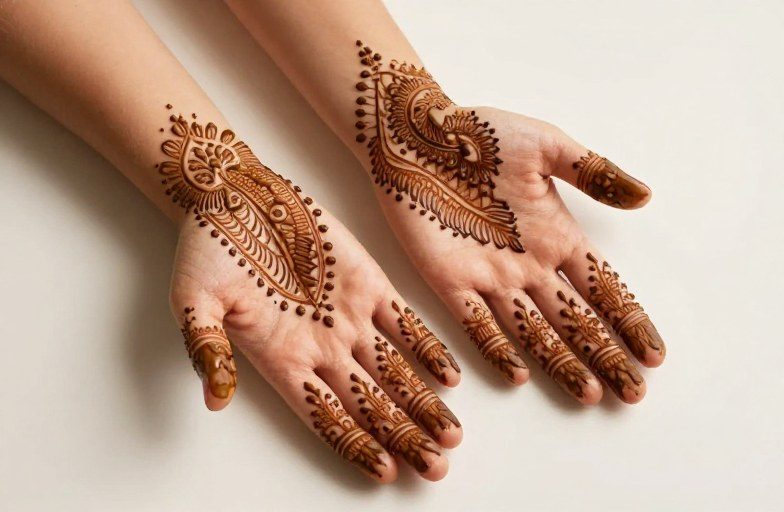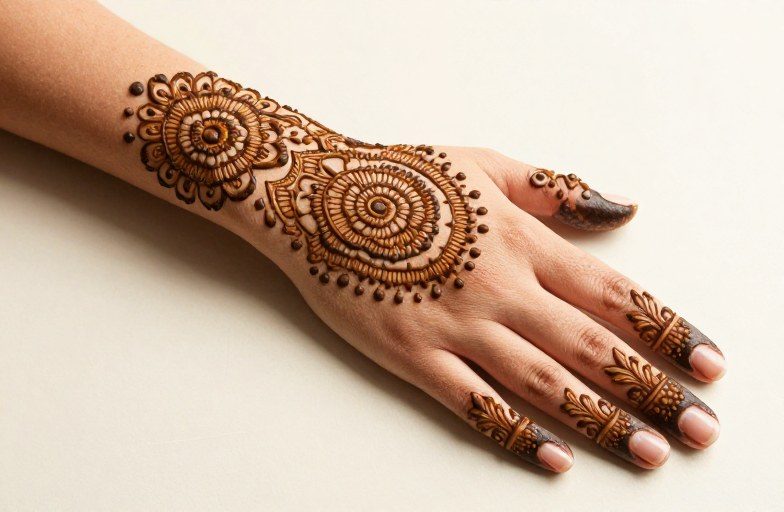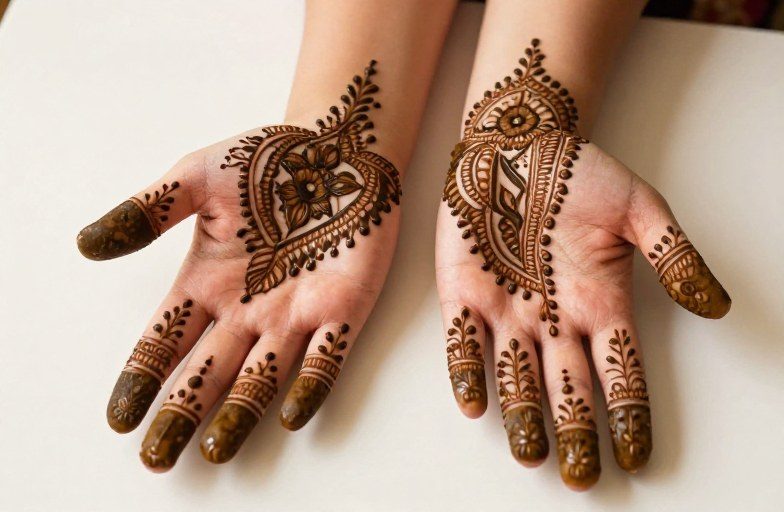
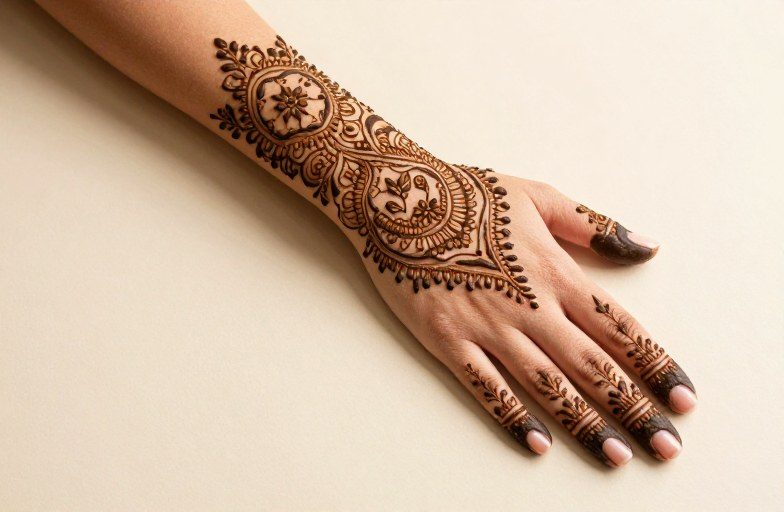
Simple arm mehndi designs strip away the dense fill of traditional bridal work and leave behind clean lines, negative space, and patterns that read clearly from a few feet away. These work for people who want the cultural resonance without the commitment of full-hand coverage, or who need something that fits under sleeves for professional settings. The arm offers length and visibility, which means even restrained designs carry presence.
Size & Scale
Arm length gives you room to stretch a motif or keep it compact. The key is matching scale to placement so the design doesn’t look stranded or overcrowded.
Wrist to Forearm
A single band, vine, or small mandala sitting at the wrist reads as jewelry. Keep it under two inches in height so it doesn’t wrap awkwardly or distort when you flex. Lines at this scale need to be bold enough, think 3mm minimum for the main stroke, because fine detail blurs within a couple of years.
Full Forearm or Upper Arm
Running a pattern from wrist to elbow (or elbow to shoulder) lets you repeat a motif with breathing room between repeats. Space matters more than density here. A common mistake is packing too many elements; the eye needs rest, and skin needs uncrowded areas to show off the ink against.
- Wrist cuffs: 1, 3 inches tall, wrap-around or partial
- Forearm bands: 4, 8 inches long, linear or scattered
- Upper arm placements: wider motifs, often circular or radial
Tips for Choosing
Your daily life should shape the design more than Pinterest trends. A teacher or healthcare worker needs different constraints than someone in creative fields.
Visibility and Dress Codes
Forearm mehndi sits where most short sleeves end. If you need coverage, upper arm placement or a design that stops two inches above the wrist bone keeps it hidden. Ask yourself: does this need to disappear for work, or can it always show?
Skin Tone and Ink Behavior
Mehndi-style linework relies on contrast. On deeper skin tones, thicker lines and solid black hold better than graywash shading. On lighter skin, fine lines stay readable longer but still soften over time. Henna stains the surface and fades; tattoo ink sits below and shifts. Plan for that shift, what looks delicate fresh may look muddy at five years if the lines were too thin or too close together.
Trending Variations
Contemporary mehndi tattoos borrow from multiple traditions and blend them with modern minimalism. These aren’t replicas of ceremonial henna; they’re adaptations that respect the visual language.
Geometric Abstraction
Traditional paisleys and florals get broken into triangles, hexagons, and straight-line grids. The result reads as mehndi-influenced without literal copying. These age well because geometric shapes distort less than organic curves as skin moves and stretches.
Single-Motif Focus
One large element, a mandala, a lotus, a peacock feather, placed off-center on the inner or outer forearm. Negative space becomes the design’s frame. This approach works especially well for first tattoos or for people building a larger collection piece by piece.
Standout Design Ideas
Specific combinations that solve common placement problems:
- Wrist vine with terminal bud: A thin stem that starts at the wrist bone and curves toward the inner forearm, ending in a single unopened flower. Follows the arm’s natural line, moves with gesture.
- Broken bracelet: Three separate bands at different heights, not connected. Reads as stacked jewelry, easy to add to later.
- Radial mandala at the inner elbow: The elbow’s hollow centers a circular design naturally. Keep the mandala open at the edges so it doesn’t look like a sticker.
- Scattered finger-to-wrist dots: Traditional mehndi often extends to fingertips. A tattoo version can place single dots at finger bases, connected by a faint line to a wrist element. Subtle, intentional.
- Half-sleeve with blank center: Dense pattern at wrist and upper arm, clean skin in the middle forearm. Creates two focal points and leaves room for future work.
How to Personalize It
Generic mehndi stencils exist, but the best simple arm pieces carry personal markers without shouting them.
Integrating Numbers or Letters
Arabic or Devanagari script, stylized into pattern elements, can hold dates or names. The script becomes texture; only you know it reads. Keep the characters large enough to hold their shape, tiny text tattoos into gray blobs within a decade.
Regional Pattern Variations
Rajasthani mehndi tends toward bold, blocky florals. Pakistani traditions often include more architectural elements, arches, doorways. Moroccan henna favors geometric lattice. Picking a regional root gives your artist a coherent starting point and connects the design to specific cultural grammar rather than vague “exotic” aesthetic.
Popular Styles
How different tattoo techniques translate mehndi patterns:
Linework Only
Pure black lines, no shading. Closest to fresh henna’s appearance. Requires the most precision from the artist; wobbly lines have nowhere to hide. Heals fastest, ages cleanest if the lines were laid in solid.
Dotwork and Stipple
Density of dots creates gradient instead of smooth shading. Gives a softer, more textile-like quality. Slower to apply, and the dots can spread slightly over time, so spacing needs to be generous from the start.
Black and Gray with Selective Fill
Some areas solid black, others left open, with graywash for soft transition. Mimics the way henna paste dries and flakes, leaving variable depth of stain. Riskier long-term, graywash can muddy, but striking when fresh and for the first several years.
What to Remember
Simple arm mehndi designs succeed when they account for how arms actually live: bending at the elbow, rotating, sometimes bearing weight, sometimes hidden under fabric. The best pieces feel like they belong to the body’s architecture rather than sitting on top of it.
Healing an arm tattoo means dealing with friction, sleeves, desk edges, bag straps. Plan your timing so you can keep it clean and unrubbed for two weeks. The inner arm heals slower than the outer; skin there is thinner and more prone to moisture.
Finally, restraint is harder than density. Every element in a simple design is visible, accountable. Choose an artist whose linework you can inspect up close in healed photos, not just fresh work. The gap between those two states tells you what your tattoo will actually become.
Frequently Asked Questions
How long does a simple arm mehndi tattoo take to apply?
A wrist cuff or small forearm piece usually runs 1, 2 hours. Larger linear designs reaching toward the elbow might take 3, 4 hours depending on detail density. Dotwork and stipple styles take longer than pure linework.
Will the design stretch if I gain muscle or lose weight?
The forearm changes less than the upper arm with muscle gain, but any skin stretching distorts tattoos slightly. Avoid wrapping designs directly around the elbow crease if you expect significant size change, as that area flexes constantly.
Can I cover an old tattoo with a mehndi-style design?
Mehndi patterns rely on negative space, which makes them poor cover-ups. Dense black fill can hide old work, but that defeats the “simple” quality. Laser fading the old tattoo first opens more options for clean mehndi linework.
Do these designs work on darker skin tones?
Absolutely, but technique matters. Bold black lines and solid fill hold contrast better than fine gray lines. Discuss with your artist whether to adjust line weight or spacing for your specific skin tone and how it takes ink.