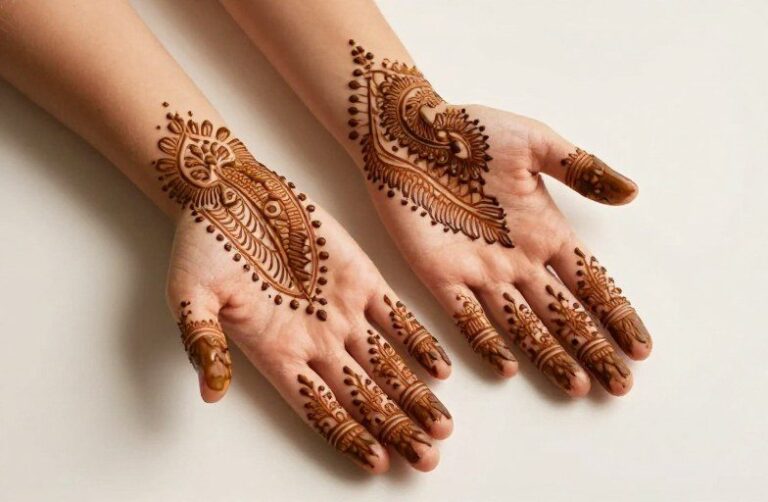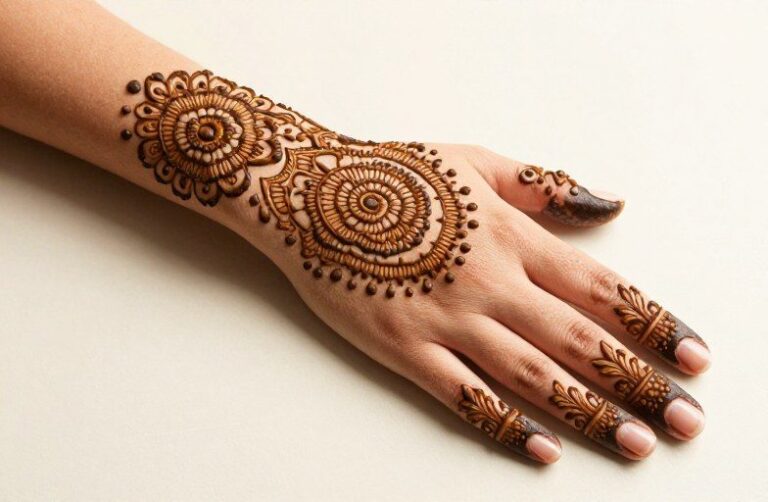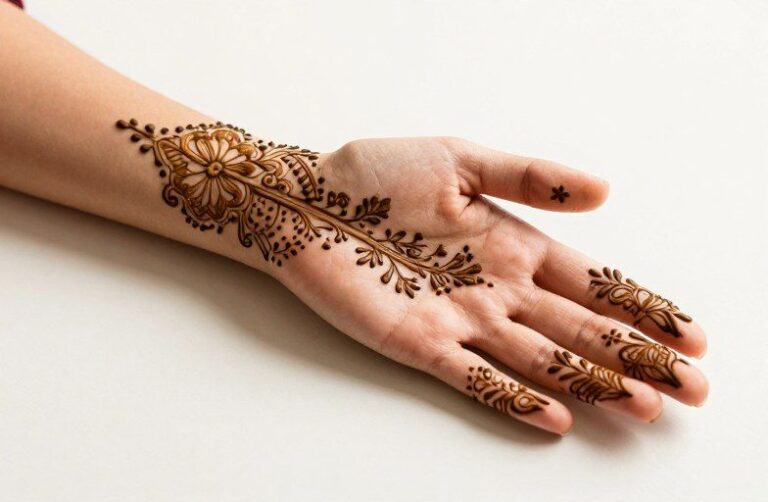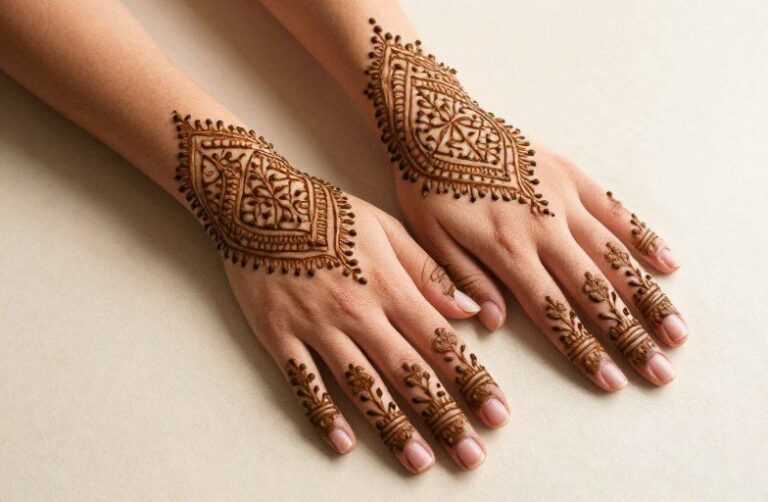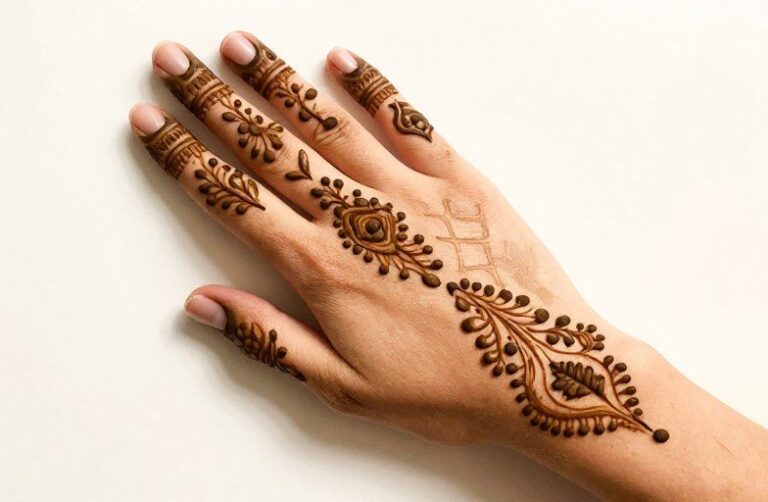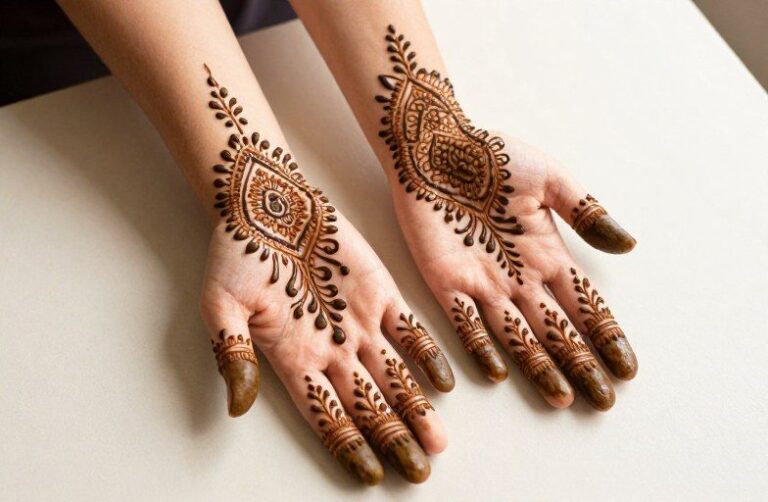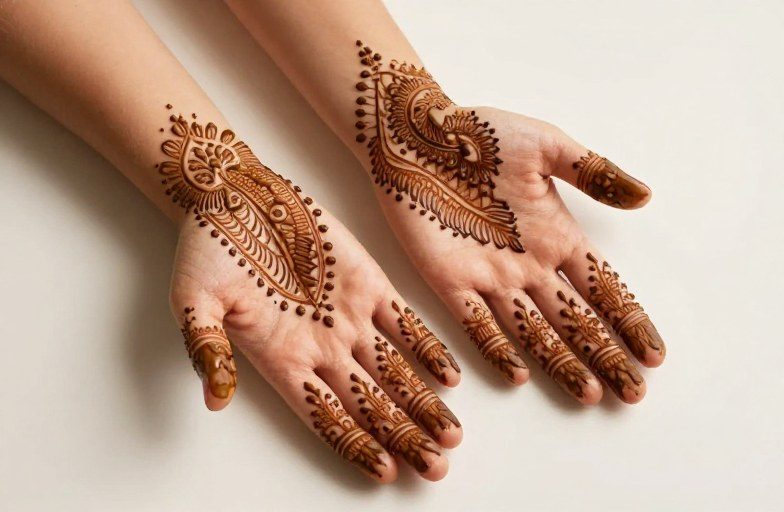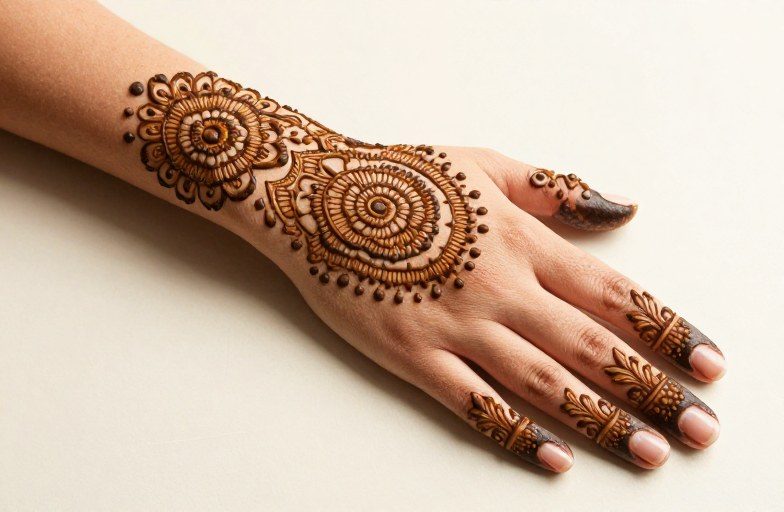
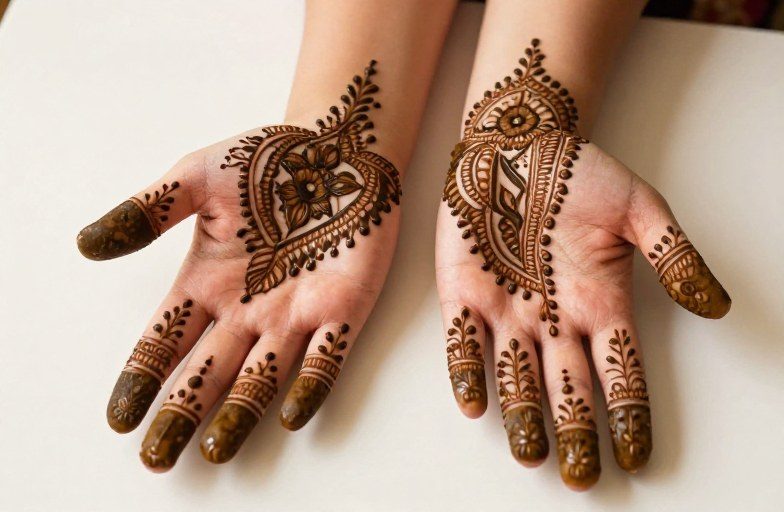
Indo-Arabic mehndi design sits at the crossroads of two distinct traditions. Arabic mehndi favors bold, sweeping floral trails with generous negative space. Indian mehndi packs in paisleys, peacocks, and geometric fillwork with barely a gap. The hybrid style marries both: open, breathing compositions that still carry intricate focal points. As a tattoo translation, this fusion works exceptionally well, skin offers permanence that henna never could, and the design language adapts beautifully to how ink ages and how bodies move.
Standout Design Ideas
The best Indo-Arabic pieces don’t just mash two styles together. They let each tradition do what it does best, then find the seam where they meet.
Floral Trails with Paisley Clusters
Arabic-style vines running along the forearm or down the spine can terminate in dense Indian paisley clusters at the wrist, elbow, or shoulder blade. The vine stays relatively bold, single-needle lines around 3-5mm thick, so it holds up as the detail work around it softens. Paisley clusters work best when they’re concentrated in one zone rather than scattered; think of them as punctuation, not wallpaper.
Mandala Meets Negative Space
A central mandala mehndi tattoo (Indian influence) surrounded by radiating Arabic floral arcs creates a piece that reads clearly from a distance and rewards close inspection. The mandala itself needs tight linework, 0.35mm needles, packed black, to maintain its geometry. The surrounding arcs can be softer, more gestural, allowing for some natural spread over years. This pairing suits upper back, sternum, or thigh placements where the circular form has room to breathe.
- Single-needle vines along the collarbone, terminating in paisley at the shoulder
- Full sleeve with Arabic “lace” on the outer arm, Indian fill on the inner
- Foot and ankle pieces: Arabic trailing up the leg, Indian density at the toes
- Spine pieces: central mandala with bilateral Arabic symmetry
Size & Scale
Indo-Arabic design demands space. The contrast between open and dense only reads when there’s enough real estate for both to register. Small pieces, under 4 inches, tend to look busy or unfinished because the eye can’t separate the two languages.
Minimum Effective Sizes
Forearm bands need at least 3 inches of width to layer both styles. A palm mehndi tattoo should use the back of hand rather than the palm itself, as tattoo ink doesn’t hold well in palm skin, and requires the full canvas to avoid looking like a smear. Thigh pieces can go smaller relative to the body because the muscle provides a flatter, more stable surface.
Scaling the Detail
Indian fillwork has a floor: below a certain size, dots merge, lines blur together, and the piece becomes a gray blob. As a rule, the smallest enclosed shape in Indian-style fill should be no less than 3mm across. Arabic linework can go finer, down to 1mm, because it’s isolated, not surrounded by competing detail. Your artist needs to plan which elements scale down and which must stay bold.
Tips for Choosing
Reference images help, but know what you’re actually looking at. Many Pinterest boards mislabel pure Indian or pure Arabic work as “Indo-Arabic.” True hybrids show both languages in dialogue, not one pasted over the other.
Consider your skin tone and how it interacts with black ink. The negative space in Arabic design is literally your skin showing through. On deeper skin tones, this contrast is subtler but still present, plan for slightly bolder lines to maintain readability. On very fair skin, fine Indian detail will pop initially but may soften faster as sun exposure accumulates.
- Bring references that show aging, not just fresh work
- Ask to see healed photos from your artist, especially in fine-line work
- Decide which style dominates: 70/30 splits read cleaner than 50/50
- Consider placement mobility, areas that stretch and compress will distort geometric elements faster
Trending Variations
The hybrid has evolved in tattoo form beyond what henna artists typically attempt. Some of the freshest work borrows structure from one tradition and content from the other.
Architectural Indo-Arabic
Arabic geometric frameworks, arches, lattice windows, Islamic star patterns, filled with Indian botanical detail. This variation reads as more structured, less floral, and suits clients who want the ornamental quality without overt femininity. Ribs, side torso, and upper back carry these well.
Minimalist Hybrid
Stripped to essentials: a single Arabic vine with one Indian motif repeated at intervals. Think of it as pattern-making rather than narrative density. For a similar pared-down approach, minimalist mehndi tattoo ideas take this restraint further. This approach works at smaller sizes and ages more gracefully because there’s less competing detail to blur together. Wrist, behind the ear, and ankle placements suit this restraint.
For First-Timers
Indo-Arabic work isn’t ideal for a first tattoo if you’re drawn to the most complex, dense versions. The session length, the pain in certain placements, and the healing demands of fine detail all add up.
Start with the Arabic Side
A flowing vine or trail is more forgiving than packed fillwork. You’ll learn how your skin takes ink, how you sit with discomfort, and what healed linework looks like on your body. Add Indian density later, either as a second session expanding the piece or as a separate nearby tattoo.
Placement Priorities
Outer forearm, upper arm, and calf offer the most predictable healing and least distortion over time. Avoid ribs, feet, and hands for your first piece, these locations hurt more, heal harder, and blur faster. The aesthetic temptation of a hand tattoo is real, but the practical reality involves frequent touch-ups and faster degradation of fine detail.
How to Personalize It
Personalization in ornamental tattooing is tricky. The designs are inherently abstract; they don’t “depict” your story the way a portrait or symbolic object might. But personal meaning can be embedded in structure.
Numerical and Text Integration
Arabic calligraphy, names, dates, short phrases, can flow along the vine structure. Indian numerical systems (Devanagari digits, for example) can be woven into geometric fill. This requires an artist literate in the script; botched Arabic or Hindi is unfortunately common in Western tattooing. Verify your artist’s lettering with a native reader before committing.
Color Accents
Traditional mehndi is henna-red and black. Tattoo translations often stick to black for longevity, but strategic color, deep maroon, ochre, or indigo, can mark personal significance without altering the design language. Limit color to small zones; large color fields in this style tend to look like a different tattoo altogether. A single paisley in your birth month’s color, or a vine gradient from black to warm brown, integrates personal reference subtly.
Final Word
Indo-Arabic mehndi design as tattoo work succeeds when the two traditions remain in tension, each visible, neither swallowed. The best pieces let your eye travel from open, breathing space to dense, rewarding detail and back again. Give it room on your body, choose an artist who understands both line precision and how ink settles over years, and resist the urge to fill every gap. The negative space is doing work too.
Frequently Asked Questions
How long does an Indo-Arabic mehndi tattoo session usually take?
A medium-sized forearm piece runs 3-4 hours. Full sleeves or large back pieces need multiple sessions of 4-6 hours each. The Indian detail work is slow; rushing it causes blowout and muddy healing.
Will the fine Indian-style dots and lines blur together over time?
Yes, eventually. Detail below 2mm starts to merge after 5-10 years depending on placement and sun exposure. A good artist spaces elements with aging in mind, leaving slightly more gap than looks necessary when fresh.
Can I get this style if I don’t have South Asian or Middle Eastern heritage?
The ornamental form itself is widely practiced and shared, but specific religious or cultural motifs, certain calligraphy, sacred geometry with specific meaning, should be researched and discussed with your artist. Avoid treating the style as pure aesthetic without context.
How do I find an artist who actually specializes in this hybrid style?
Look for portfolios showing both traditions competently, not just one with a few elements from the other. Ask about their needle groupings for fine detail and their approach to negative space. Healed photos matter more than fresh Instagram posts.