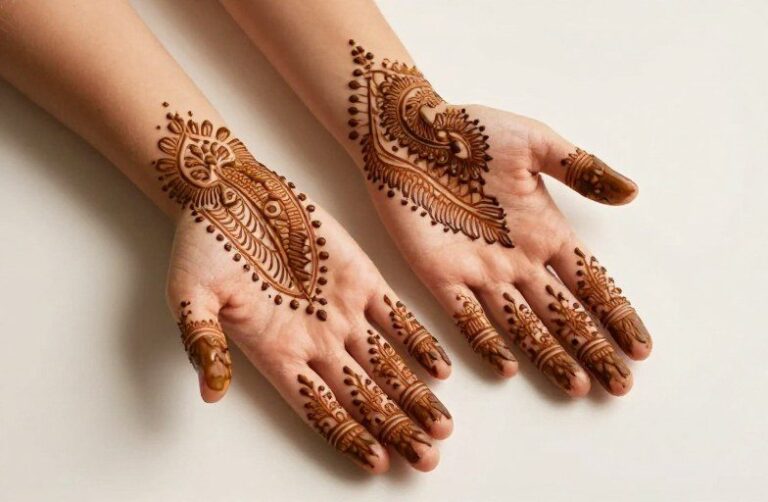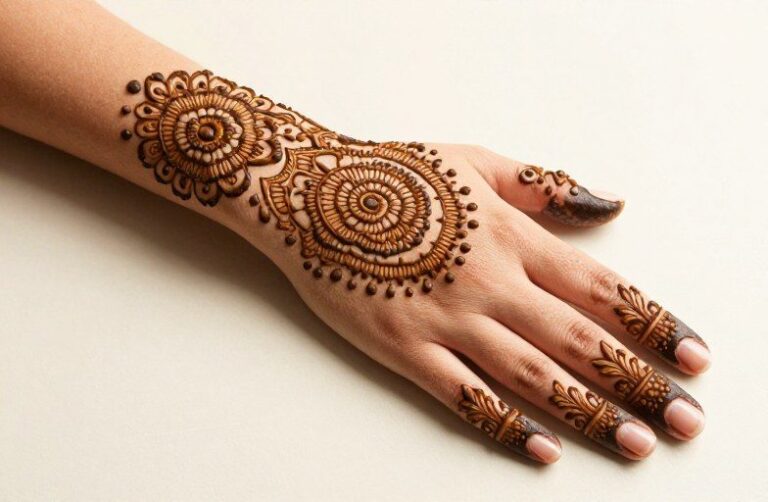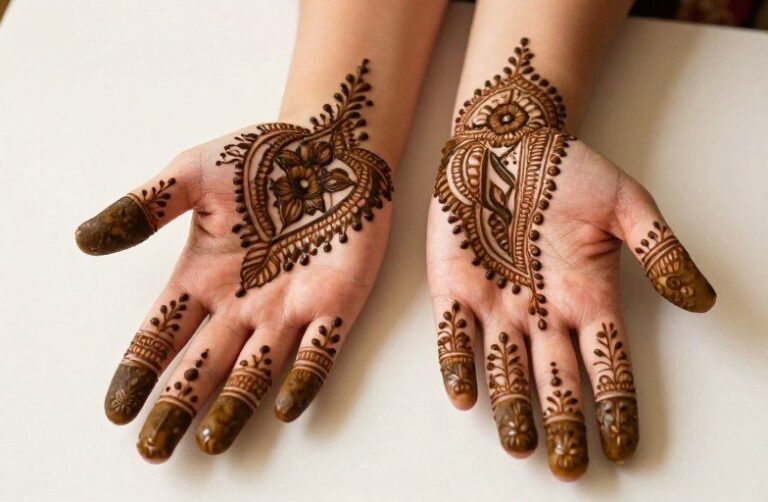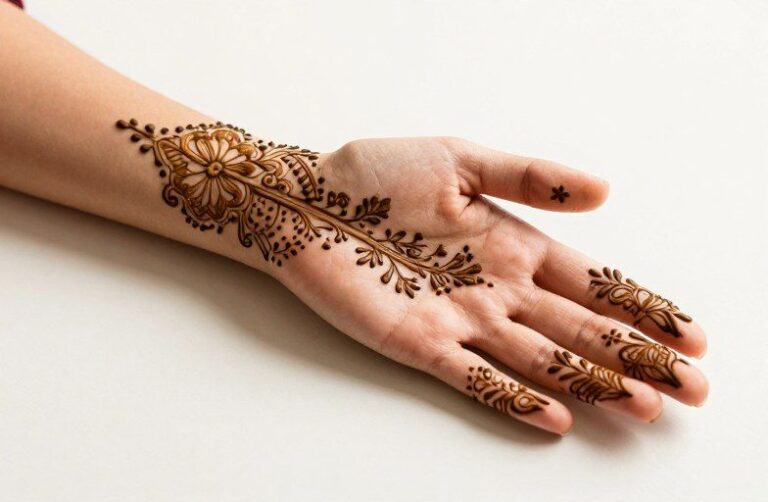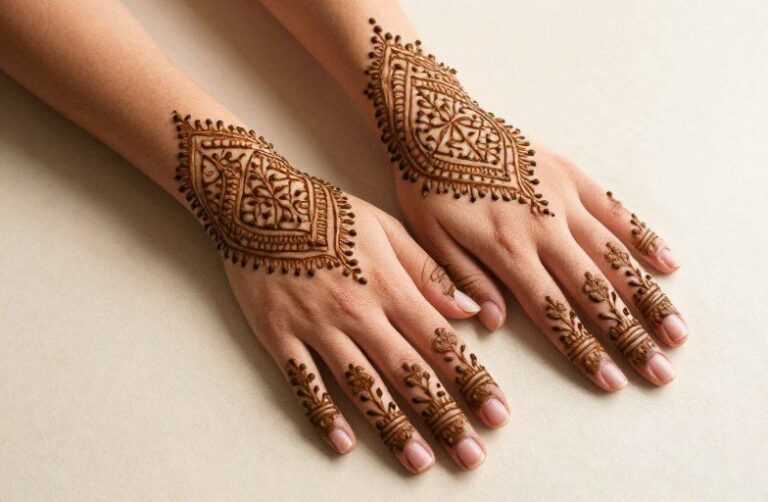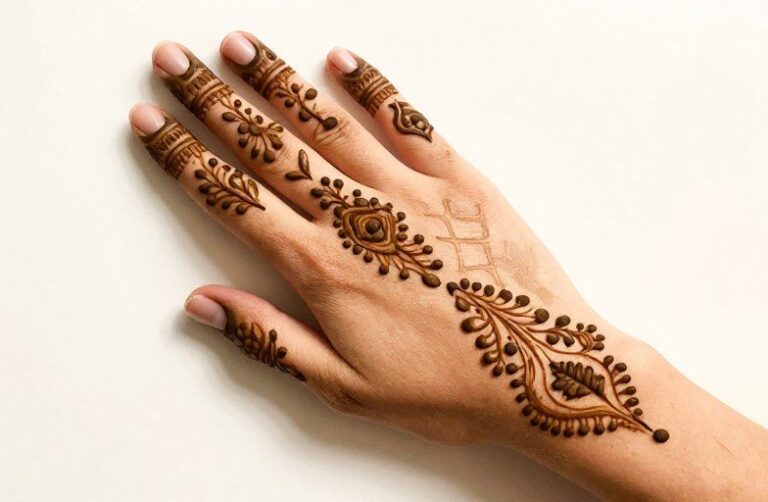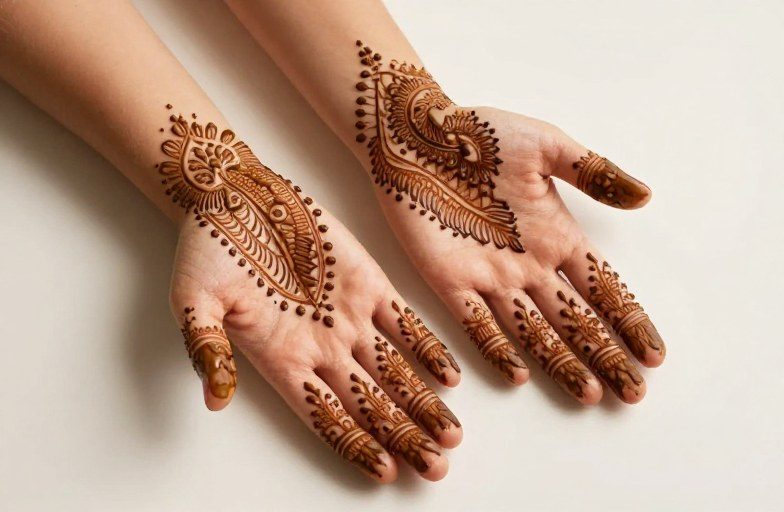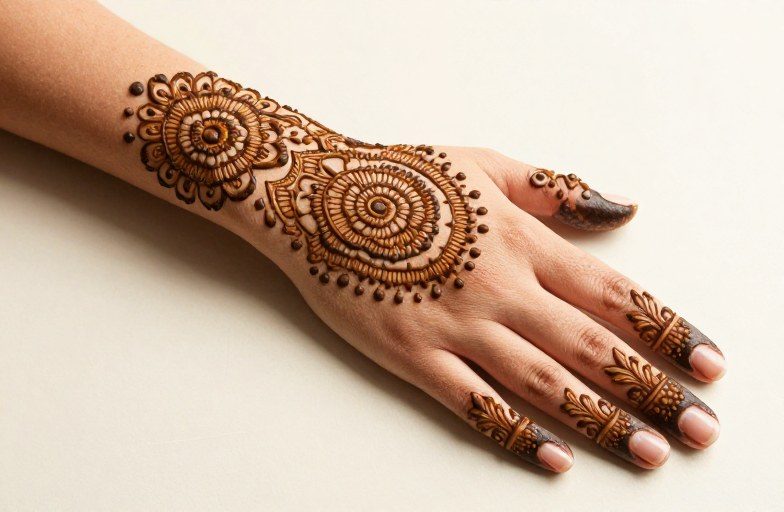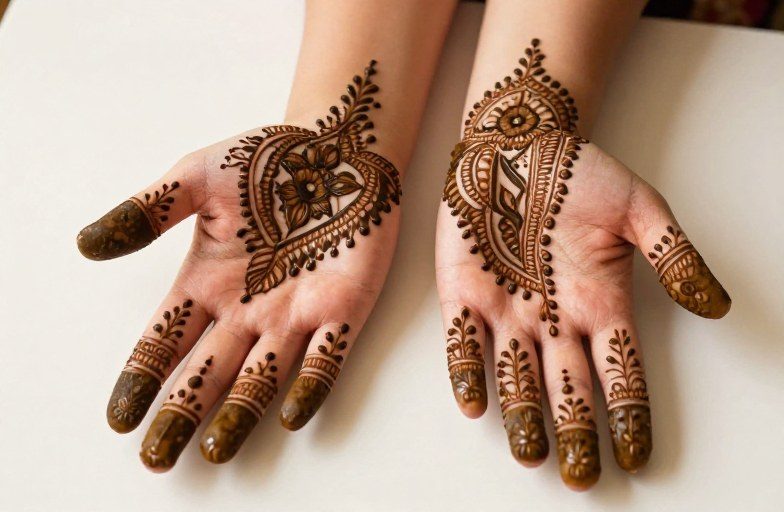
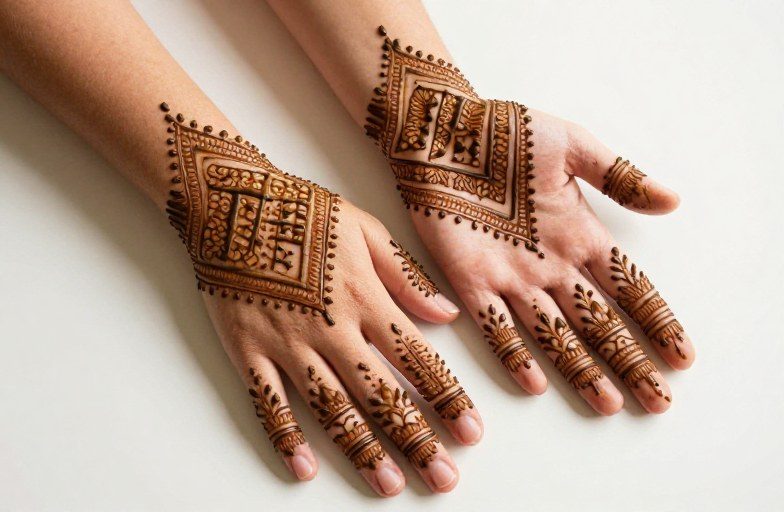
Geometric henna designs strip the traditional art form down to its bones: straight lines, circles, triangles, and repeating patterns that build outward from a center point. Unlike the dense floral swirls of bridal mehndi, these designs read as modern, architectural, almost mathematical. They suit people who want the ritual and temporary nature of henna without the ornate, storybook quality. The precision required also separates good geometric work from sloppy execution, wobbly lines destroy the entire effect. If you’re drawn to this style, understanding placement constraints, how the paste interacts with different skin tones, and how to scale patterns correctly will get you closer to the result you actually want.
Best Placements
Geometric henna demands flat, stable surfaces. Curved or highly mobile areas distort the lines as skin flexes, and the paste cracks before it sets properly. Some spots reward the discipline; others fight it.
The Back of the Hand and Fingers
This is the classic stage for geometric henna, but it comes with caveats. The dorsal hand has relatively flat planes between the knuckles, perfect for mandala centers or hexagonal grids. Fingers, though, crease constantly. Geometric bands around fingers look crisp for about a day, then blur as the paste flakes at the joints. If you want finger detail, keep it above the middle knuckle or accept that it’ll degrade fast. The wrist transition, where a hand design meets the forearm, works beautifully as a straight border or radiating sunburst.
Forearms and Calves
These cylindrical but mostly stable areas let patterns scale larger without wrapping awkwardly. A forearm sleeve of interlocking triangles reads clean from every angle. Calves offer similar real estate with less daily abrasion than the forearm, so the stain lasts deeper into its two-week lifespan. Avoid the inner forearm near the elbow ditch; the skin there stretches and folds too much for tight geometry.
- Upper back between shoulder blades: Flat, rarely sun-exposed (preserves stain), ideal for large symmetrical pieces.
- Top of the foot: Flat enough for mandalas, but walking stresses the paste; plan to stay off your feet for the setting period.
- Behind the ear / side of neck: Small-scale sacred geometry works here; large patterns feel crowded and fade unevenly due to hairline friction.
Standout Design Ideas
The difference between generic and memorable geometric henna lies in specificity of pattern and intentional use of negative space.
Islamic Geometric Patterns
Girih tiles, interlocking polygons that create star and floral motifs, translate directly into henna with stunning results. A 12-point star built from overlapping circles and hexagons, filled with parallel lines, creates depth without shading. The key is consistency: every line weight must match, every angle must repeat exactly. This style works at medium to large scale; at small sizes, the intersections blur into mud.
Sacred Geometry and Natural Forms
The Flower of Life, Metatron’s Cube, and Fibonacci spirals offer recognizable frameworks that artists can elaborate or simplify. A forearm piece might start with a central Seed of Life and radiate outward with progressively larger hexagons. Alternatively, a minimalist approach, single unbroken line forming an impossible triangle or Penrose-style illusion, relies on the artist’s steady hand and your ability to hold perfectly still.
- Dotwork gradients: Dense stippling creates tonal variation within geometric boundaries; requires experienced artist.
- Negative space mandalas: The skin shows through as the pattern, henna fills the background; striking on darker skin tones.
- Platonic solids: Wireframe tetrahedrons or dodecahedrons, often paired with celestial elements like moon phases.
Color Choices
Natural henna produces one color: a reddish-brown derived from lawsone binding with keratin. The variation comes from your skin’s chemistry, the paste’s freshness, and aftercare, not from additives. “Black henna” is a misnomer for PPD-laden chemical mixes that scar and sensitize; avoid it entirely. “White henna” is actually body paint or adhesive with white pigment, sitting on top of skin rather than staining it. It lasts 1-3 days versus henna’s 1-2 weeks.
For true geometric henna, the monochrome nature is a feature, not a limitation. The brown stain against your natural skin tone creates the contrast. On very fair skin, the color reads as warm amber; on deeper skin tones, it can appear burgundy to nearly black depending on the body chemistry. Some artists add indigo to the paste for a cooler, more purple-brown result, but this is still a single-color stain.
If you want color variation within a geometric piece, the legitimate approach is combining henna with jagua (a blue-black fruit-based stain) in separate areas. A piece might use henna for warm geometric lines and jagua for cool shadowed sections. Never mix the two pastes; they have different setting times and can interact unpredictably.
Matching & Pairing Ideas
Geometric henna pairs well with certain styles and clashes with others. The rule is: match the energy, not necessarily the content.
Complementary Styles
Fine-line permanent tattoos in blackwork or dotwork create a visual conversation with geometric henna. The henna’s organic, slightly imperfect lines soften the tattoo’s permanence; the tattoo’s precision gives the henna something to measure against. Many people with existing geometric permanent tattoos use henna to fill gaps or extend sleeves temporarily, testing placement before committing to more ink.
Jewelry also pairs intentionally. A geometric hand piece framed by thin silver rings extends the pattern beyond the skin. Metal bracelets with angular, architectural designs echo forearm henna rather than competing. Avoid ornate, curvilinear jewelry, Victorian filigree, chunky organic stones, near geometric henna; the visual languages contradict.
Clothing and Context
Geometric henna reads modern and somewhat austere. It suits clean lines in clothing: structured cuffs, geometric necklines, solid colors rather than busy prints. A dense mandala on the back of the hand against a white shirt sleeve creates a deliberate focal point. The same design against floral chiffon dissolves into visual noise.
How to Personalize It
Personalization in geometric henna happens through scale, asymmetry, and hidden elements, not through literal imagery.
Scale a standard mandala to fill only your palm center, leaving fingers bare, and you’ve made a quiet statement. Break symmetry intentionally: one half of a forearm piece follows strict hexagonal rules, the other dissolves into scattered dots or an interrupted line. This creates tension that pure symmetry cannot.
Some artists incorporate subtle numerical references: a pattern repeating exactly seven times, a central shape with eight points matching a significant date. These remain invisible to casual viewers, visible only to those who know to look. Another approach is mapping a real location’s coordinates into angle degrees, 37 degrees north becomes a 37-degree angle in the pattern’s baseline.
Your skin’s own characteristics also personalize the result. Freckles, moles, and scars can become nodes in a geometric network, incorporated rather than covered. This requires an artist who works with your body rather than imposing a template.
Size & Scale
Geometric henna fails more often from wrong scaling than from poor design. The line width, pattern density, and overall dimensions must relate to each other and to the body part.
Small Scale: Under 3 Inches
At this size, keep it extremely simple. A single unbroken hexagon, a small triangle cluster, or a minimal dot pattern. Complex interlocking shapes compress into unreadable blobs. Lines must be thin, needle-fine, but not so thin they break during paste removal. Small pieces behind the ear, on the side of a finger, or at the wrist bone work best.
Medium Scale: 3 to 8 Inches
The sweet spot for most geometric henna. A full hand back, a forearm band, or a calf centerpiece. Line weights can vary within the piece: thick outlines containing finer interior detail. Patterns can include two or three shape types, hexagons containing triangles, circles intersecting squares. The negative space between elements should equal roughly one line width; too dense and it overwhelms, too sparse and it looks accidental.
Large Scale: 8+ Inches
Full back pieces, thigh sleeves, or extending from wrist to elbow. These require genuine compositional planning. The eye needs resting points, areas of simpler pattern or pure negative space between complex zones. Large-scale geometric henna often uses a central focal mandala with radiating or descending simpler bands. The artist must maintain consistent line weight across the entire piece, which takes longer and costs more, but the result carries visual authority that smaller work cannot match.
The Takeaway
Geometric henna rewards patience and specificity. Choose placement based on flatness and stability, not trend. Commit to real henna paste and accept its single color range. Scale the complexity to the size, and size to the body part. Work with an artist who can draft patterns with a ruler and understands that in geometric work, a one-millimeter deviation is visible. The temporary nature of henna lets you experiment with placement and scale before any permanent commitment, but the discipline of good geometric work, precision, restraint, mathematical clarity, applies whether the stain lasts two weeks or a lifetime.
Frequently Asked Questions
How long does geometric henna last compared to traditional floral designs?
Geometric henna lasts the same 1-2 weeks, but its crisp edges show fading faster. Floral mehndi’s organic curves hide the gradual exfoliation; straight lines reveal every break. Expect geometric work to look sharp for 3-5 days, then soften noticeably.
Can geometric henna work on very dark skin tones?
Yes, but the contrast differs. The stain reads as deep burgundy to black-brown on darker skin, still visible but subtler. Negative-space designs, where the pattern is your skin showing through, actually pop more dramatically. Avoid fine-line-only work; slightly thicker lines hold better visibility.
Why do some geometric henna lines look blurry or blown out?
The paste was too wet, left on too long, or applied over skin that moved during setting. Geometric work has no forgiving curves to hide wobbles. An experienced artist uses firmer paste consistency and has you rest the area completely flat for 30-45 minutes after application.
Is geometric henna culturally appropriative if I’m not South Asian?
Henna itself spans multiple cultures across North Africa, the Middle East, and South Asia. Geometric patterns, Islamic girih, sacred geometry, have their own lineages. Avoid copying specific religious or ceremonial motifs without understanding; abstract geometric patterns are broadly shared visual language. Respect matters more than origin claims.