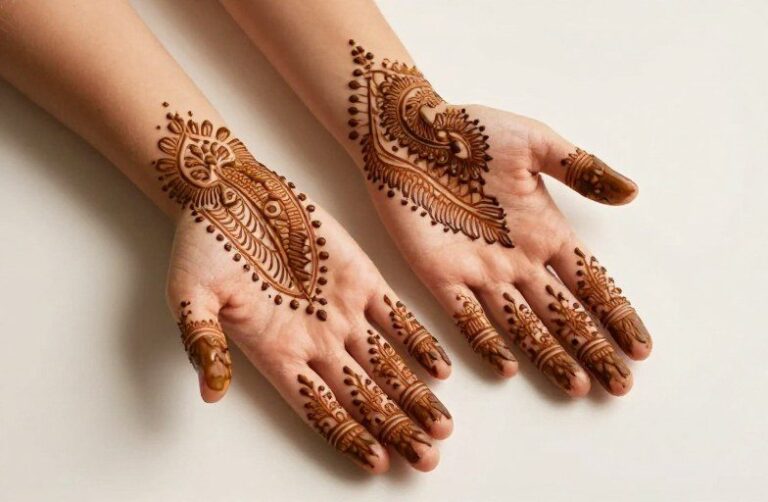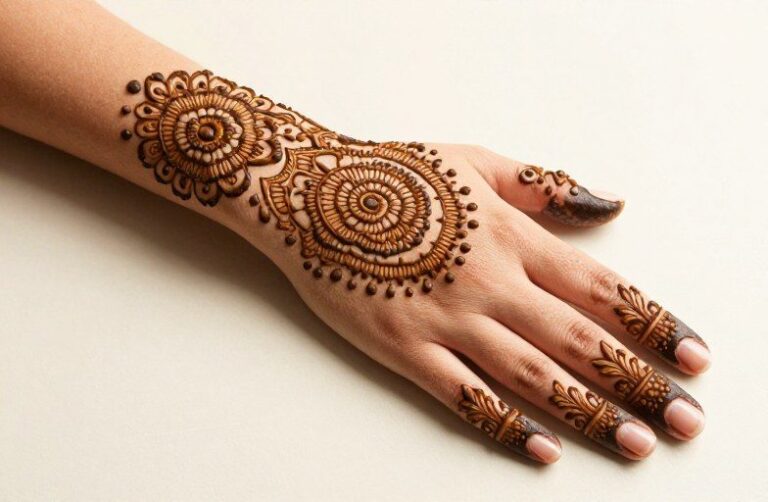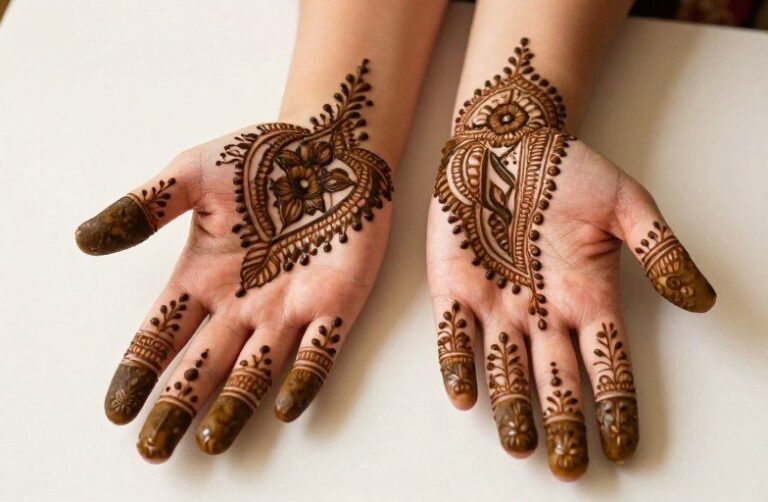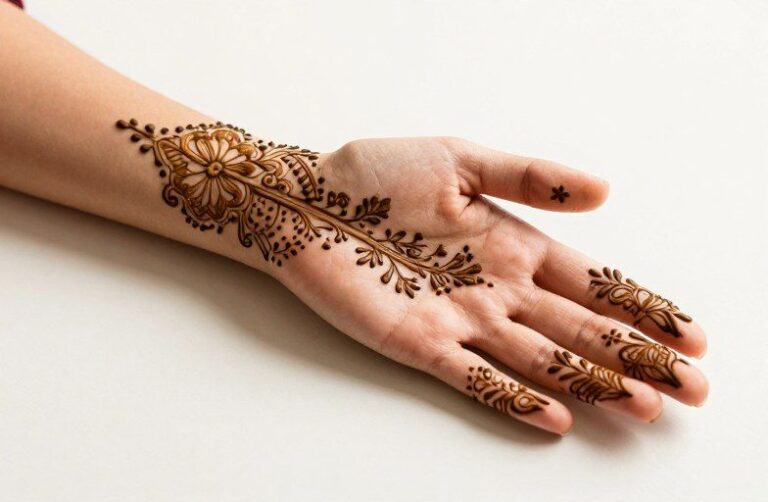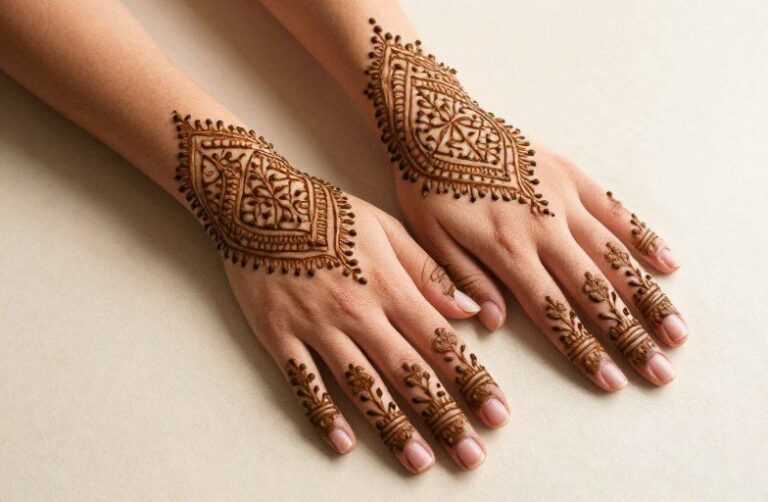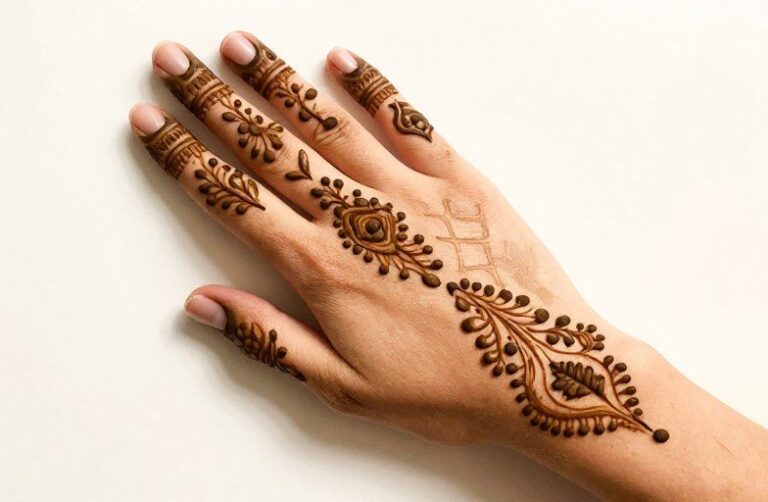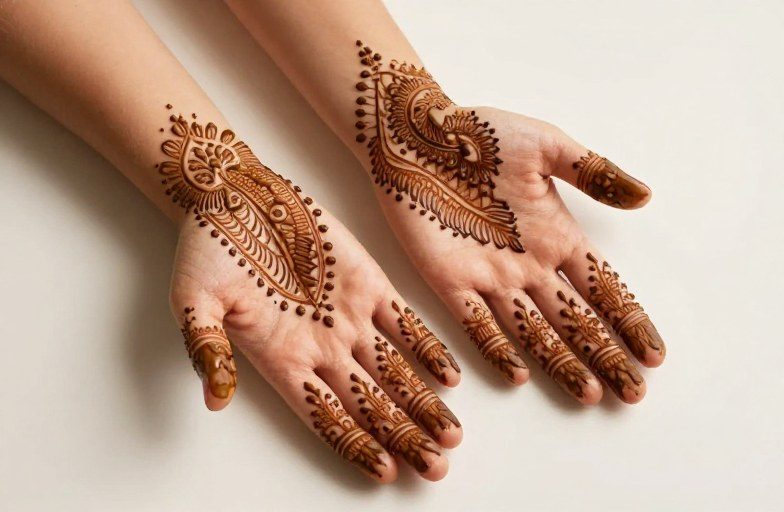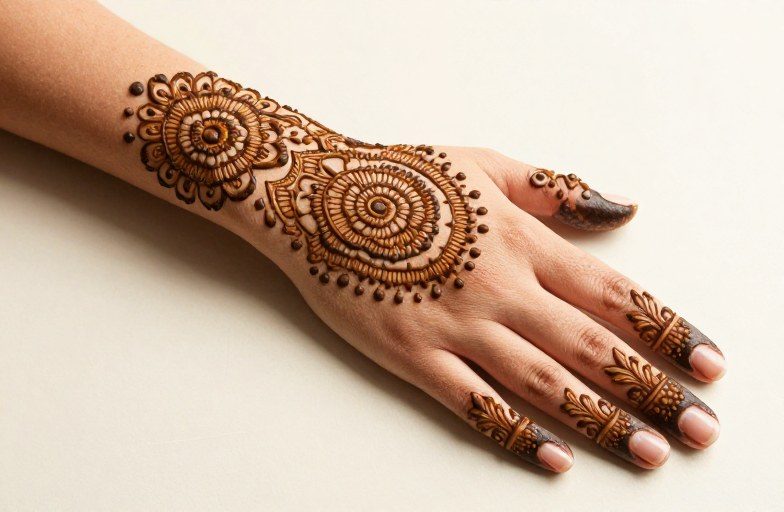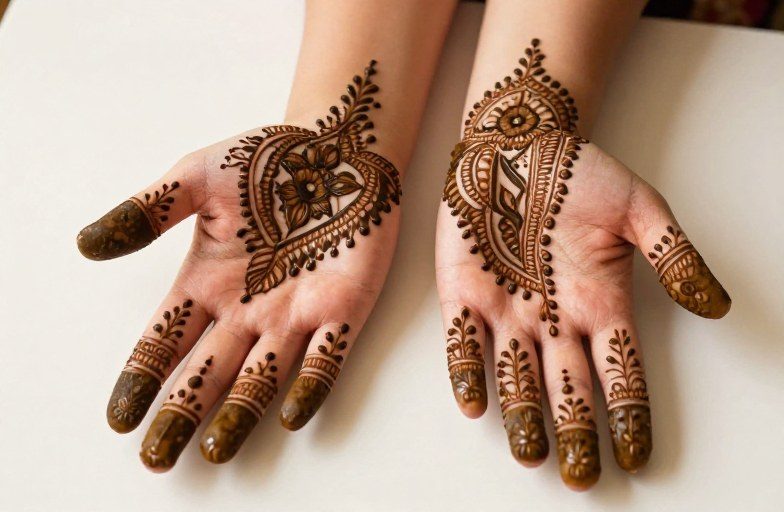
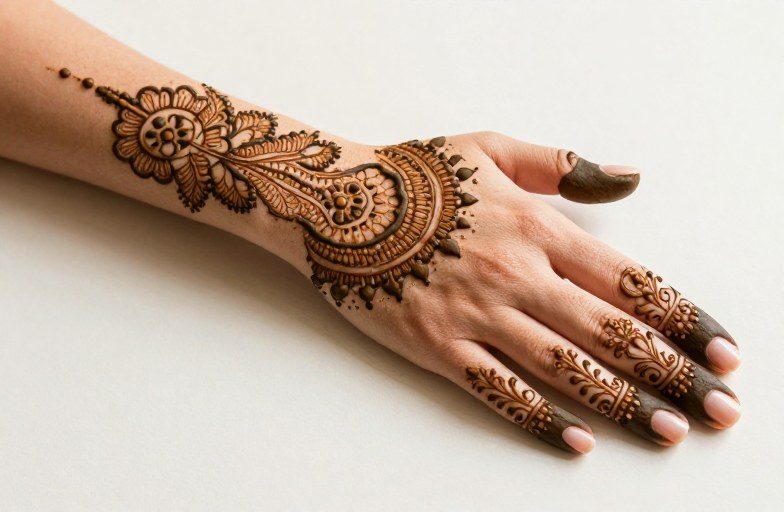
A henna-inspired marriage tattoo carries the visual language of mehndi ceremonies into permanent skin art. The meaning centers on union, fertility, and the intricate bonds between partners, those lacy, flowing patterns traditionally drawn on hands and feet to bless a bride now translated into needle and ink. For permanent tattoos, the symbolism shifts slightly: you’re choosing to carry ceremonial beauty forward as a lifelong mark rather than a temporary ritual.
Color vs Black and Grey
Actual henna stains skin in earthy reddish-browns. Permanent tattoos can chase that warmth or abandon it entirely, and each path changes what the design communicates.
Color Approaches
Copper, rust, and deep orange tones come closest to authentic henna’s iron-based chemistry. These age faster than black, reds and oranges are notorious for fading toward pink or muddy brown within five to eight years, especially with sun exposure. Some artists layer brown washes with fine red highlights to suggest henna without committing to high-maintenance saturation. The tradeoff is realism versus longevity; that burnt-sienna glow looks stunning fresh but demands touch-ups and strict sun protection.
Black and Grey Interpretations
Black ink interprets henna patterns through linework and dot density rather than color mimicry. This reads more abstract, less literal ceremony. The advantage is structural: black holds crisp edges for decades, and the negative space between paisleys and florals stays clean. Many marriage tattoos in this style incorporate a partner’s initials or wedding date into the negative space, hidden within the pattern’s geometry. Grey wash can suggest the faded quality of old henna, a subtle nod to impermanence within permanent ink.
Mythology & Folklore
Henna’s ceremonial roots are often linked to South Asian, Middle Eastern, and North African traditions, though specific origin claims vary regionally. The marriage connection runs through multiple symbolic threads rather than a single source.
The Night of Henna
Some trace the pre-wedding mehndi ritual to practices where the bride’s female relatives gather to apply patterns while singing and blessing the union. The darkness of the stain was traditionally read as an omen, deep color meant strong love from the husband, or from the mother-in-law, depending on which regional variation you encounter. This folklore persists in modified form; many permanent tattoo wearers reference the “night before” energy of anticipation and communal blessing rather than literal divination.
Botanical Protection
The henna plant itself carries protective associations across several cultures. Lawsone, the dye molecule, naturally cools the skin, historically useful in hot climates, and symbolically extended to “cooling” bridal nerves or deflecting the evil eye. Permanent tattoos sometimes incorporate actual henna leaves or flowers as central motifs, merging botanical accuracy with symbolic function. The marriage meaning here is practical magic made visible: a shield for the new partnership.
How It Ages on Skin
Henna patterns rely on extreme fineness, lines that blur together become mud. Understanding how this specific style degrades helps you design for reality, not just the fresh photo.
Line Weight and Spacing
Traditional mehndi uses lines thinner than most tattoo needles can reliably deposit. Single-needle work can approximate this but spreads over time; what starts as hair-fine detail becomes fuzzy at three to five years. Successful permanent henna-style tattoos use slightly bolder lines with intentional gaps, negative space that accommodates natural ink spread. The dense fill patterns (dots, teardrops, tiny florals) need room to breathe; packed too tight, they merge into grey blobs.
Placement and Sun Exposure
Hands and feet, the classic mehndi locations, are terrible for tattoo longevity. Palmar surfaces shed ink rapidly; fingers blur within months. If you want the marriage symbolism tied to those placements, expect significant fading and plan for multiple sessions. The compromise many choose: henna-style designs on the forearm, shoulder, or upper back where the pattern stays readable for years. UV exposure destroys the fine detail that makes this style work; sunscreen isn’t optional, it’s structural maintenance.
Who Chooses This Tattoo
The wearers fall into distinct groups with different priorities, and the design should serve the actual person, not a generic bridal fantasy.
People with direct cultural heritage often seek permanent henna to honor ceremonies they grew up witnessing, mothers and grandmothers with stained hands at family weddings. The tattoo becomes lineage made visible, sometimes incorporating specific regional patterns (Rajasthani florals, Arabic flowing vines, Moroccan geometric frames) that signal family origin. For this group, accuracy and respectful execution matter; working with an artist who understands the pattern vocabulary prevents touristy genericism.
Others come without heritage connection but with genuine aesthetic attraction to the form. The marriage meaning here is more universal: partnership as intertwined growth, the organic-meets-geometric quality of two lives braiding together. These designs often hybridize, pairing henna-style lacework with Western wedding symbols, interlocking rings, dates in Roman numerals, partner’s handwriting woven into paisley tails.
Best Placements
Where the tattoo lives changes how the marriage symbolism reads to others and how the detail survives.
Visible Commitment
- Forearm, inner or outer: Constantly visible, socially readable. The wrap-around vine quality works well here; the eye travels along the arm’s length. Inner forearm protects slightly from sun but sees friction from desks, armrests, sleeves.
- Upper back, centered or shoulder blade: Framed by clothing, revealed intentionally. Large-scale mehndi patterns flourish here; the flat surface allows symmetrical mandala-style centers with radiating detail. Partners often see this placement during intimacy, a private-public balance.
Concealed Intimacy
- Ribcage side: Painful, slow to apply, completely hidden under most clothing. The marriage meaning here is inward-facing; the tattoo exists for the wearer and chosen viewers, not social display. Fine detail suffers on the rib’s stretch and compression, so simpler patterns work better.
- Thigh, upper or outer: Large canvas, easily covered, ages reasonably well on this fleshier area. Popular for incorporating significant text within the henna framework, vows, coordinates, names in partner’s native script.
Religious & Spiritual Angles
The spiritual weight varies enormously by personal belief and cultural context. Some traditions consider permanent tattoos haram or discouraged; others embrace body marking as devotional. The henna marriage tattoo sits at this intersection, and its meaning depends partly on how the wearer navigates it.
Islamic Considerations
Mehndi itself is sunnah, encouraged particularly for married women. Permanent ink is more contested among scholars. Those who choose this tattoo often emphasize the pattern’s celebratory origin rather than the permanence, or they locate it where it can be concealed for religious contexts. The marriage blessing intention remains central; the method shifts with personal interpretation of permissibility.
Hindu and Jain Ceremonies
Mehndi is commonly associated with Hindu weddings, particularly the bride’s adornment as part of the Solah Shringar (sixteen adornments). Permanent versions sometimes incorporate specific auspicious symbols: the lotus for purity amid difficulty, the peacock for beauty and dignity, the mango leaf for fertility. These aren’t generic decoration; they carry loaded meaning within the ceremony’s spiritual framework. Getting them permanently requires understanding that weight, not just copying attractive shapes.
Final Thoughts
A henna marriage tattoo succeeds when it respects the form’s density and delicacy while accepting the reality of permanent ink. The meaning, union, blessing, protective intention, translates across temporary and permanent media, but the execution must change. Go too fine and it blurs; go too generic and it empties. The best versions I’ve seen pair cultural knowledge with technical honesty: an artist who knows why the patterns flow certain directions, and a wearer who knows where on their body the detail will survive. Marriage itself is long; the mark honoring it should be designed with that same patience.
Frequently Asked Questions
Can a henna marriage tattoo look exactly like real mehndi?
Not for long. Real mehndi uses surface staining that sits in dead skin layers; tattoo ink lives deeper and spreads slightly over years. The finest lines in temporary henna are impossible to maintain permanently. A good artist will adjust line weight and spacing to suggest the delicacy without promising exact replication.
Is it cultural appropriation to get this tattoo without South Asian heritage?
Intent and execution matter. Avoiding sacred religious symbols you’re not connected to, researching specific pattern origins, and choosing an artist educated in the tradition all help. Many tattoo artists from these cultures actively welcome respectful engagement; the problem is thoughtless tourist copying, not genuine cross-cultural appreciation.
How do I keep the fine detail from turning into a grey blob?
Start with slightly bolder lines than look ideal fresh, maintain strict sun protection, and choose placement carefully, avoid high-friction, high-sun areas like fingers and tops of hands. Plan for touch-ups every few years, and accept that some merging of the densest fill patterns is inevitable over decades.
Can my partner and I get matching henna-style marriage tattoos?
Absolutely, and the form lends itself well to pairing. Consider complementary rather than identical designs, interlocking patterns that complete each other when placed side by side, or shared central motifs with individualized surrounding detail. The henna tradition already celebrates connection through applied art; permanent versions can extend that into paired but not cloned marks.