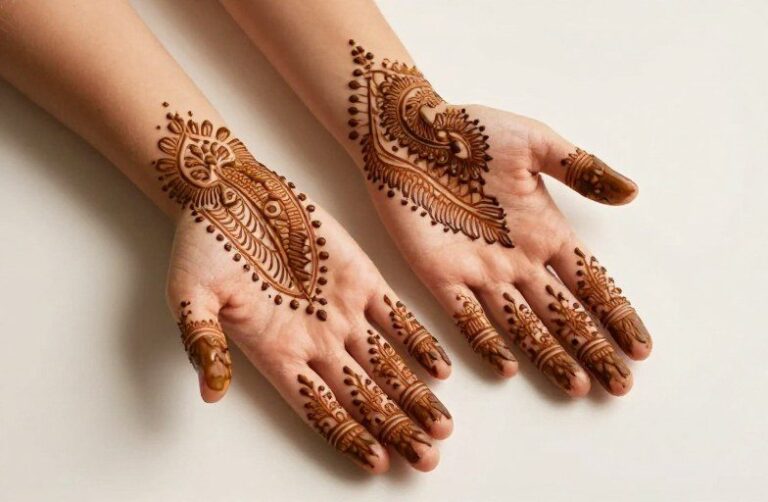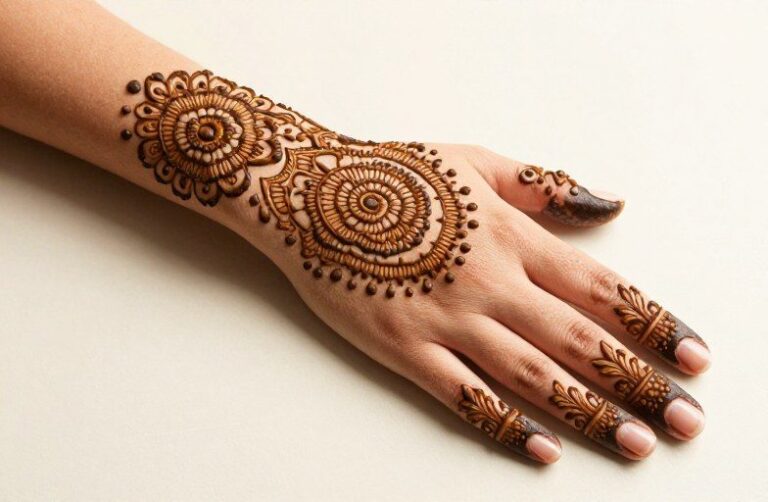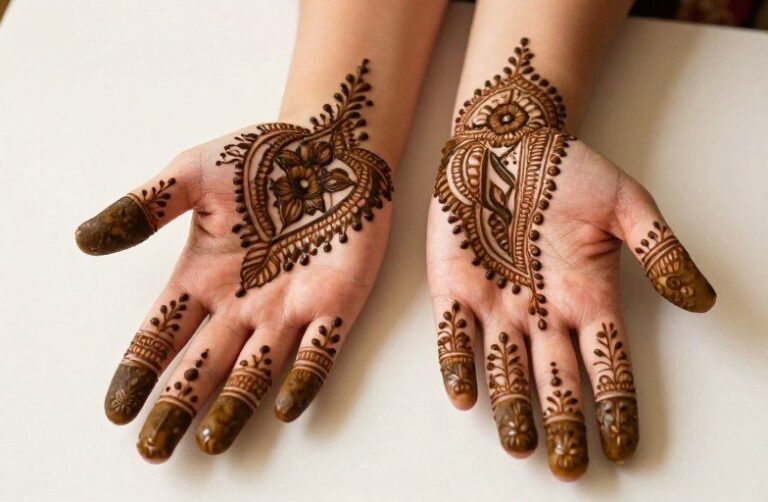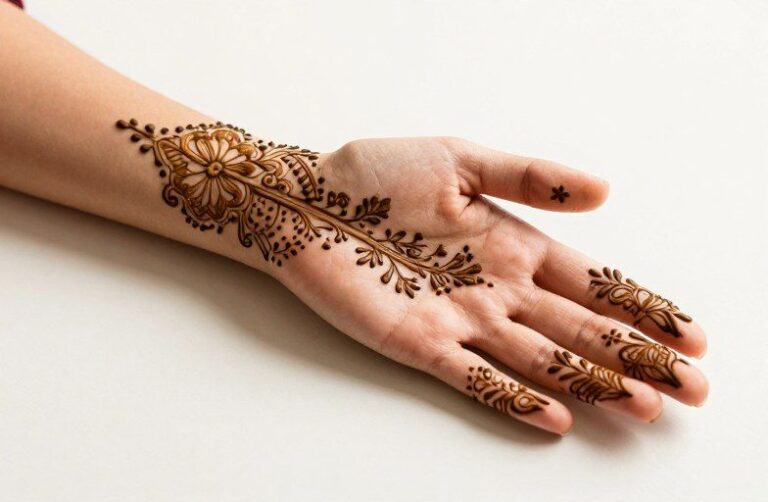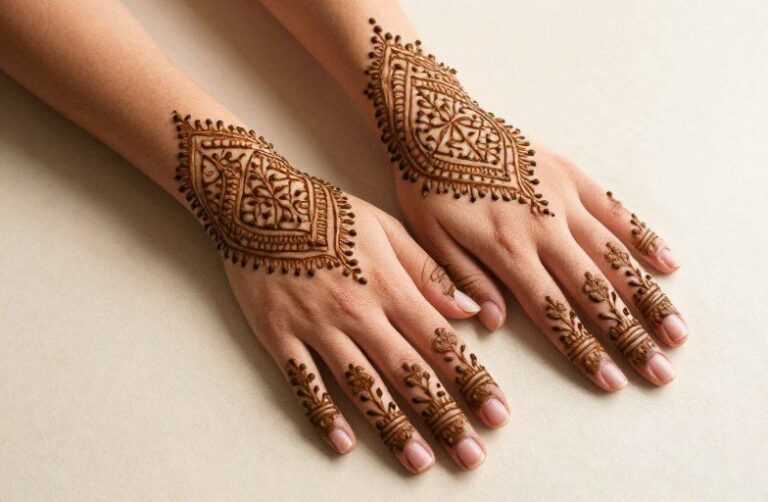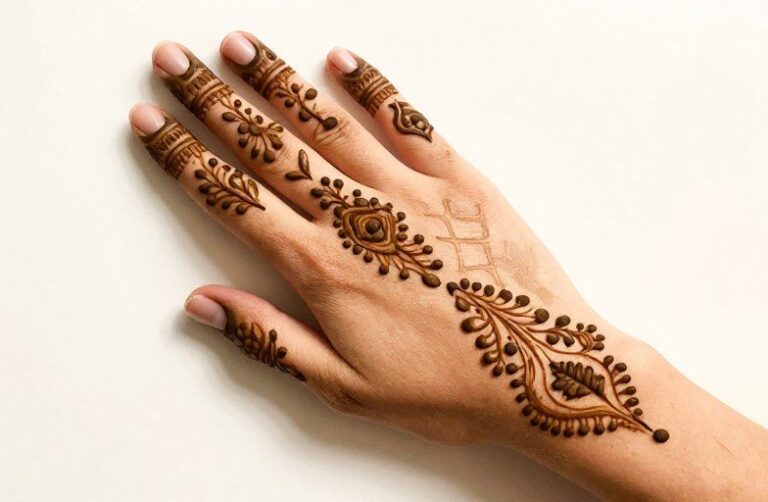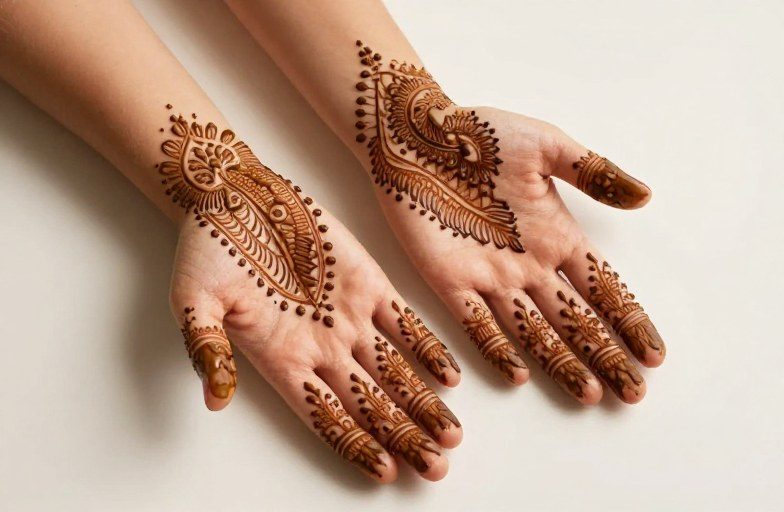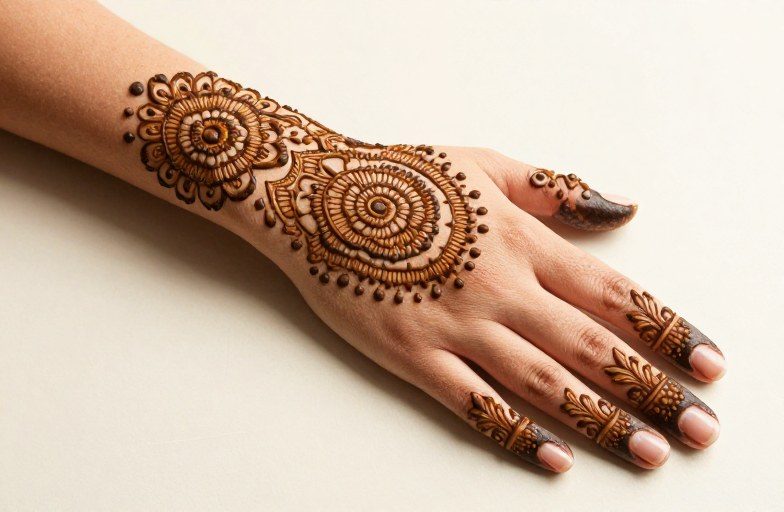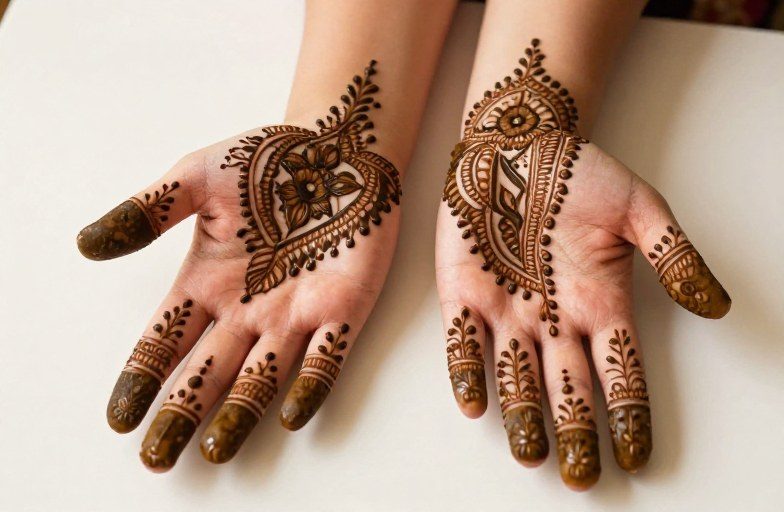
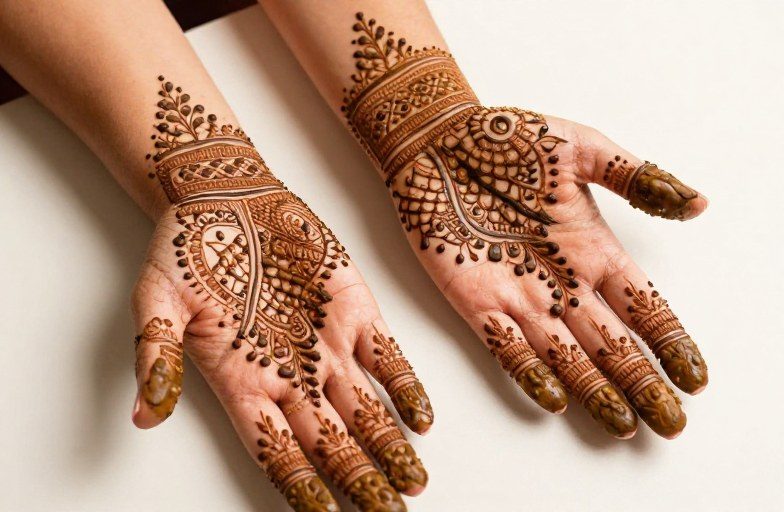
Rajasthani mehndi carries some of the densest, most geometrically complex patterning in henna tradition. Peacocks, mango leaves, checkerboard grids, and fine dotwork fill entire palms and forearms in the original art form. Translating that into permanent tattoo work means solving real problems: how to keep lines crisp when skin ages, which details survive at small scale, and where on the body these flat, ornamental compositions actually sit well.
For First-Timers
Jumping straight into a full-hand or full-foot replica of bridal mehndi as your first tattoo is usually a mistake. The sheer coverage, the hours under the needle, and the healing demands of dense blackwork on hands or feet make this punishing for someone unaccustomed to tattoo sessions.
Start with a Focal Motif
Pick one element, perhaps the paisley (kairi or ambi), a peacock silhouette, or a mandala center, and let it stand alone. A single peacock on the outer forearm, maybe four to six inches tall, gives you the Rajasthani flavor without the overwhelming commitment. You’ll learn how your skin takes solid black ink, how the fine lines heal, and whether you want to expand into larger compositions later.
Understand the Healing Reality
Hands and feet heal differently than arms or backs. The constant flexing, the thinner skin, the friction from shoes and daily use, these areas shed ink faster and blur sooner. If your first tattoo must be on a hand, expect touch-ups. Many artists won’t tattoo fingers or palms at all for first-timers because the dropout rate is high and the results disappointing. A forearm or calf gives you a much more honest introduction to how these patterns age.
Standout Design Ideas
Authentic Rajasthani mehndi has identifiable vocabulary. The best tattoos don’t just copy a henna photo; they adapt that vocabulary to the permanence and dimensionality of tattoo ink.
- Peacock with geometric tail: The state bird of Rajasthan, rendered with tail feathers broken into diamond and triangular segments rather than soft organic curves. This reads clearly from distance and holds its structure over years.
- Checkerboard (jaali) bands: Alternating solid and negative-space squares wrapping around a wrist or ankle. The repetition creates optical movement and ages gracefully because the pattern is built on contrast, not hair-thin lines alone.
- Mango leaf (kairi) border: A repeating leaf motif used as a frame for a central mandala or left as a standalone band. Works exceptionally well as an armband or bracelet tattoo.
- Floral mandala with dotwork: A circular center radiating petal shapes, surrounded by concentric rings of stippled dots. The dotwork softens the geometry and mimics the texture of fresh henna paste.
One approach that fails: attempting to reproduce the “stained” gradient of real henna. Tattoo ink doesn’t fade from dark to light the way henna paste oxidizes on skin. Instead, build value through line density, tight packed lines where you want darkness, open skin where you want lightness.
Color Choices
Traditional mehndi is monochromatic: the rust-brown of henna itself. Tattoo adaptations have more options, but most successful pieces stay limited in palette.
Black and Gray
The majority of Rajasthani-inspired tattoos live in black ink. Solid blacks for the geometric grids, graywash for softening peacock bodies or floral centers, and pure skin tone for the negative space. This ages the cleanest. Black ink on lighter skin gives the closest visual cousin to dark henna stains. On darker skin tones, the contrast shifts, black reads as bold graphic pattern rather than “stained” color, which is its own valid aesthetic.
Selective Color Accents
Some clients add sparse red or orange in the peacock’s eye or flower centers, referencing the turmeric and henna mixtures sometimes used in ceremonial application. Green appears occasionally for leaf motifs. The key restraint: one accent color, used in no more than ten percent of the piece. Rajasthani design logic is about pattern density, not color complexity. Too many hues and the composition dissolves into something generic.
White ink has gained popularity for “henna-style” tattoos, but white fades to yellowish or disappears entirely within a few years, especially on hands. It’s generally unsuited to the fine linework these designs demand.
Size & Scale
Mehndi patterns are designed for relatively flat, broad surfaces: palms, tops of feet, forearms to fingertips. The original art assumes a viewer standing close, examining intricate detail. Tattooing compresses or expands this to body contours that curve and move.
Small (under 3 inches): A single kairi or small mandala on the wrist bone, behind the ear, or ankle. Only the simplest motifs survive. Dotwork below 1mm often heals as a blob; lines need to be bold enough to hold. A tiny peacock silhouette works. A tiny peacock with full feather detail does not.
Medium (4-8 inches): The sweet spot for most adaptations. A forearm band, a shoulder cap mandala, or a calf piece with central motif and surrounding border. Enough room for the characteristic density without overwhelming the body part.
Large (sleeve or full back): Full replication of bridal mehndi coverage. Possible but rare. The back handles it better than limbs because the surface is relatively flat and stable. Arms and legs twist and taper, breaking the continuous field that makes mehndi visually coherent. If you want large-scale, consider a back piece with the pattern oriented to be viewed from behind, or a thigh where the muscle provides a broad canvas.
Best Placements
Not all skin accepts fine ornamental work equally. The ideal spot balances visibility, aging, and the flatness needed for geometric accuracy.
Forearm and Wrist
The outer forearm offers the most versatile placement. Muscle movement is minimal, skin is moderately thick, and the cylindrical shape accepts bracelet-style bands or single motifs well. Inner forearm is softer and more prone to stretching with weight change, but still viable. The wrist bone itself, prominent, thin-skinned, constantly flexing, is where lines blur fastest. Keep details away from the bone; place them slightly above or below.
Foot and Ankle
Ankles hold detail better than the top of the foot, which is notoriously difficult for tattoo longevity. The foot’s constant friction, thinner epidermis, and propensity to swell during healing make it a gamble. Ankle bands, positioned just above the bone, are the compromise: visible, culturally resonant (henna is traditionally applied to feet), and technically more forgiving.
Upper Arm and Shoulder
Less traditional for mehndi but mechanically sound for tattoos. The deltoid cap accepts a mandala beautifully, with the circular shape echoing the muscle curve. Upper arm inner bicep is hidden, which some prefer for cultural or professional reasons, but the skin there stretches and compresses significantly, geometric precision suffers over time.
Matching & Pairing Ideas
Rajasthani mehndi is inherently symmetrical in its original form, both hands matched, both feet matched. Tattoo adaptations can follow or deliberately break this logic.
Matched pair: Identical designs on left and right forearms, or wrists. Reads as intentional and ceremonial. The risk is that no two tattoos heal identically, and subtle asymmetries become noticeable. Experienced artists will tattoo both sides in the same session to minimize variation in ink saturation and hand pressure.
Complementary pair: Related but not identical. A peacock on one forearm, a mango tree on the other, sharing the same border style and dotwork vocabulary. More forgiving of minor differences and more interesting visually.
With non-mehndi elements: Some pair Rajasthani patterns with Sanskrit script, lotus motifs from other Indian traditions, or geometric Islamic patterns. This works when the line weight and density match. A thick American-traditional rose next to fine mehndi dotwork clashes; a geometric mandala in similar scale harmonizes. The pairing should feel like conversation, not collision.
Couples occasionally request matching mehndi-inspired bands. The style suits this well, unlike portrait or name tattoos, ornamental bands carry personal significance without literal representation, and they age with dignity even if relationships shift.
Final Thoughts
Rajasthani mehndi tattoos reward patience in design and restraint in execution. The temptation is to replicate the overwhelming density of a bridal henna session, but tattoo ink behaves differently than henna paste. Lines spread, details drop out, and the body moves in ways that flat hand surfaces do not. The best pieces honor the visual language, peacocks, jaali grids, kairi borders, stippled dotwork, while adapting the scale and placement to how tattoos actually live on skin. Work with an artist who understands ornamental tattooing specifically, not just one who can copy a Pinterest image. Ask to see healed photos, not fresh work. The true test of these patterns is how they look five years later, not five minutes after the needle stops.
Frequently Asked Questions
How well do fine dotwork and lines from Rajasthani patterns hold up over time?
Fine dotwork under 1mm often spreads or disappears within a few years, especially on hands and feet. Lines need to be bold enough to stay legible; most artists build in slightly heavier line weight than the original henna reference to account for aging.
Can I get a Rajasthani mehndi tattoo if I’m not South Asian?
The ornamental geometric patterns themselves are widely appreciated across cultures, though some specific motifs carry religious or ceremonial significance. Discuss context with your artist, and avoid treating bridal or specifically sacred symbols as mere decoration.
Why do artists recommend against white ink for henna-style tattoos?
White ink fades to yellowish or translucent within one to three years on most skin tones, and it lacks the opacity to create convincing contrast against skin. It also heals poorly in fine lines, making it unsuitable for the detailed patterns characteristic of this style.
What’s the difference between a Rajasthani mehndi tattoo and an Arabic mehndi tattoo?
Rajasthani style features denser geometric grids, peacocks, and mango leaf motifs with less empty space. Arabic mehndi tends toward larger floral flows, more negative space, and vine-like movement. Tattoo adaptations reflect these differences in how the pattern wraps around body contours.