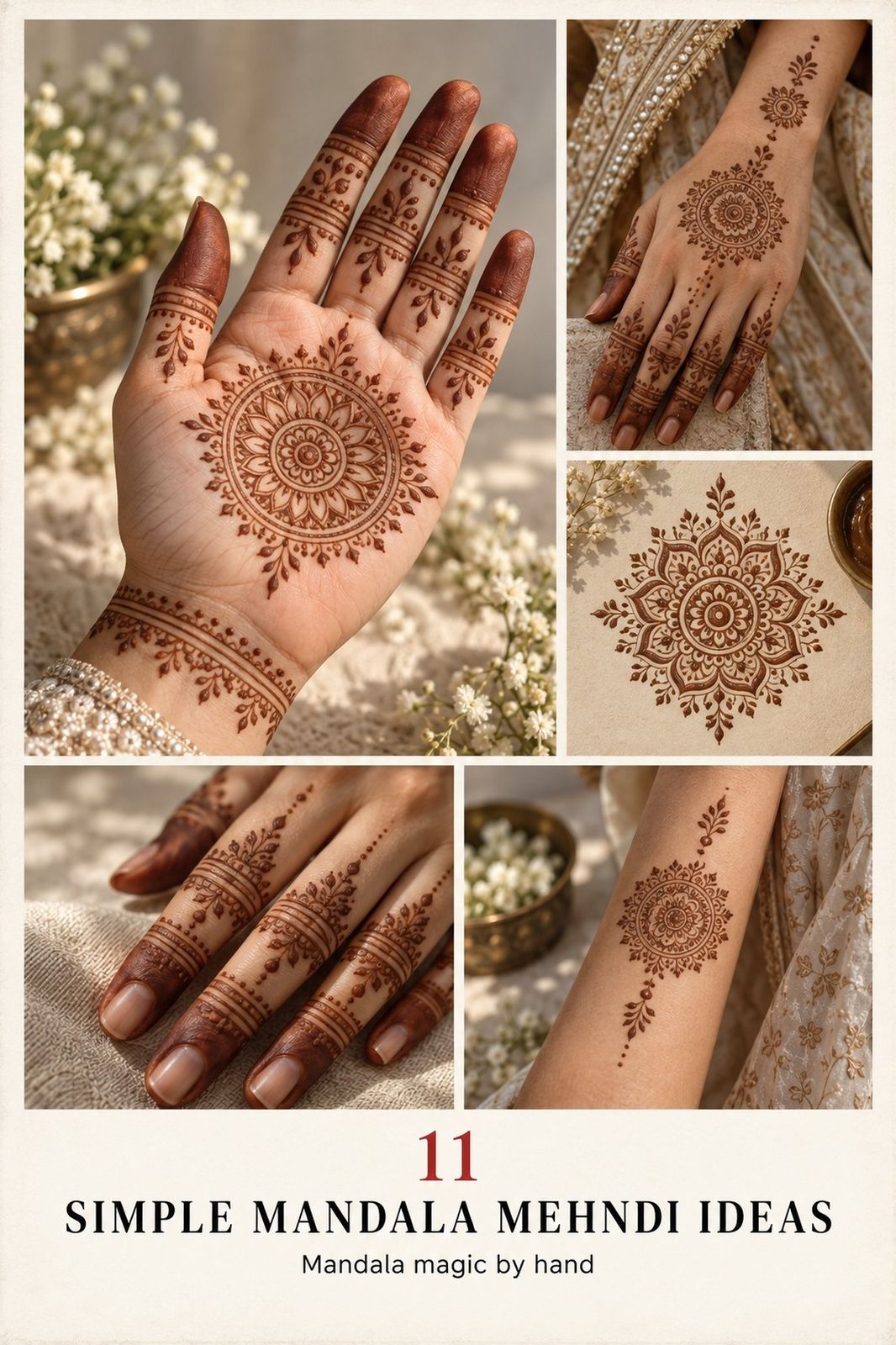
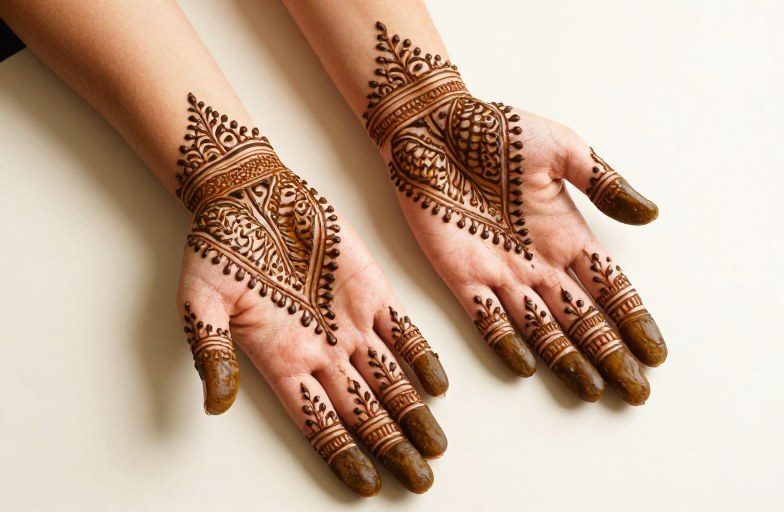
Moroccan mehndi sits between the dense floral flooding of Indian henna and the sparse, angular patterns of Middle Eastern work. The style favors bold geometric frames, diamonds, chevrons, eight-pointed stars, interlaced with vines and negative space that lets skin breathe. As a tattoo, it translates to both fine-line precision and heavier blackwork, though the geometry demands technical accuracy that not every artist handles well. Here is what actually matters if you are considering this direction.
Color and How It Ages
Traditional henna offers a single reddish-brown stain. Tattoo adaptations open wider possibilities, but the choice changes how the design reads and how it lasts.
Black and Near-Black
Black ink remains the most common translation. Solid blacks hold the geometric edges that define Moroccan style, and they age predictably, softening slightly but maintaining contrast for years. Ask your artist about their preferred black; some run cooler with bluish undertone, some warmer with brownish cast. For Moroccan work, a neutral to slightly warm black usually looks more organic against skin tones.
Related reading: Moroccan henna tattoo meaning | Moroccan mehndi tattoo ideas | geometric henna designs | mandala mehndi tattoo ideas
Brown and Red-Brown Tones
Some people want the literal henna color. Light brown inks exist, but they fade faster than black and can heal unevenly, turning muddy or orange-tinged. A medium-dark brown with black line work layered on top gives the warm tone while preserving legibility. Red-brown is trickier. True red fades fastest of all standard pigments, and tattoos aiming for “henna red” often look pink and blurred within five years.
- Black-only: best longevity, sharpest geometry
- Black with brown fill: warm tone, moderate fade risk
- Single-pass brown or red: high maintenance, frequent touch-ups needed
White ink highlights? Generally skip them. White fades to yellowish or disappears entirely, and in geometric work it tends to look like gaps rather than intentional accents.
Where to Place It
Moroccan patterns flow along flat planes and natural contours differently than organic designs. Placement affects both the pattern’s integrity and how it moves with you.
Hands and Fingers
The classic henna placement, but demanding as a tattoo. Finger skin regenerates rapidly; ink here blurs and fades within two to five years, sometimes sooner. The backs of hands hold better, especially across the metacarpals where there is less flexing. A diamond or star centered on the back of the hand, with finger extensions, reads as traditional without the full commitment of finger-only work. Plan for touch-ups every few years if you go this route.
Forearms and Calves
These cylindrical surfaces suit the repetitive, band-like quality of Moroccan borders. A forearm sleeve built from stacked geometric bands, chevrons, lattice, floral meander, wraps cleanly without the distortion you would get on a more curved area. Calves offer similar stability and less sun exposure than arms, which matters for longevity. Both areas let the artist work at a comfortable scale where line precision is achievable.
Other Placements to Consider
Feet and ankles work, but like hands, they fade faster due to friction and skin turnover. Ribs and sternum can accommodate large centerpieces, an eight-pointed star with radiating geometry, but the stretching and compression of torso skin will distort fine details over time. Shoulder caps and upper backs offer stable, relatively flat surfaces for substantial pieces that age well.
Size and Scale
Moroccan mehndi relies on repetition and rhythm. Shrink it too small and the patterns collapse into gray blobs; blow it up without enough detail and the negative space feels empty rather than intentional.
Minimum Viable Size
A single Moroccan star or diamond motif needs roughly two inches in diameter to hold its structure. Below that, the internal lines, typically one to two millimeters in the original henna, merge during healing. Fine-line specialists can push smaller, but the margin for error shrinks dramatically. For reference, a palm-sized piece, roughly three by three inches, allows one central motif with a simple border.
Scaling Up
Larger pieces gain complexity through layering: an outer geometric frame, a middle band of interlaced vines, an inner focal point. At half-sleeve or full-back scale, the artist can introduce tiny irregular lines that break perfect geometry and add organic texture, similar to the fine cracks that appear in dried henna paste. Without that variation, big geometric work can feel sterile, like a vector graphic rather than a living pattern.
- Under 2 inches: high blur risk, choose bold simple shapes only
- 2-4 inches: standard for single motifs, bracelets, small mandalas
- 5+ inches: allows true mehndi layering and detail density
Personalization Without Breaking the Style
The base vocabulary, stars, diamonds, chevrons, vines, is shared, but the arrangement creates individuality. Personalization in Moroccan mehndi comes from proportion and asymmetry rather than literal symbols.
Asymmetry and Breaks
Traditional henna often builds from a central focal point with mirrored expansion. Breaking that symmetry, offsetting the star, interrupting a border with a single larger bloom, letting one vine escape the frame, creates a contemporary feel. This requires an artist who understands the rules well enough to break them cleanly; sloppy asymmetry just looks like a mistake.
Integrating Outside Elements
Some people layer in Berber tattoo motifs from pre-Islamic North African practice, though scholarly interpretations of these symbols vary and their cultural weight deserves genuine research rather than casual borrowing. Others integrate birth flowers or abstracted initials into the lattice structure, rendered in the same geometric language so they do not disrupt the visual system. The key is translation: the outside element must speak in Moroccan visual grammar, not sit pasted on top.
Substyles Within the Tradition
Within Moroccan mehndi tattooing, a few approaches have emerged as distinct substyles. Knowing which draws you helps you communicate with artists.
Strict Geometric
Pure blackwork, compass-and-ruler precision, minimal botanical intrusion. Reads as modern and architectural. Best on flat areas where lines will not warp. Tends to age excellently but requires an artist with genuine technical discipline.
Botanical-Heavy
Vines and leaves dominate, with geometric frames providing structure rather than focus. Softer in overall impression. Ages more gracefully since organic shapes tolerate slight blur better than hard edges.
Dotwork Texture
Stippled shading fills geometric shapes instead of solid black. Creates a softer, almost fabric-like quality. Requires an artist with genuine dotwork patience; rushed stippling looks uneven and amateur.
White-Space Dominant
Thin lines defining large empty areas. Very delicate, very high risk. Only worth attempting with an artist who specializes in fine-line longevity and on skin that is not prone to keloiding or hyperpigmentation.
Practical Realities for New Collectors
New to tattooing but drawn to this aesthetic? Some practical realities worth knowing before you book.
Finding the Right Artist
Geometric work exposes technical flaws immediately. A wobbly line in a floral piece might read as organic; in a Moroccan star, it is a broken edge. Ask to see healed photos, not just fresh work. Look for consistent line weight, clean intersections, and symmetry that holds up after several months. Artists with architecture, drafting, or printmaking backgrounds often adapt well to this style.
Start Small, Plan Big
A single bracelet band or small hand-back motif lets you test your skin’s reaction and your comfort with visibility. Moroccan patterns expand logically. You can add bands above and below, extend vines, build a sleeve from a single starting point. But plan that expansion from the start. A random collection of small Moroccan pieces looks disjointed; the style wants connection and flow.
Aftercare and Healing
Healing geometry requires discipline. Scabbing pulls lines apart if you pick; sun darkens and blurs edges if you skip protection. The investment in aftercare pays visible dividends in this style more than most. Solid black areas also mean more needle passes, which can mean more irritation during healing than a comparable-sized line piece.
What to Remember
Moroccan mehndi tattoos succeed when geometric discipline meets organic flexibility. Black ink preserves the structure best; hands and feet demand maintenance commitment; two inches is the practical floor for readable detail. Personalization works through proportion and controlled asymmetry, not literal symbol insertion. The style rewards patient artist selection and long-term thinking about expansion. Drawn to the architectural severity of pure geometry or the softer interlace of vine-heavy work, the core appeal remains: patterns that feel ancient and immediate simultaneously, rooted in a specific tradition but open to individual interpretation.
Frequently Asked Questions
How long does a Moroccan mehndi tattoo take to complete?
A small bracelet band or single palm-sized motif typically takes one to two hours. Half-sleeves or large back pieces with dense layering can require multiple sessions of three to five hours each. The solid black fills and precise line work cannot be rushed without sacrificing quality.
Can I get a Moroccan mehndi tattoo if I have darker skin?
Yes. Black ink reads clearly on all skin tones. The question is tonal contrast, not color. A skilled artist will adjust line weight slightly for your specific melanin level to ensure the geometry remains legible as the tattoo heals and ages.
Is Moroccan mehndi tattooing culturally appropriative?
Henna itself is a widespread practice across North Africa, the Middle East, and South Asia with regional variations. Moroccan mehndi specifically refers to a regional style. Most concerns arise from copying sacred or protective symbols without understanding their meaning, or treating the aesthetic as pure decoration divorced from context. Research, credit the tradition, and avoid borrowing specific Berber or Amazigh symbols casually.
Why do geometric tattoos sometimes look crooked after healing?
Skin shifts. What looks perfect on a flat stencil may distort over curved muscle, or settle differently as swelling subsides. Experienced geometric artists account for this by slightly adjusting angles during application. This is why flat, stable placements like forearms and calves generally yield cleaner results than highly mobile areas.