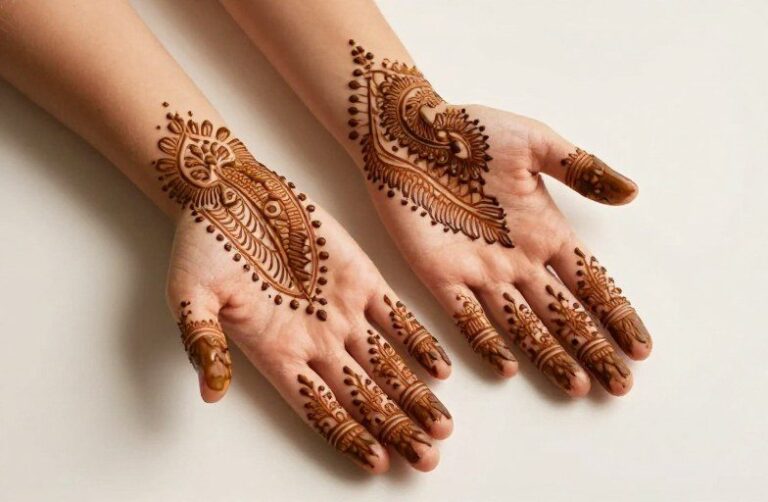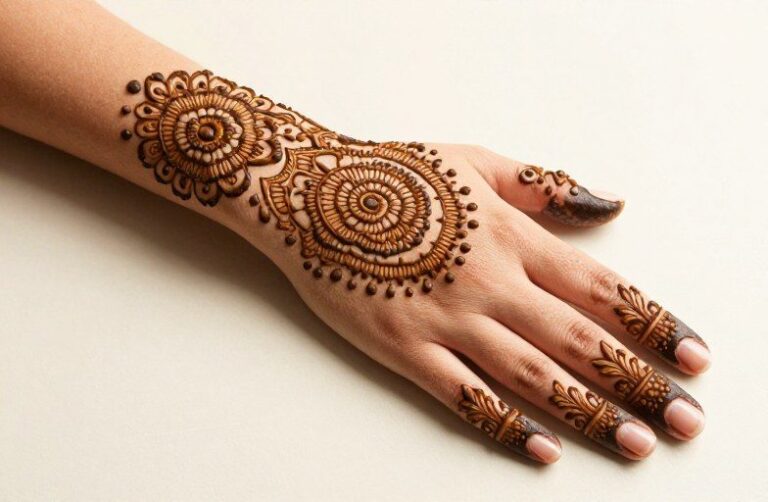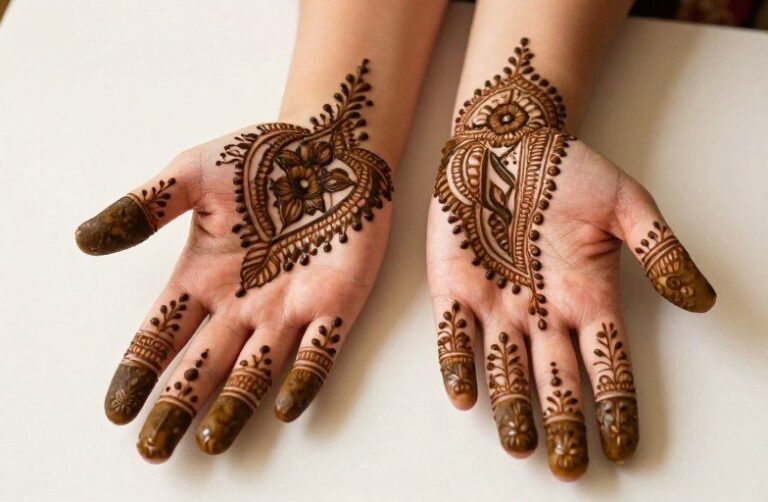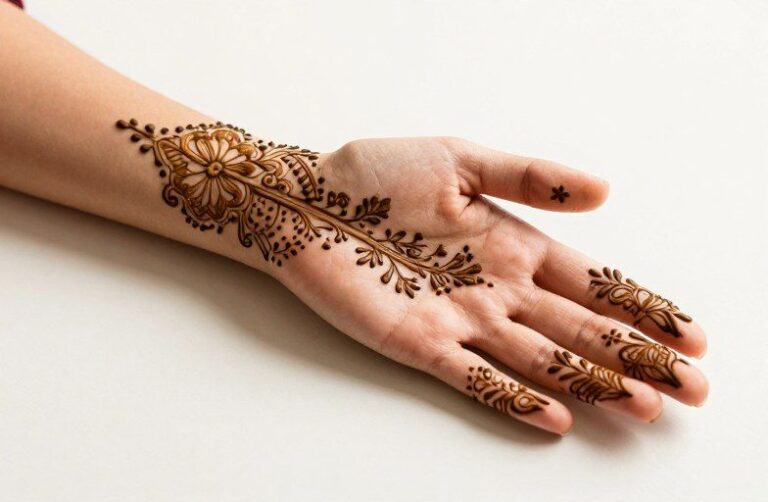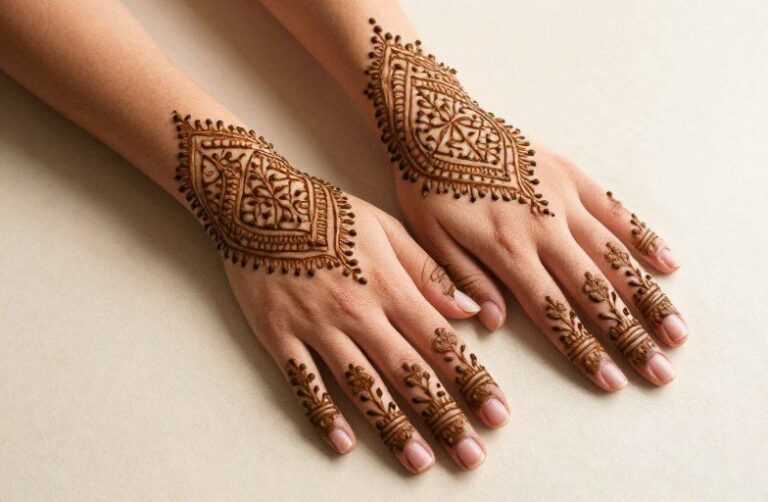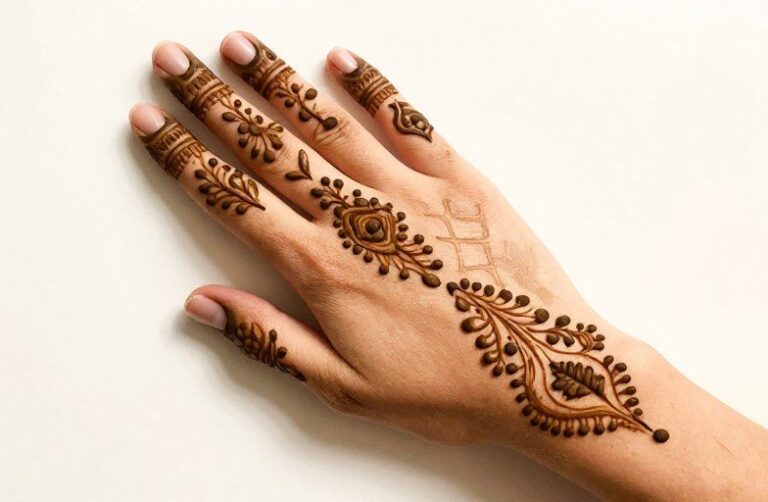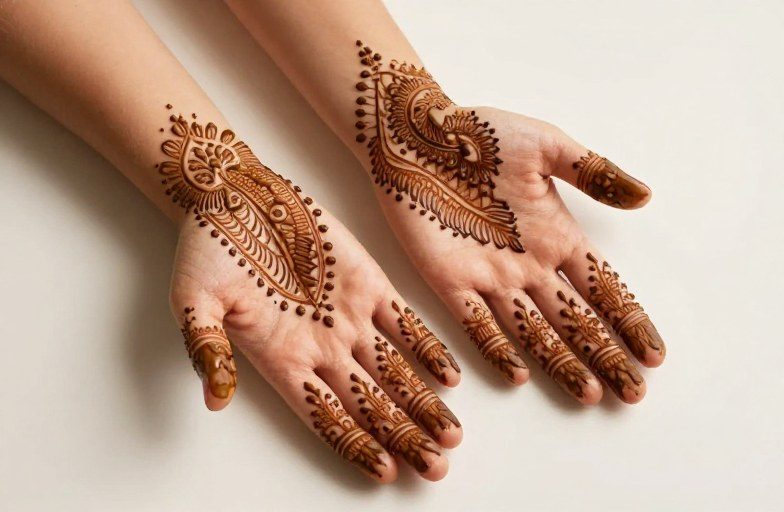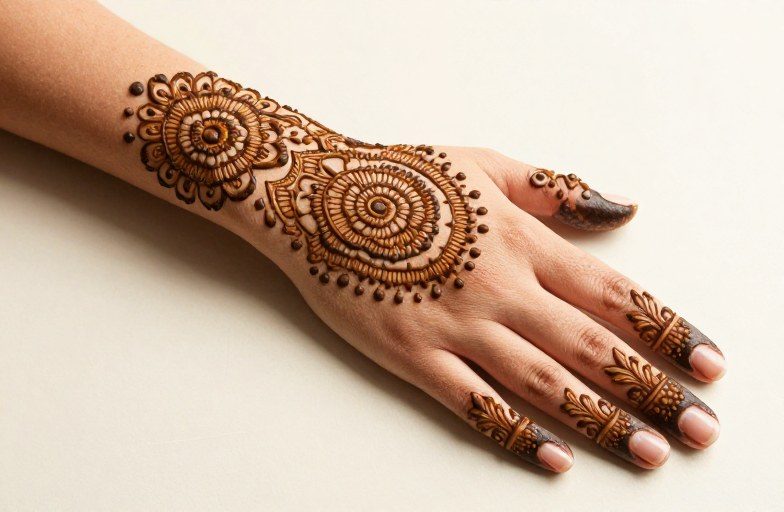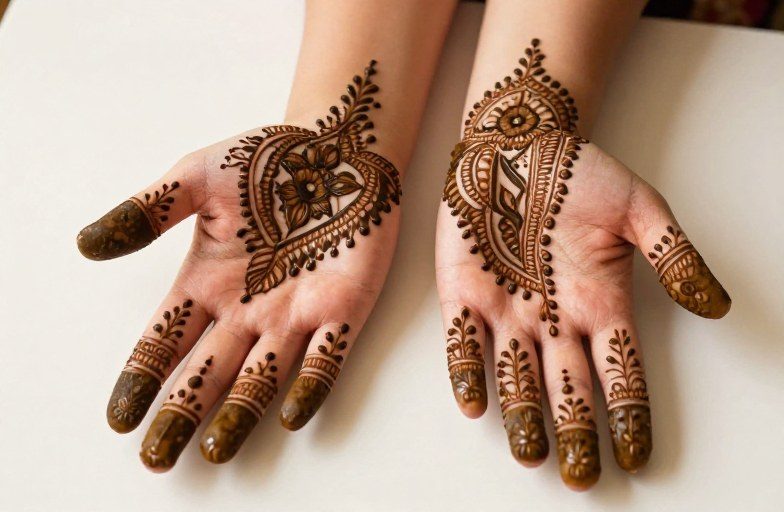
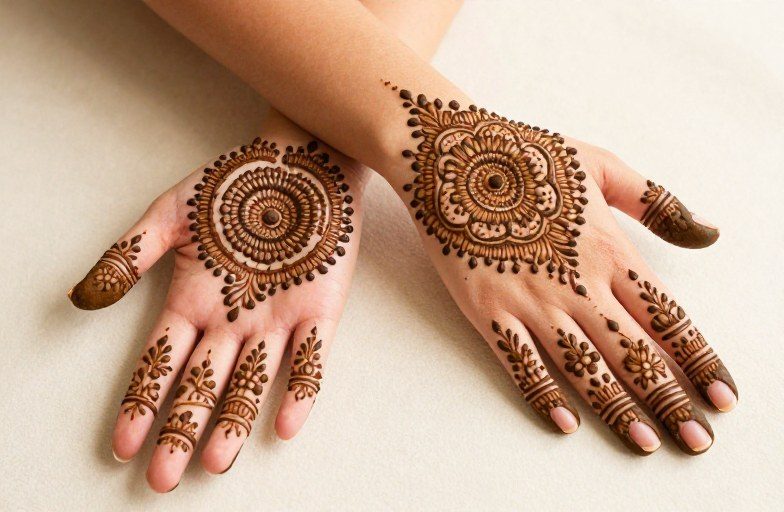
Mandala patterns drawn from mehndi tradition carry a visual logic that predates modern tattooing by centuries. The radial symmetry, the dense dotwork, the way negative space becomes as important as the ink itself, these aren’t decorative afterthoughts. They’re structural necessities. Translating that logic onto skin means respecting how ink ages, how hands and feet move, and how fine lines behave differently in tattoo form than they do in henna paste sitting on top of the epidermis.
For First-Timers
Starting with a mandala mehndi piece means understanding what you’re actually asking for. Henna artists work freehand with paste that stains the skin temporarily. Tattoo artists work with needles and permanent pigment. The visual language overlaps, but the execution diverges sharply.
What Surprises People
The most common shock for first-timers: mehndi designs rely on extremely fine lines and delicate stippling that don’t age well in tattoo form. A henna mandala on a palm might feature hair-thin details that look crisp for two weeks. The same detail in tattoo ink will blur and settle over years. Good artists adapt by building in slightly bolder linework, strategic negative space, and dot clusters rather than individual pinpricks.
Placement matters enormously for first pieces. Palms and soles of feet, the classic mehndi locations, are notoriously difficult for tattoo retention. The skin there sheds rapidly and thickens. Most artists steer first-timers toward the back of the hand, the wrist cuff area, the forearm, or the top of the foot instead. These spots hold ink better and heal more predictably.
Popular Styles
Several distinct approaches have emerged as tattoo artists and clients collaborate on this hybrid form. None are “better”, they serve different preferences and body placements.
- Direct translation: Literal reproduction of traditional mehndi motifs, mango shapes (kairi), floral sprays, peacock elements, arranged in circular mandala structure. Usually rendered in black linework with minimal shading.
- Geometric abstraction: Stripped-down sacred geometry using the mandala’s radial framework but replacing organic mehndi elements with precise mathematical patterns. Think dot mandalas, hexagonal tessellations, concentric circles of decreasing complexity.
- Dotwork/stipple: Entirely built from dot density rather than lines. Creates soft gradients and texture impossible with linework alone. Slower to execute, but ages with remarkable grace if the dots are sized appropriately.
- Fusion with ornamental tattooing: Mehndi-inspired elements flowing into ornamental blackwork patterns, lace, filigree, or dot-and-line frameworks that extend beyond the circular mandala form.
Color vs. Black and Grey
Traditional mehndi is reddish-brown by nature. Tattoo adaptations sometimes incorporate that warmth through sepia or warm brown ink, though most clients choose stark black for longevity. A middle path exists: black linework with selective warm brown accents that will fade faster than the black, creating a living, changing piece over time. That’s a feature, not a flaw, if planned for.
Standout Design Ideas
The most memorable mandala mehndi tattoos do something unexpected with the form rather than executing it faithfully but blandly.
Broken symmetry: A nearly perfect radial mandala with one deliberate disruption, an asymmetrical floral burst, a shifted geometric quadrant, a trailing vine that escapes the circle. The tension between order and organic growth mirrors how actual mehndi application flows on skin.
Negative space mandala: The pattern exists as the un-inked skin, surrounded by dense black fill. From a distance, a dark shape. Up close, a mandala revealed through absence. This demands confident, committed blackwork and heals with less visual degradation than fine positive lines.
Multi-plane layering: Concentric rings that suggest different depths, some floating forward, others receding, achieved through varying line weight, selective shading, and dot density. Creates visual movement without animation gimmicks.
Biomechanical integration: Mehndi motifs emerging from or dissolving into mechanical elements, circuitry, or anatomical structures. A niche choice, but effective for clients wanting to bridge cultural reference with personal symbolism.
Matching & Pairing Ideas
Mandala mehndi pieces pair well with certain companion elements and less well with others. The radial format creates natural connection points.
Complementary Elements
Floral sleeves or half-sleeves: a mandala at the wrist or elbow with mehndi-inspired vines extending toward the shoulder. The mandala serves as a visual anchor, the vine work provides narrative flow.
Ornamental bands: rings around fingers, cuffs at wrists or ankles, that echo the mandala’s detail density without competing for attention. Creates continuity across multiple sessions.
Script or lettering: positioned to interact with the mandala’s geometry rather than float nearby. Text following a circular path, or breaking through the mandala’s edge, integrates where arbitrary placement would clash.
What to Avoid Pairing
Heavy traditional Japanese or bold American traditional imagery adjacent to delicate mehndi linework creates visual warfare. The scale mismatch, the line weight difference, the cultural dissonance, none of these are insurmountable in skilled hands, but they require deliberate bridging elements, not casual adjacency. Similarly, photorealistic portraits adjacent to geometric mandalas rarely resolve successfully without substantial transitional design.
How to Personalize It
Personalization in mandala mehndi work happens through specific motif choices, not through vague “make it mine” requests.
Consider integrating birth flowers into the petal structures, or replacing generic floral elements with plants specific to your region or heritage. Numerology can shape the mandala: eight sections for certain traditions, twelve for others, prime numbers for those drawn to mathematical properties. Some clients incorporate constellation patterns into the dotwork, or map coordinates rendered in microscopic dot clusters within the design’s densest regions.
The most effective personalization I’ve witnessed involved a client who brought her grandmother’s actual mehndi patterns, photographed from old family albums, and worked with an artist to extract motifs, adapt them for tattoo longevity, and arrange them in a mandala structure that honored the source without attempting exact replication. The result was unmistakably hers, not generically “custom.”
Size & Scale
Scale determines everything in mandala mehndi tattoos: what details are possible, how the piece ages, where it can live on the body.
Small (Under 3 inches)
Wrist dots, finger mandalas, behind-the-ear pieces. At this scale, complexity must be ruthlessly limited. Three to five concentric elements maximum. Individual dots rather than dot clusters. These age fastest and blur soonest, plan for touch-ups or accept the softening as part of the form.
Medium (3-6 inches)
The sweet spot for most placements: forearms, shoulders, upper back, thighs. Permits genuine mehndi complexity, multiple ring layers, varied motif types, graduated dotwork. Line weight can vary meaningfully. Shading becomes possible without becoming muddy. This is where most successful mandala mehndi tattoos live.
Large (6+ inches)
Back pieces, chest centers, full sleeves built around mandala focal points. At this scale, the mandala becomes architectural, defining the entire composition’s geometry. Requires substantial sitting time and committed aftercare. The payoff is a piece that maintains readability from distance and rewards close inspection, much like traditional mehndi viewed from across a room versus held in your hands.
What to Remember
Your mandala mehndi tattoo will not look like fresh henna. It shouldn’t try to. The translation between temporary stain and permanent pigment demands adaptation, not imitation.
Line weight matters more than line quantity. A mandala with fewer, slightly bolder lines ages better than one crammed with detail that blurs into visual noise. Negative space is your ally, dense blackwork with breathing room holds up where solid saturation would become indistinct.
Placement determines longevity before any design choice does. The back of the hand, the inner forearm, the calf, these reward your investment. Palms, soles, fingers, and areas of constant friction will need more frequent maintenance and may never achieve the crispness possible elsewhere.
Finally, the artist’s familiarity with ornamental tattooing matters more than their general skill level. A brilliant portrait artist may struggle with the precise, meditative linework these pieces demand. Look for portfolios showing sustained ornamental or geometric work, not one or two mandala attempts among dozens of unrelated styles.
Frequently Asked Questions
How long does a mandala mehndi tattoo typically take to complete?
A medium-sized piece runs 3-5 hours depending on complexity. Large back pieces or dense ornamental work can require multiple sessions. Dotwork especially adds time since each mark is individually placed rather than drawn in continuous lines.
Will the fine lines in a mandala mehndi tattoo blur over time?
Yes, all tattoos spread slightly as skin ages, but well-executed lines with appropriate weight and spacing maintain their structure for years. Extremely fine details, under 1mm, will blur faster. Good artists build in slightly bolder linework than the reference henna might suggest.
Can I get a mandala mehndi tattoo if I’m not from South Asian heritage?
The mandala form itself appears across numerous cultures and religious traditions. Mehndi-specific motifs carry more cultural weight, so approach with respect, research meaning, avoid sacred symbols used in active religious practice, and consider working with artists who understand the tradition rather than treating it as generic decoration.
What’s the typical healing process for a dotwork-heavy mandala?
Dotwork heals similarly to linework but can appear patchy during the first two weeks as individual dots scab and settle. The overall pattern usually resolves clearly by week three. Avoid picking at raised dots during healing, as this pulls pigment unevenly.