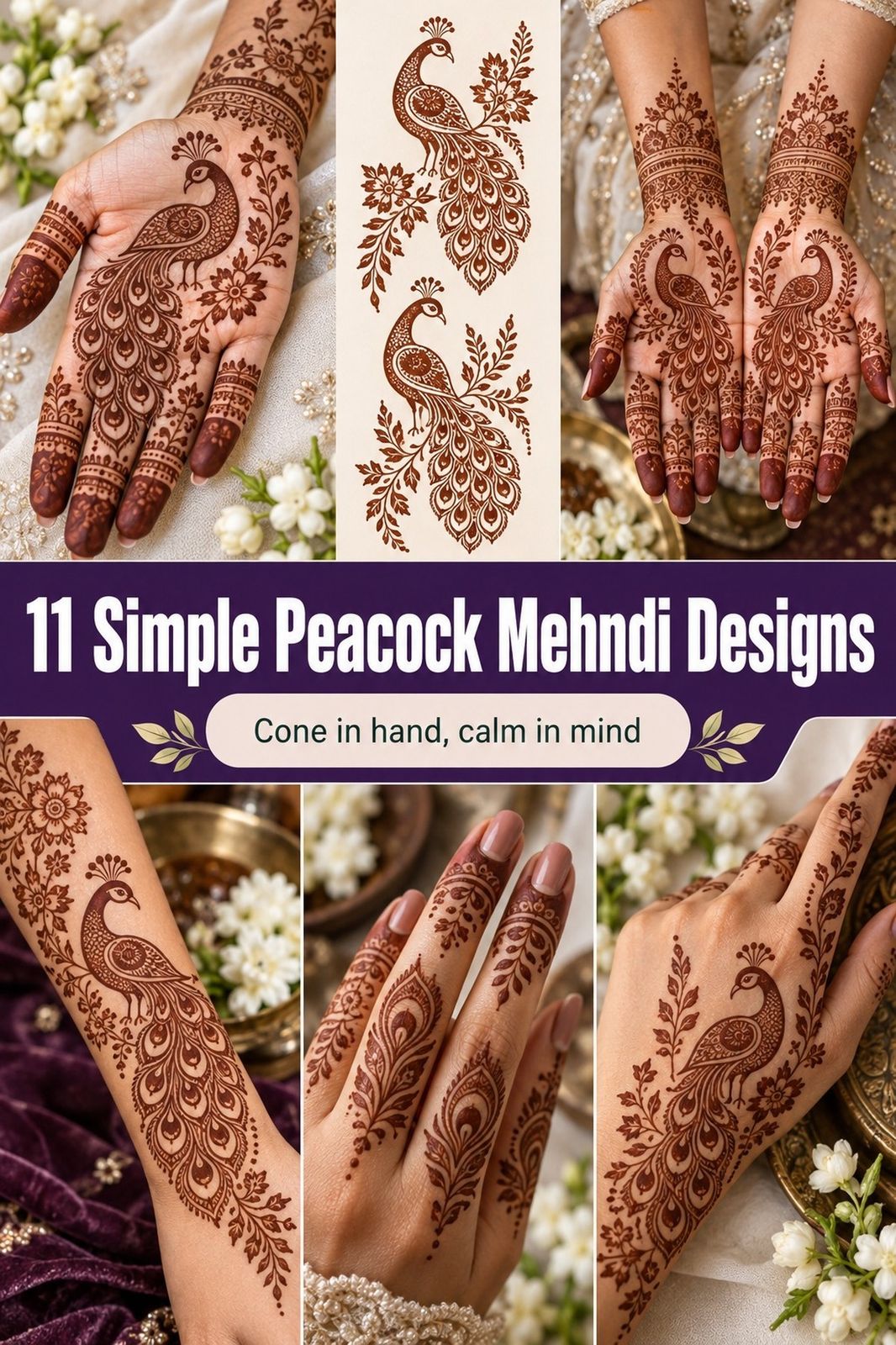
Simple peacock mehndi designs can work beautifully as tattoos when the feather rhythm stays open and the lines have room to breathe. I once crowded a peacock tail into a tiny palm piece, and the details blurred together. You don’t need more ornament. You need deliberate spacing, a clear silhouette, and an artist who understands how fine-line tattooing ages.
Start with your placement, your budget, and the meaning behind the bird. I’d bring a few references to a custom tattoo consultation and ask whether the idea will still look expressive after healing.
- Simple Peacock Mehndi Designs for Hand Palms
- How Can Finger Designs Stay Dainty?
- Let the Wrist Carry One Flowing Curve
- Backhand: The Three-Leaf Rhythm
- Why Does a Forearm Need More Air?
- Latest Simple Peacock Mehndi Linework
- Bold Arabic Patterns, One Dominant Feather
- Bridal Designs: Mirror the Meaning, Not Every Detail
- The Symbolic Feather
- Build the Anklet Around the Bone
- When Should a Peacock Enter a Mandala?
1Simple Peacock Mehndi Designs for Hand Palms
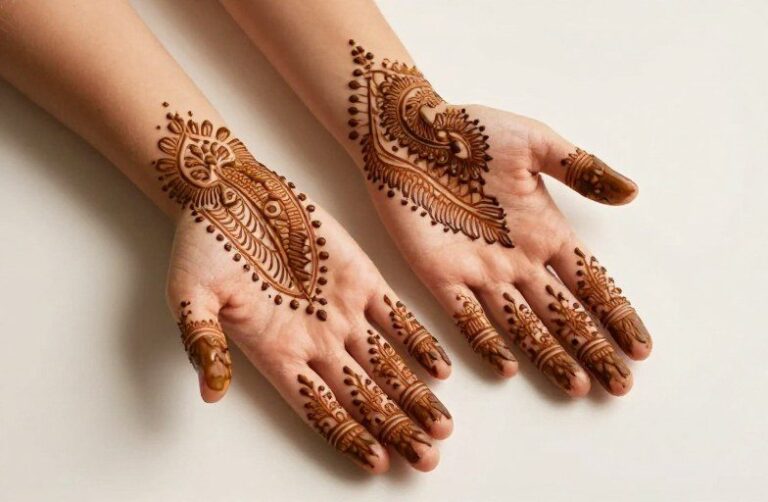
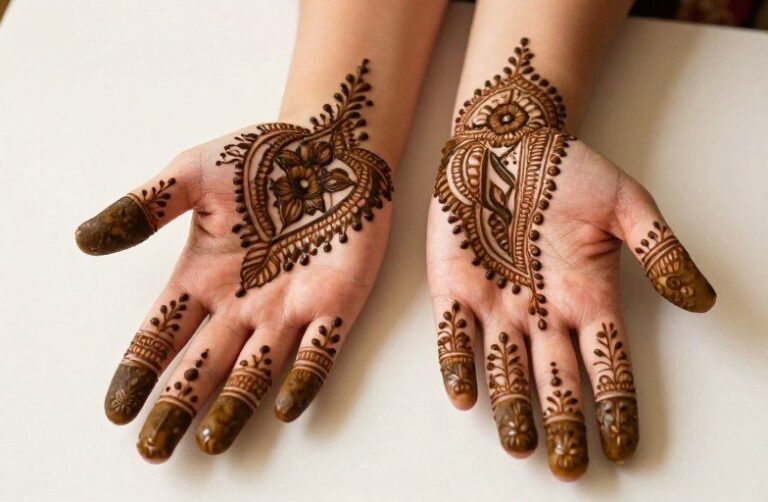
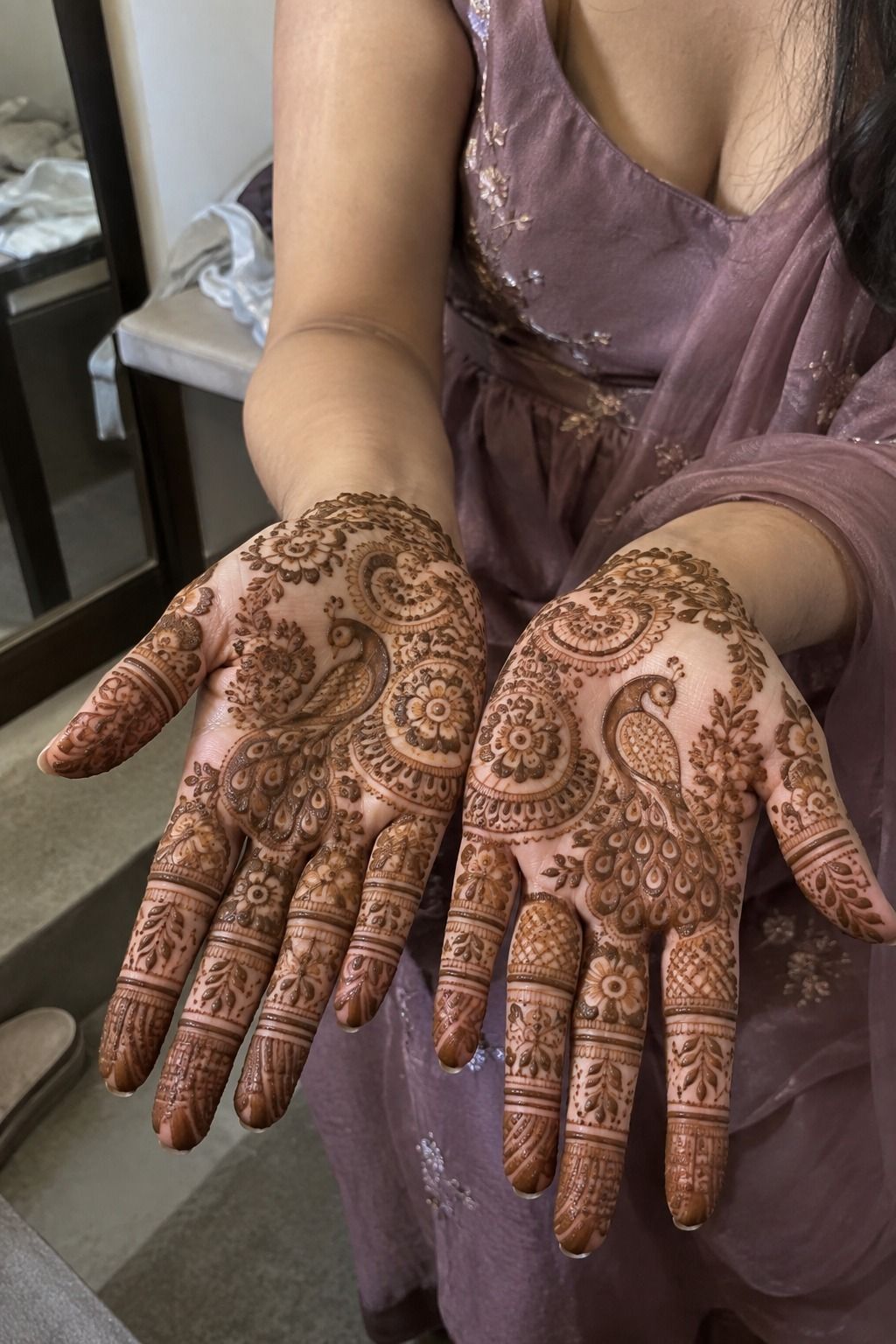
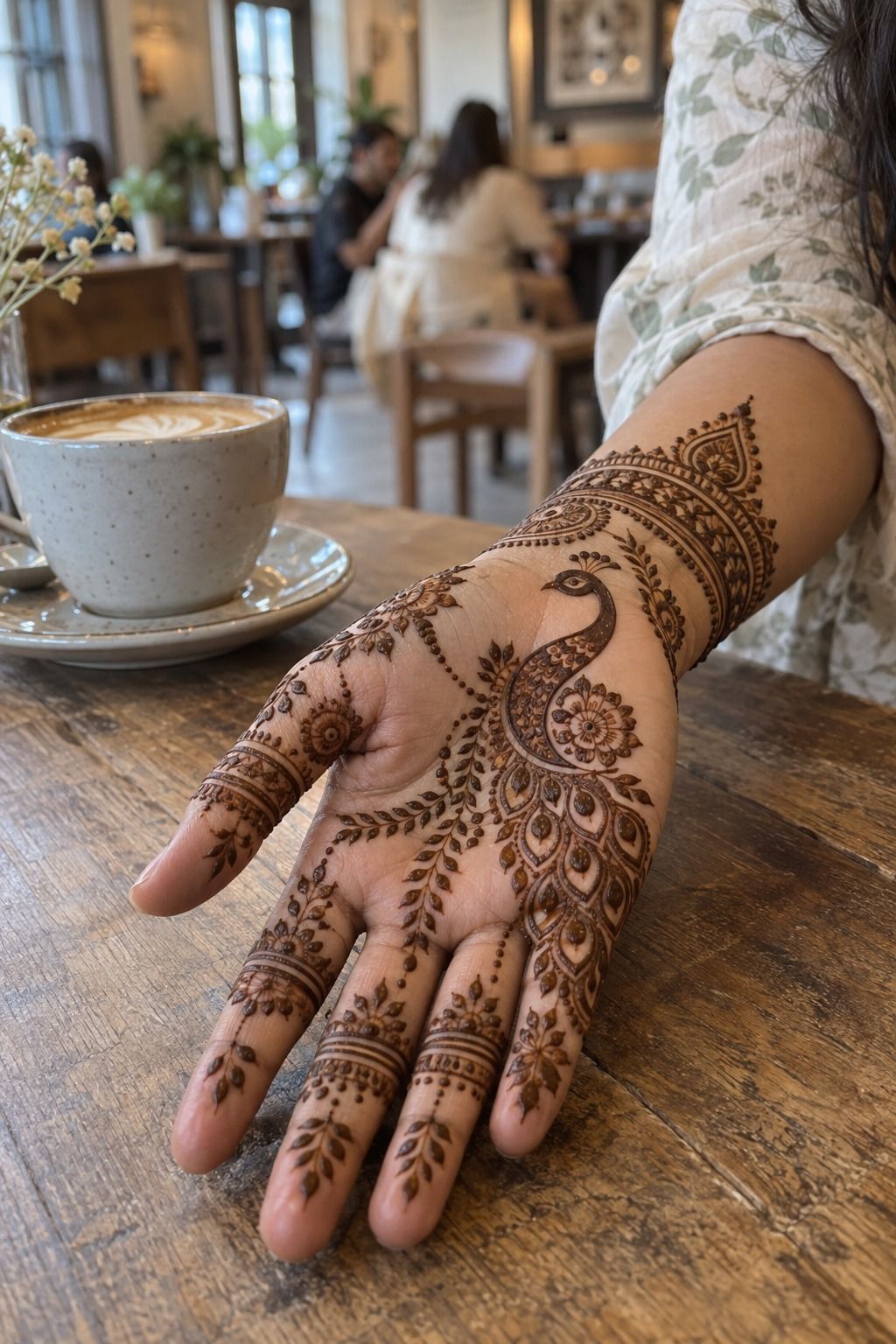
For simple peacock mehndi designs for hands, start with one graceful bird curving across the palm instead of filling every inch. I prefer a small eye, a curved neck, and three or four feather eyes. That’s enough for a striking centerpiece.
I’ve seen palm tattoos lose their edge when every feather receives dots, vines, and scallops. You don’t need dense filler near the thumb pad. Your palm moves constantly, and the skin can be unforgiving.
Use the Open Palm Ratio: roughly one-third focal bird, one-third negative space, and one-third supporting linework. You don’t need to measure it with a ruler, but your artist should sketch the balance first. A palm tattoo placement should support the silhouette, not swallow it.
A 0.35 mm single-needle cartridge can create delicate lines, though I’d choose a slightly stronger outline for this high-contact area. Your artist should explain how friction, washing, and natural fading may affect the final result.
If you’re planning a larger hand collection, compare the spacing with these simple palm mehndi tattoo ideas and these simple front-hand mehndi tattoo designs. The palm can feel meaningful, but you’ll need realistic expectations about touch-ups.
Ask what the touch-up policy includes before booking. That’s worth it!
2How Can Finger Designs Stay Dainty?
Finger placement makes a peacock feel dainty and intimate, especially when the bird’s neck follows the side of one finger and the tail points toward the knuckle. Your tattoo version should simplify the movement into a few polished strokes. A fine blackwork liner gives the design a sharp outline without turning every curve heavy.
Try the Peacock Spine Rule: one continuous curve should guide your eye from the bird’s head through its back and into the first feather. Your fingers already create breaks, so extra vines can make the composition look chopped. I wouldn’t copy a full bridal pattern here.
A tiny crown, two dots, and one open feather eye can feel more meaningful than twelve miniature details. If you’re choosing between the side of the finger and the top, I’d choose the top for visibility and the side for a quieter mark. Black tattoo ink will usually read more clearly than pale brown after repeated washing.
Your artist should show healed finger work, not only fresh photographs. Fingers fade faster because of friction, sun, and frequent washing, and you may need a refresh later.
For another restrained placement reference, browse these simple stylish mehndi designs for the front hand. You can also ask whether the finger touch-up cost is separate from the original session.
A finger tattoo can be playful and elegant, but its value depends on how well it survives daily use. I’d keep the design minimal if you want a crisp result.
3Let the Wrist Carry One Flowing Curve
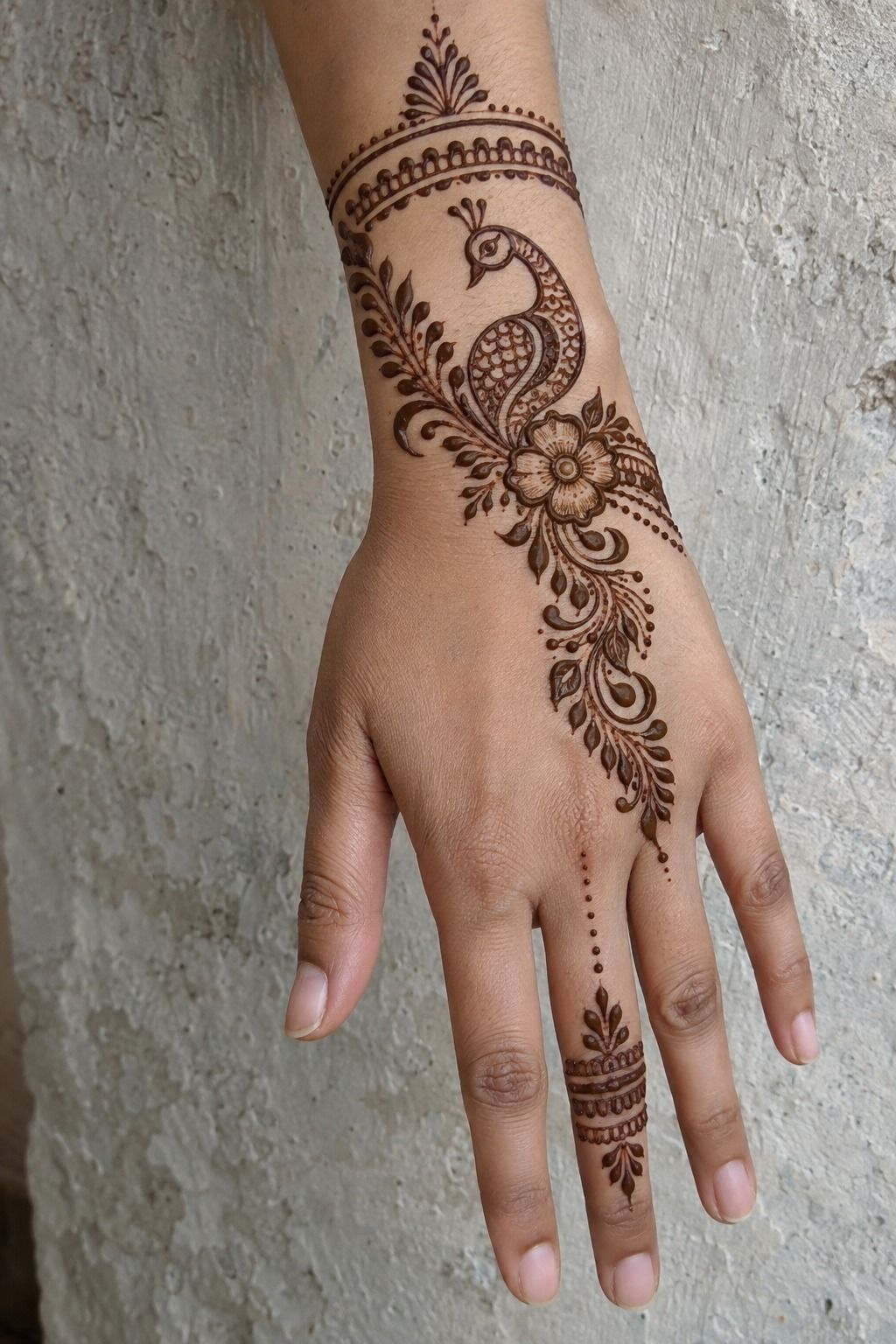
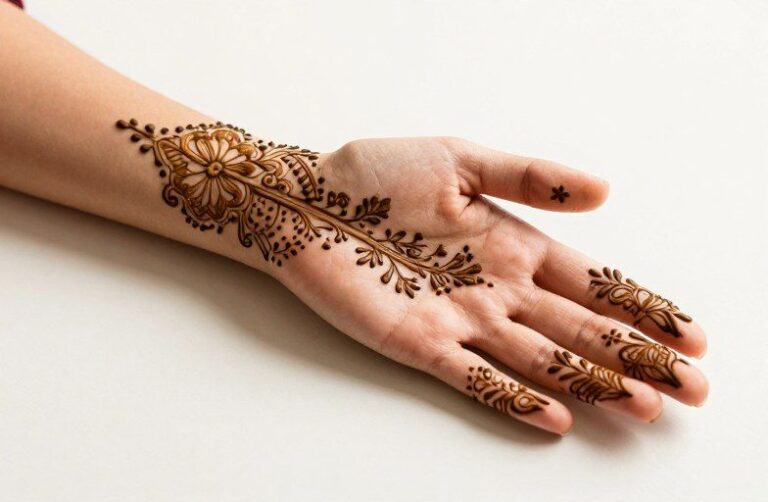
A wrist peacock works best as a small flowing emblem, with the head turned toward the hand and the tail ending before the forearm becomes visually busy.
4Backhand: The Three-Leaf Rhythm
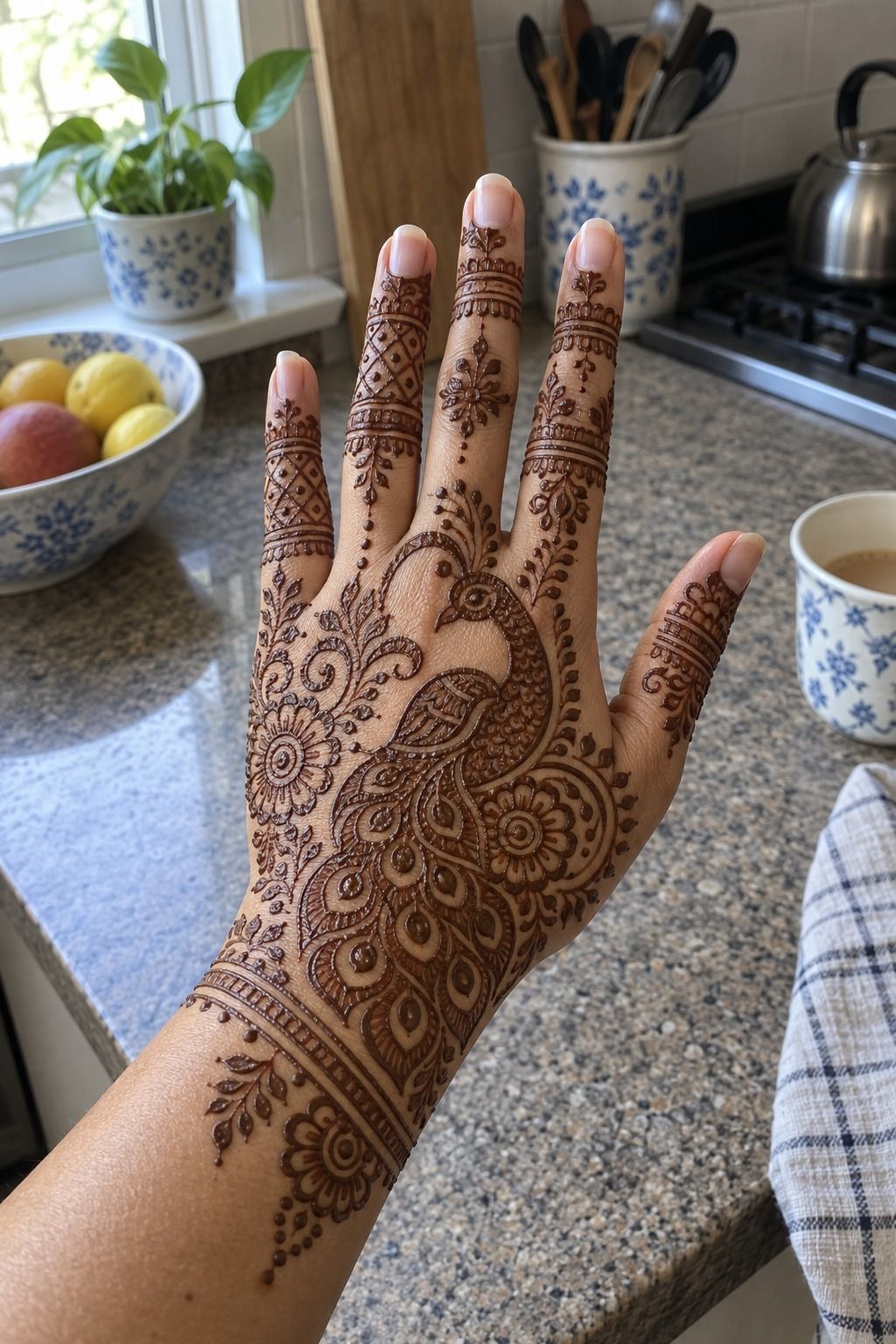
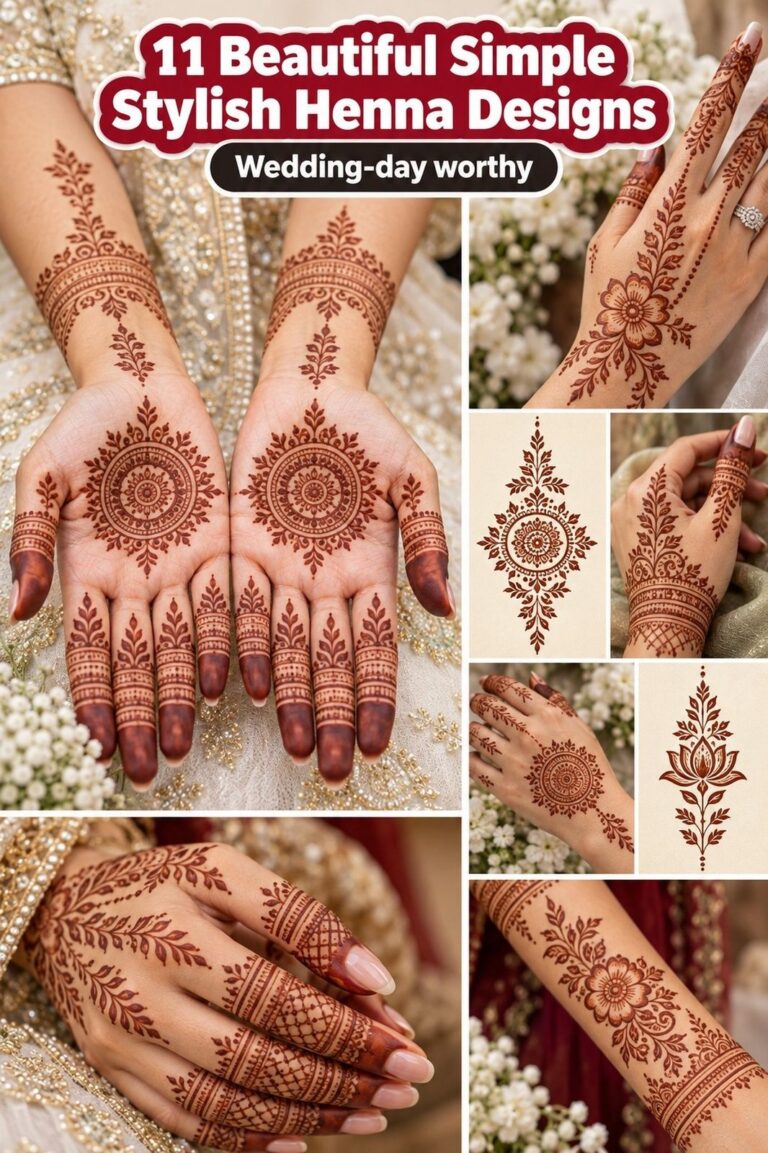
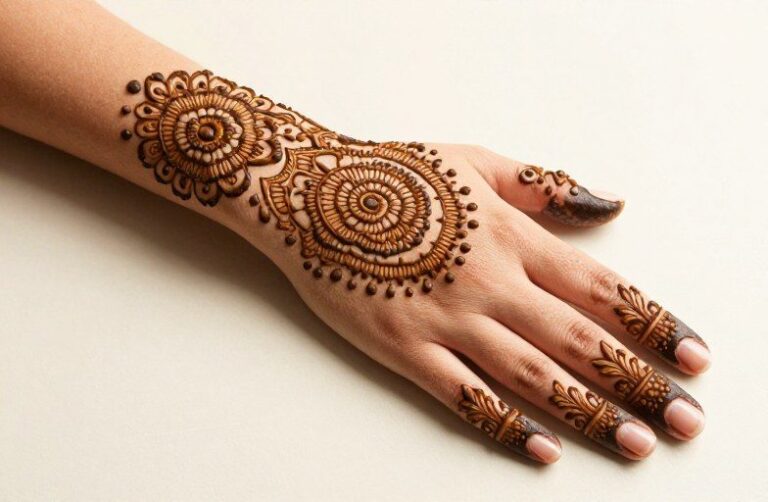
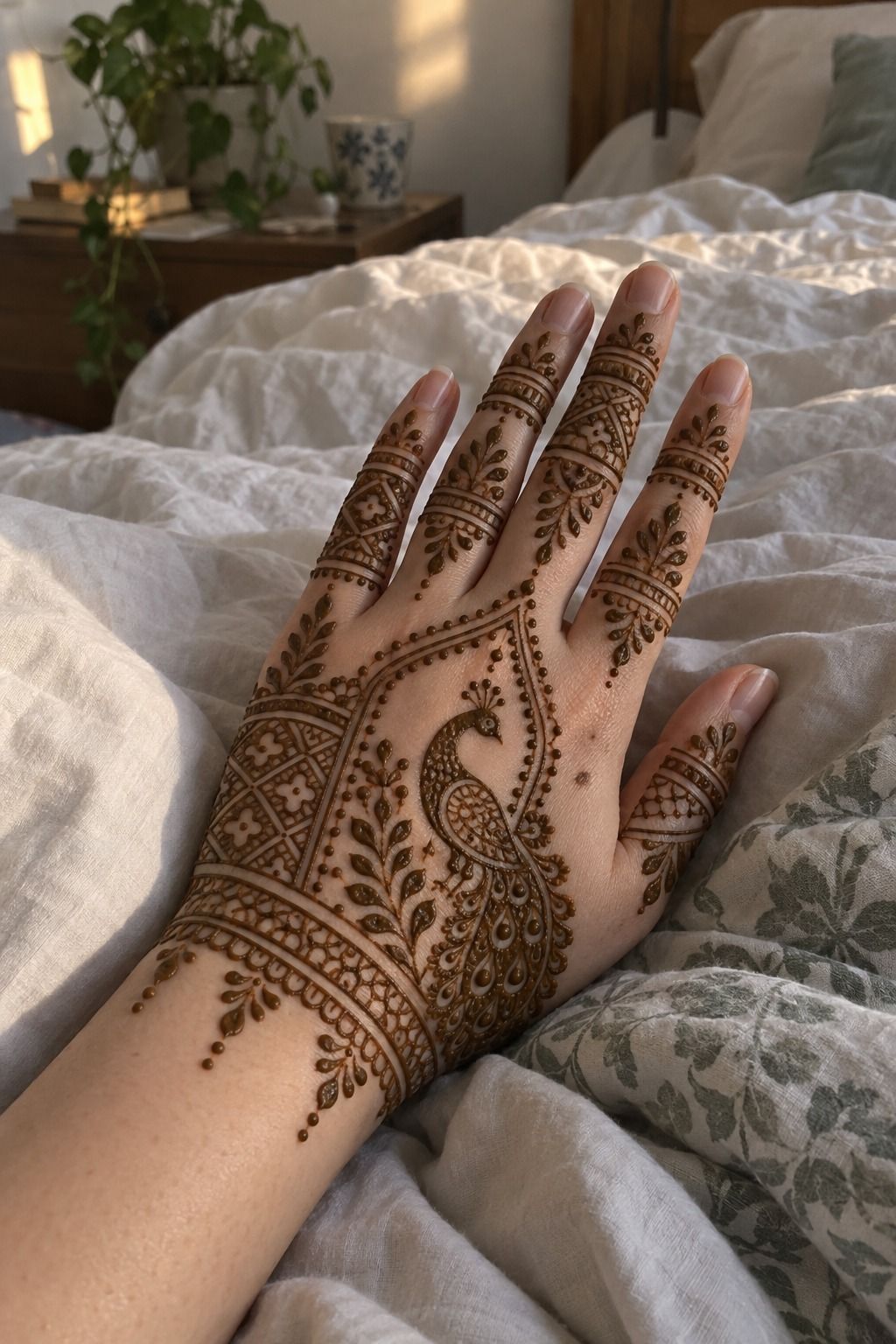
The backhand gives you more visual room than the fingers, so an intricate peacock can spread across the knuckles without becoming full coverage. Start with the head, body, and largest feather, then add smaller leaves only where your hand still has open skin. A smooth black outline should anchor the design.
Build outward from the bird. The Three-Leaf Rhythm is my preferred guide: one large leaf, one medium leaf, and one tiny leaf repeated no more than twice. More repetition makes the pattern predictable and heavier.
You’ll want your artist to check the design with your fingers relaxed, spread, and curled. A composition that looks balanced on a flat stencil can shift when your hand closes. Healed blackwork photography is more useful than a fresh portfolio image because it shows whether the crisp details stayed crisp.
I’d choose a selective ornate pattern over total coverage. Your backhand already has strong lines from the knuckles, and covering every gap can hide the peacock’s silhouette.
For more inspiration, save these simple full-hand mehndi tattoo examples and these simple stylish mehndi designs for the front hand. The backhand can look fierce and polished without demanding a large glove-style tattoo.
Discuss the coverage limit with your artist before the stencil is finalized. You’ll get a more daring result when every added mark has a purpose.
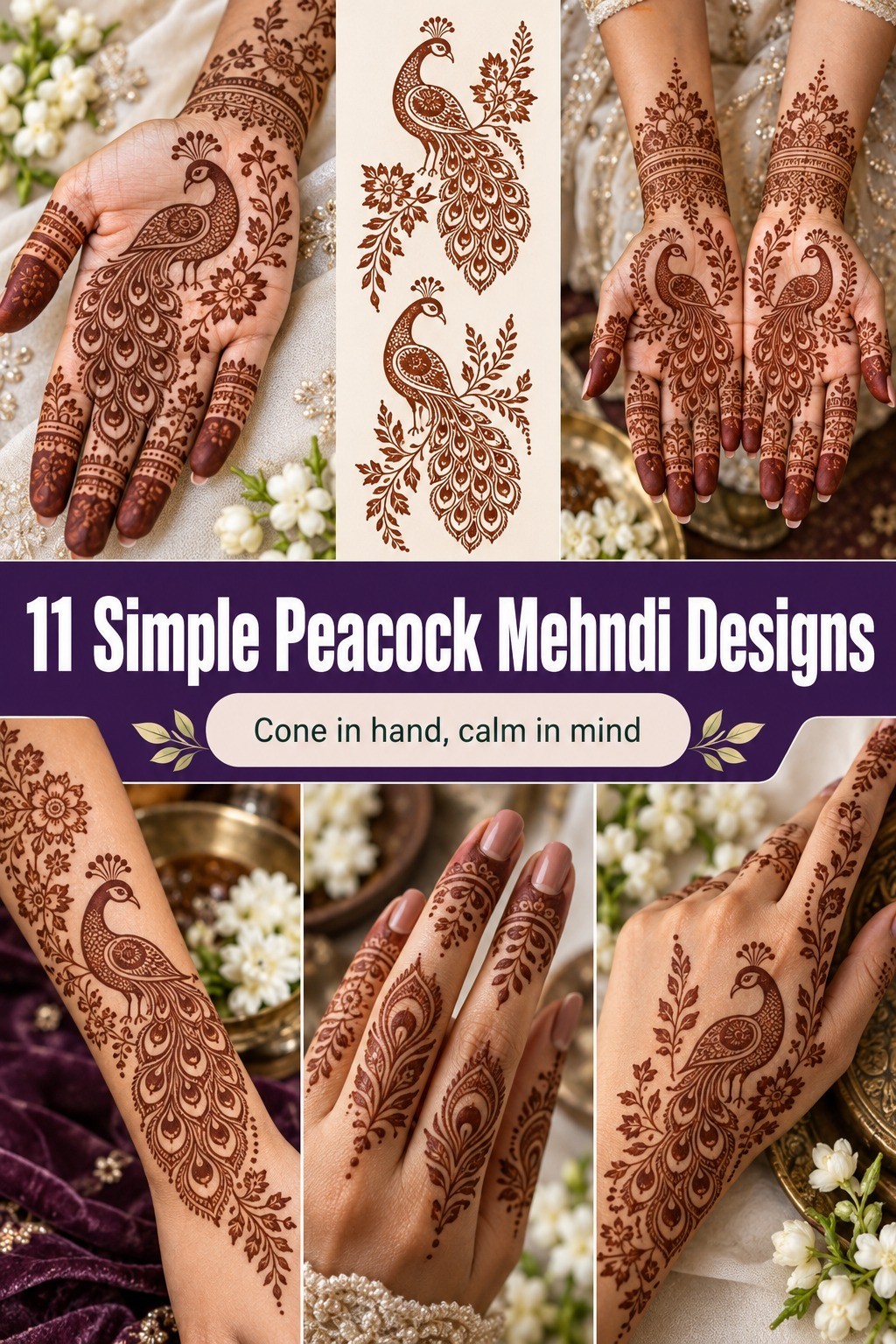
5Why Does a Forearm Need More Air?
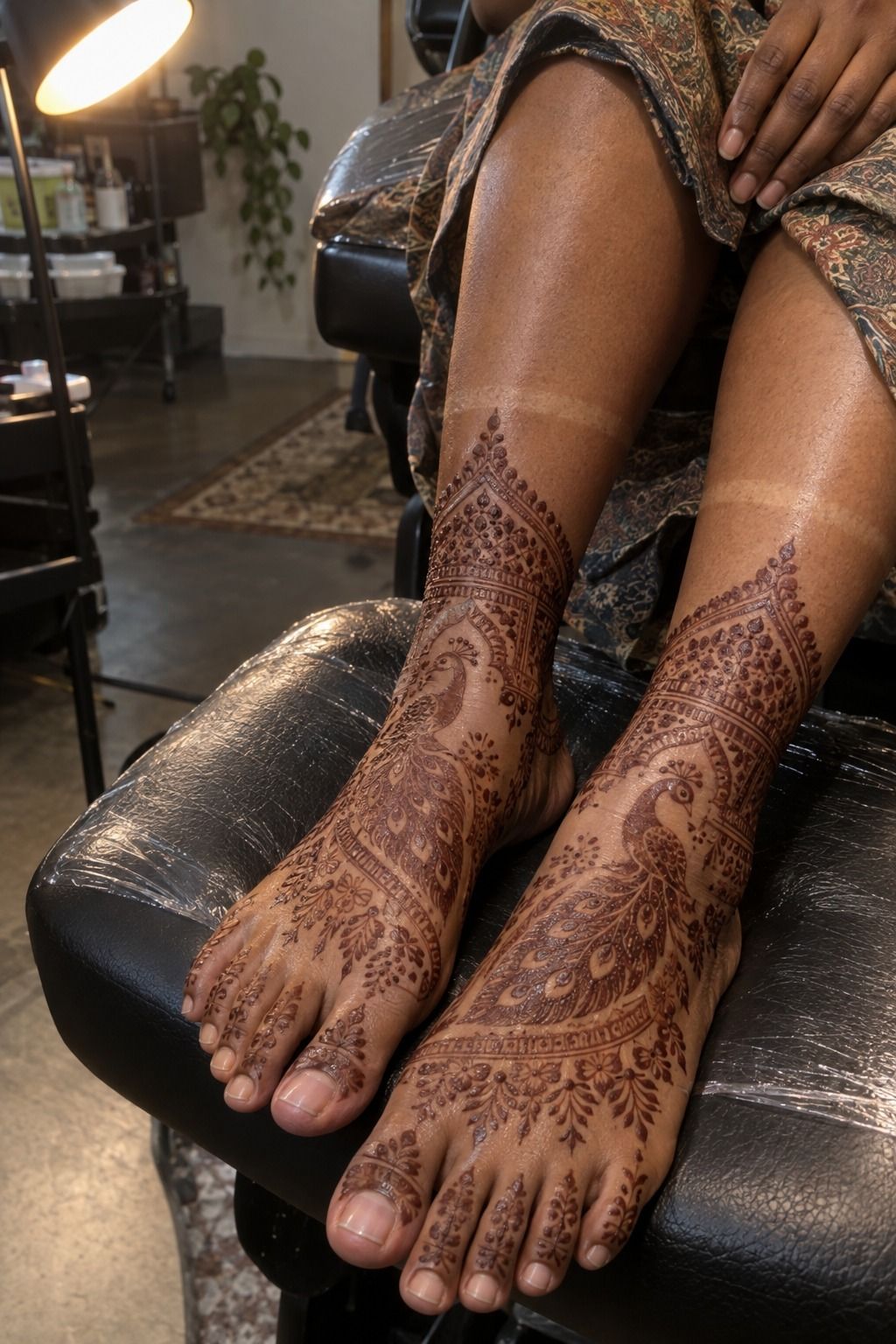
A forearm gives a flowing peacock enough length to develop a neck, body, and feather fan without compressing the details.
6Latest Simple Peacock Mehndi Linework
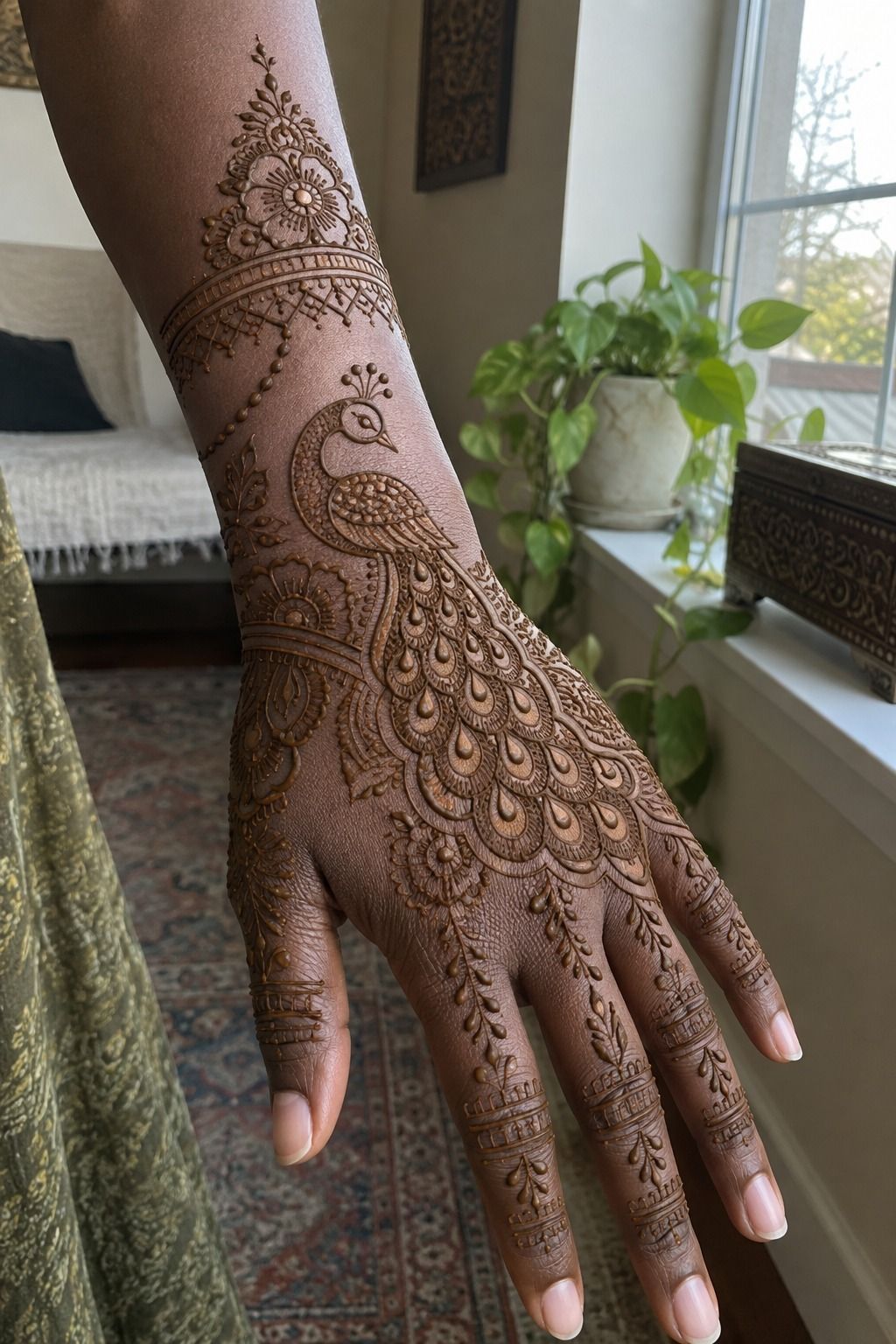
The latest simple peacock mehndi designs tend to use cleaner contours, fewer filled shapes, and more intentional breaks between feathers. The goal is stylish linework that remains readable after healing. A solid black anchor line gives the design structure.
The Feather Ladder is a useful approach. Place one large feather near the bird, two medium feathers beneath it, and a small final mark at the end of the curve. This creates rhythm without turning the tail into a solid fan.
Fine lines can look crisp at first and widen slightly as skin ages. That doesn’t make them a bad choice, but you should leave sensible gaps between parallel strokes. Your artist may recommend a 3RL tattoo needle for delicate sections and a stronger liner for the outer contour.
Don’t judge a portfolio only by dramatic studio lighting. Ask for healed daylight photos, then compare line strength and spacing. I’d rather see an ordinary photograph than a perfect fresh close-up.
You can also study these simple full-hand mehndi tattoo examples before deciding how much coverage suits you. The best linework feels modern, crisp, and personal without chasing novelty.
If the artist charges more for healed-detail work, I’d consider the added price worthwhile. You’re paying for judgment, not just needle time.
7Bold Arabic Patterns, One Dominant Feather
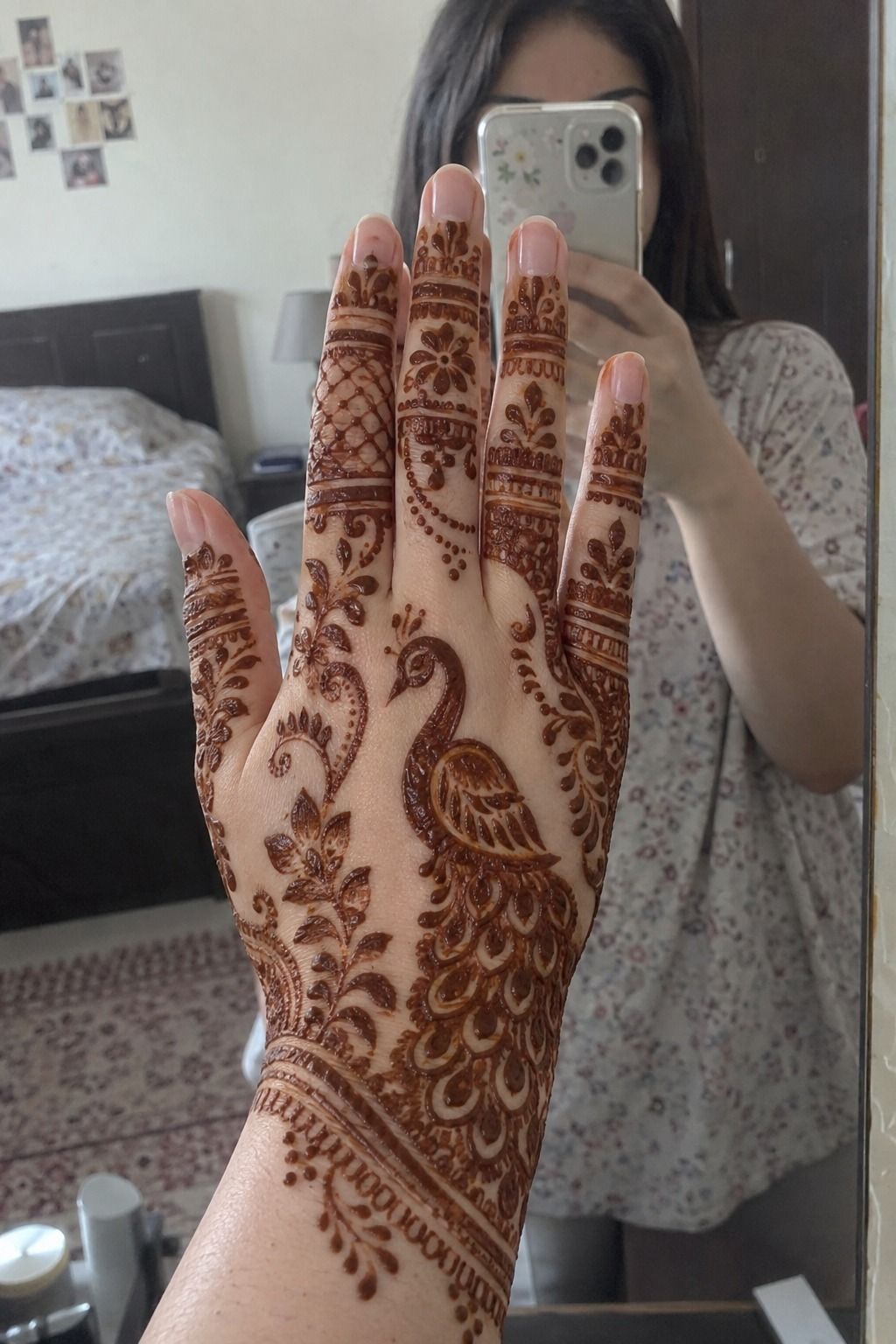
Arabic-inspired structure gives a peacock tattoo a bold silhouette through sweeping vines, open leaves, and one dominant feather fan.
8Bridal Designs: Mirror the Meaning, Not Every Detail
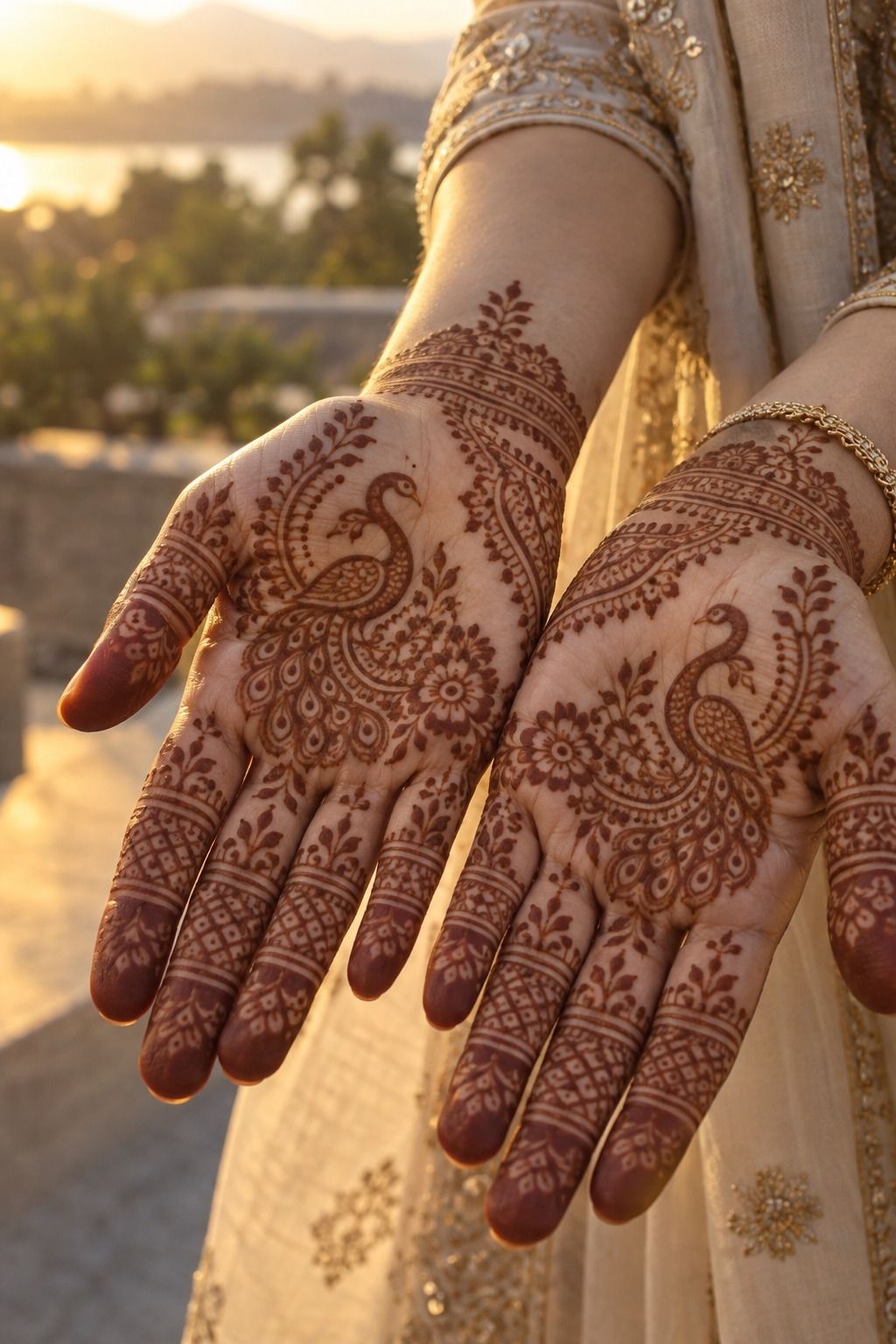
A bridal peacock design can stay dainty when the bird is treated as a symbolic centerpiece instead of a full ceremonial map. Choose one detail that means something to you, such as a paired feather, a small crown, or a vine that curves toward another motif. A fine-line black outline can preserve that lightness.
The Romantic Pairing Rule keeps two tattoos related without making them identical. Your designs can mirror direction while using different feather counts. That feels more personal than tracing the same pattern twice.
I’d avoid copying temporary mehndi paste exactly. Henna can hold tiny details for a short celebration, while tattoo ink stays in the skin and needs more room to age. Stencil transfer paper lets your artist test scale and placement before committing.
A hand tattoo can be meaningful, empowering, and highly visible. It can also be harder to conceal at work and more exposed to sun and washing. You’ll want to think through that tradeoff before booking.
For a softer companion placement, browse these simple wrist mehndi tattoo designs. A romantic result doesn’t need to become overly ornate.
Set a paired-tattoo budget before the appointment so the design stays realistic. I’d rather simplify the second tattoo than force both pieces into unsuitable placements.
9The Symbolic Feather
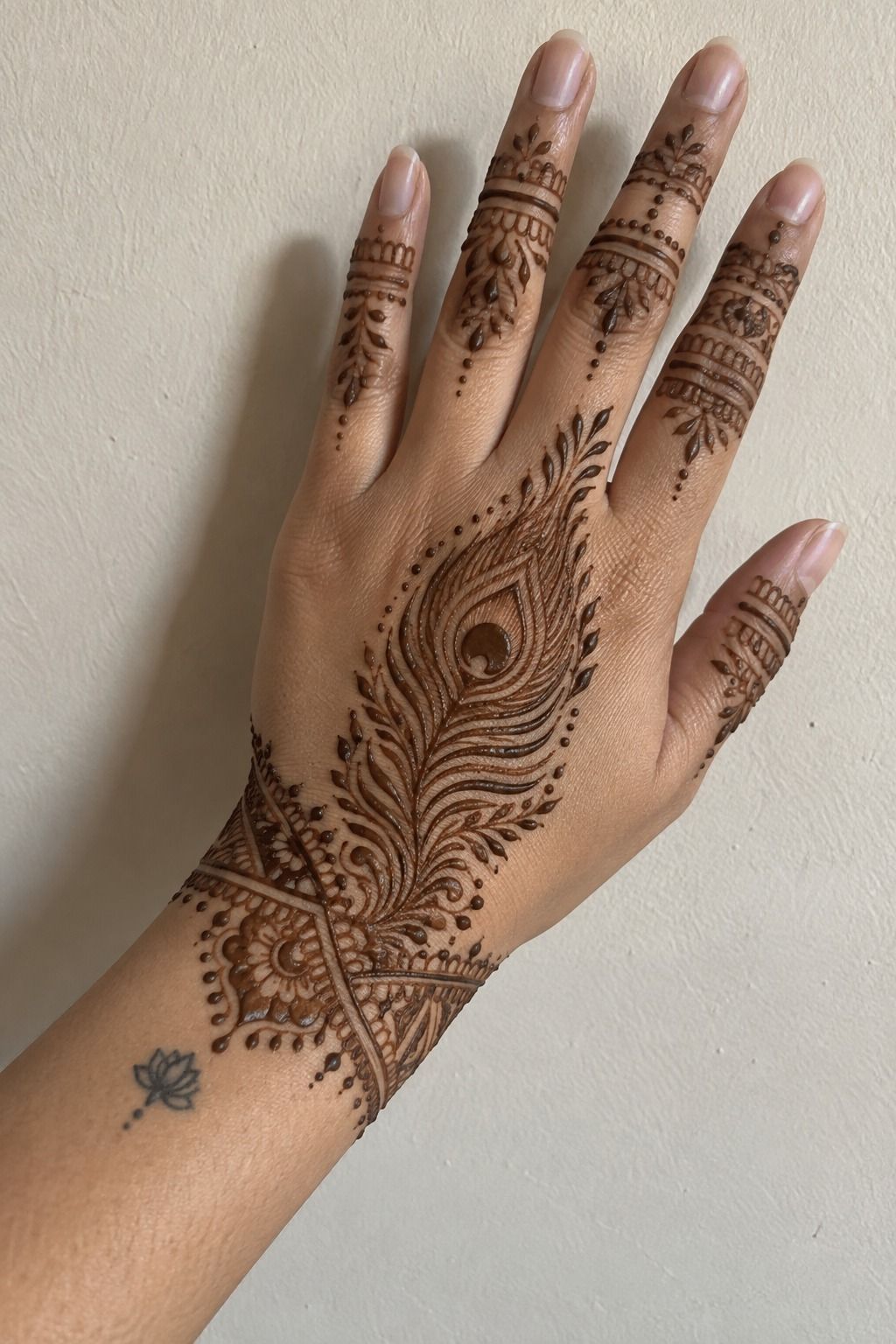
A feather-focused design works when you want the peacock’s symbolism without a full bird. A few curved eyes can suggest the whole animal, while a peacock feather outline gives your artist a recognizable starting point.
Decide what the feather means before choosing decoration. For some people it suggests renewal, protection, pride, or a connection to family. Your reason doesn’t need to be explained to everyone who sees it.
I’d choose a single feather with one expressive eye over a stack of identical feathers. Repetition can flatten the emotional point, while one sharp motif feels more meaningful.
The Symbolic Feather Rule is simple: one central eye, three supporting curves, and a tip that points toward your chosen direction. It creates an iconic shape without requiring a large tattoo. Muted brown tattoo ink may look romantic at first, but ask how that pigment behaves after healing on your skin.
Placement changes the message. A wrist feather feels intimate and visible, while an ankle feather can feel more private and grounded. For a longer vertical composition, look at these simple foot mehndi designs.
Ask about pigment longevity before choosing a softer color. You’re choosing how the symbol will age, not just how it looks on appointment day.
10Build the Anklet Around the Bone
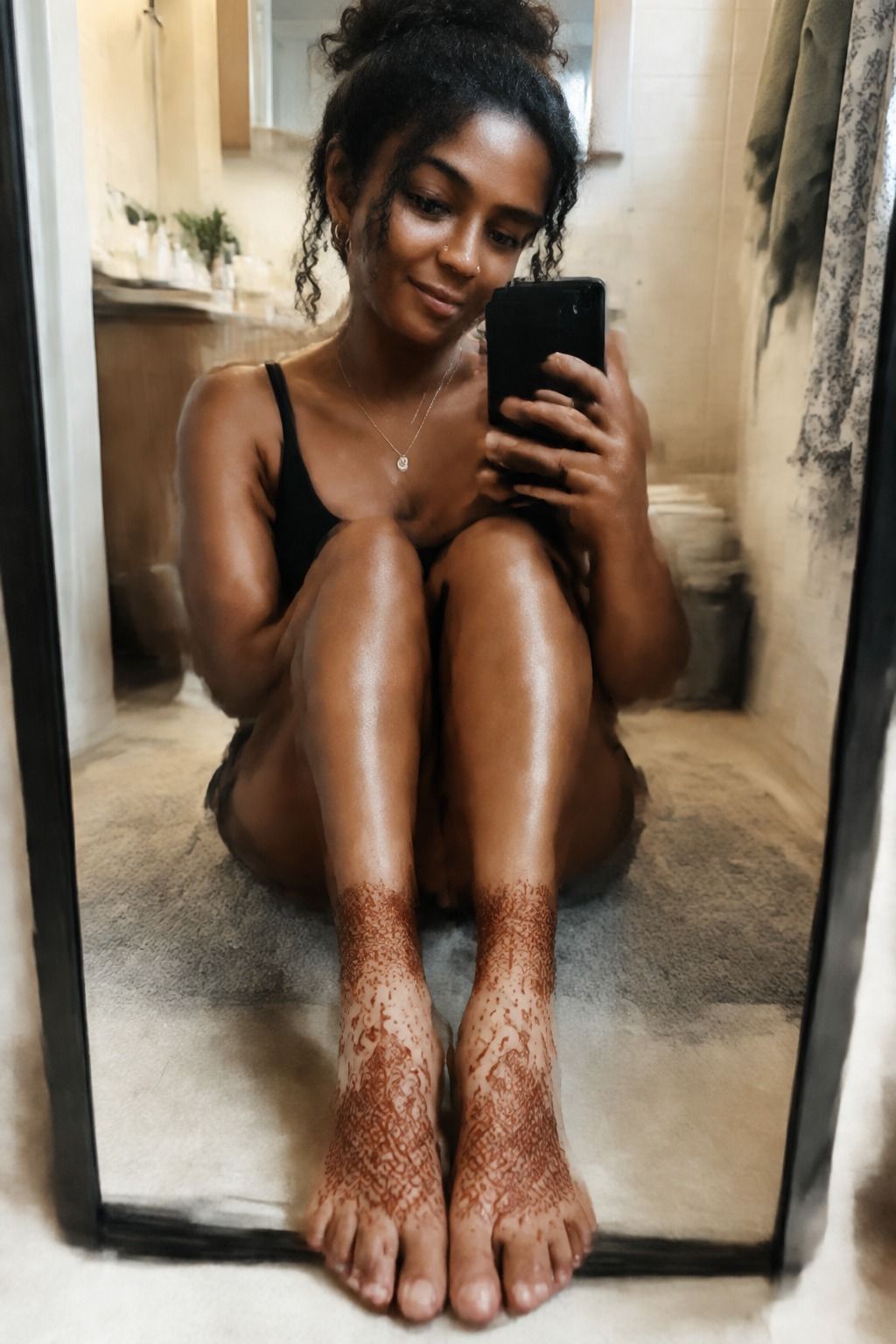
An anklet composition can borrow the peacock’s curves without pretending the ankle is a flat page. The ankle needs a simpler band, a small bird, or one feather that follows the bone. A black ankle contour gives the design a crisp visual edge.
You’ll want to decide whether the peacock faces inward or outward. Inward feels more personal when you look down, while outward reads more clearly to others. I prefer an offset bird with a small gap at the back of the ankle.
Feet and ankles can be sensitive, especially over bone. Ask your artist about a session plan and whether the design should be completed in one appointment. 3RL fine-line inkwork can make delicate marks, but the outer silhouette still needs enough strength for long-term clarity.
Aftercare matters because shoes and socks can rub a fresh tattoo. Keep the area clean, follow the studio’s healing directions, and avoid swimming while the surface heals. Protect it!
For another placement option, compare the vertical rhythm with these simple foot mehndi designs. The ankle can look elegant and feminine when the band isn’t too tight.
Ask for the ankle-session price rather than assuming size tells the whole story. I’d also ask whether a touch-up is priced separately.
11When Should a Peacock Enter a Mandala?
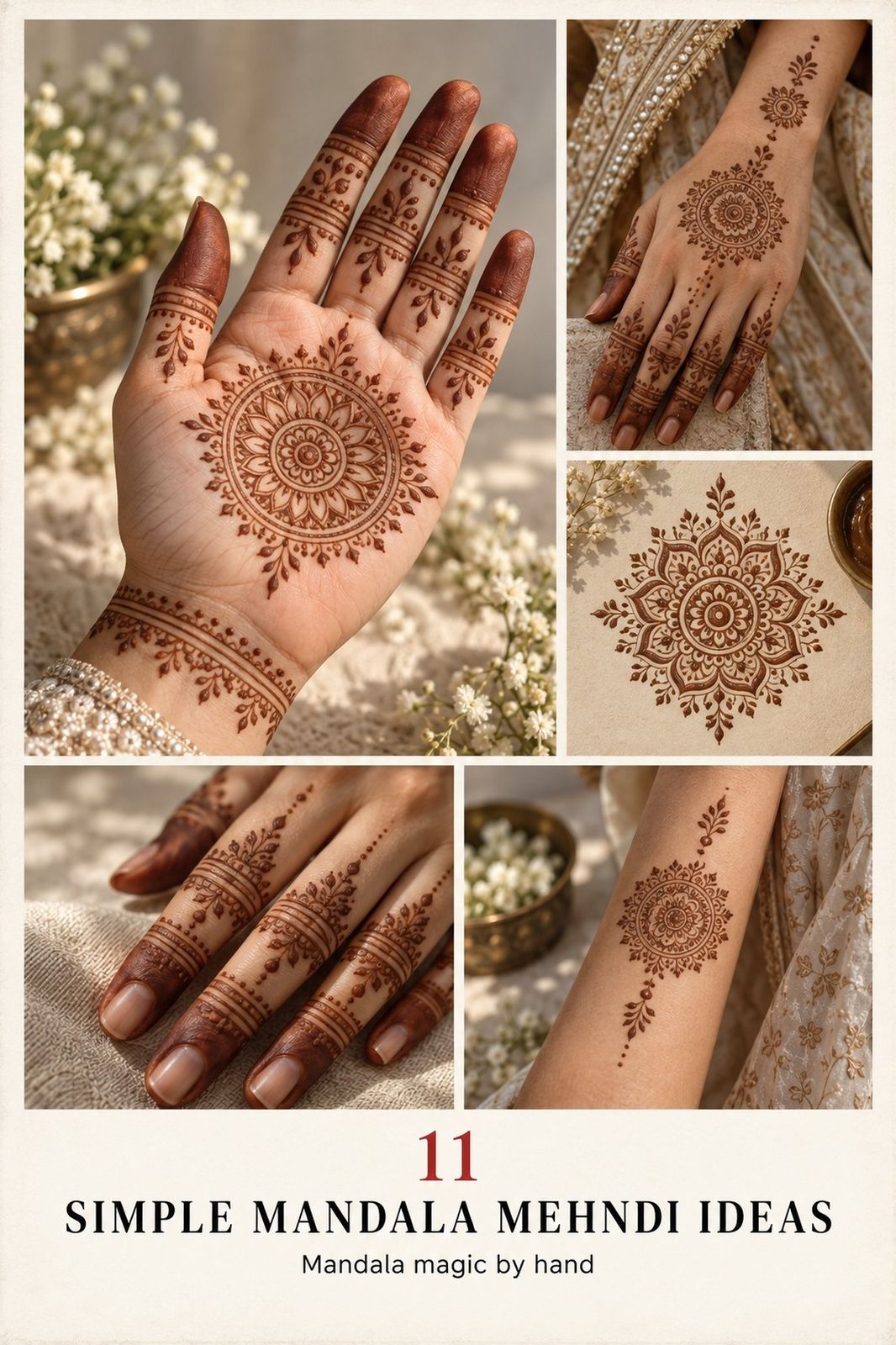
A mandala composition gives the peacock a centered, balanced structure, especially when the bird sits inside a circle of petals and open feather eyes. Your artist can adapt the geometry to a palm, wrist, or forearm. A fine circular stencil helps keep the center even.
Start with the peacock, then build the mandala around it. If you begin with too many rings, the bird can become an afterthought. The Four-Ring Pause works well: bird silhouette, open ring, petal ring, then a final dotted border only if the size allows it.
Mandala lines need room, particularly when the design is small. A three-inch piece can hold more than a one-inch piece, but your artist should judge the detail against the placement. Bold blackwork shading may define the central body, while lighter linework can keep the outer petals distinct.
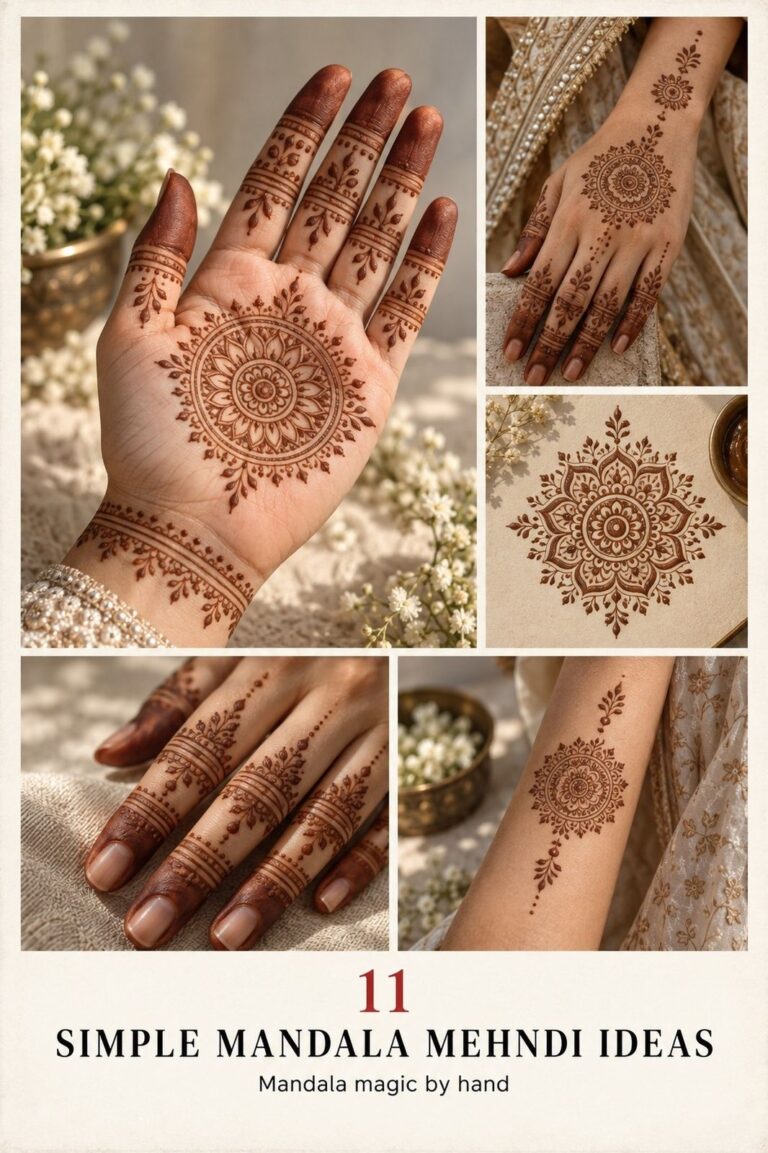
Don’t assume symmetrical means lifeless. Small differences in feather direction can make the design feel hand-drawn and personal. You can compare the circular structure with these simple mandala mehndi designs.
If you’re choosing one idea from this list, this composition is the most graceful option for someone who wants order without visual clutter. The design is worth the cost only if the center remains readable after healing.
Ask about mandala healing clarity before you book. I’d rather enlarge the piece slightly than lose the feather eyes.
The Tattoo Decision I’d Make Before Booking
I’ve learned that a peacock tattoo succeeds or fails before the needle touches skin. The decisive moment is the sketch review, when you can see whether the bird has a readable body, whether the feathers have enough space, and whether the placement matches your daily life. A healed tattoo portfolio tells you far more than a perfect fresh photograph.
Start with placement, then size, then detail. If you put an intricate design on a high-friction area, the artist may need to simplify it.
That isn’t a compromise in quality. It’s a smarter match between artwork and skin.
I’m firmly against choosing an artist only because their flash sheet looks ornate. Look for clean linework, consistent circles, healed examples, and photographs across different skin tones.
A sterile needle cartridge is standard studio equipment, but hygiene is bigger than a single product. Trust the healed result!
Write down what you want the peacock to express. I’d use words such as sacred, personal, or protective, then let the artist translate that feeling into shape.
Before Booking, Check the Readability
Ask to see the stencil from standing distance and from your normal viewing angle. A feather that looks expressive up close may disappear when the tattoo is viewed from across the room. Your stencil placement check should happen before the session begins.
Look for one clear focal point. If your eye jumps between the bird, vines, dots, and petals, the design needs editing. A minimal tattoo can still feel intricate when every line has a job.
You can save a few references from these simple palm mehndi tattoo ideas and ask your artist which details will survive. I’d trust a clear explanation more than a promise of perfect permanence.
Match the Detail to Placement
Your artist should adjust line density according to friction, movement, and exposure. Fingers, palms, feet, and ankles need stronger decisions than a protected upper arm. A placement-specific line plan can prevent disappointment later.
Don’t pay for detail your skin can’t hold. The best value comes from choosing a scale that supports the design rather than forcing every reference mark into a tiny area.
If you’re unsure, compare a forearm idea with these simple wrist mehndi tattoo designs. You’ll see how the same flowing bird can become more understated or more expressive through scale alone.
Ask About Healed Results
Fresh ink is only the beginning. Ask to see healed work from at least several months later, especially if you’re considering fine lines, brown pigment, or dense ornamental marks. A healed-work gallery reveals how the artist handles spacing.
You’ll also learn whether the artist’s style stays crisp across different skin tones. That matters more than a dramatic close-up taken immediately after the appointment.
I’d ask three direct questions: how the lines age, when touch-ups are recommended, and which placements the artist would avoid. Their answers can tell you whether they’re thoughtful or simply eager to book.
The Price Is Part of the Design
Cost deserves a calm conversation. Typical US pricing varies by artist and region, and a simple piece may fall near a shop minimum even if the tattoo takes less than an hour.
An hourly rate can make more sense for a larger palm or forearm composition. The studio consultation fee may also be separate.
A low quote isn’t always good value if the artist lacks healed ornamental work. Ask what the quoted price includes, including deposits, revisions, and possible touch-ups.
You can compare the broader design direction with these simple mandala mehndi designs before requesting a final quote. I’d budget for quality and aftercare, not just the smallest number.
Aftercare Changes the Value
The surface usually settles in about two to three weeks, while complete healing can take two to three months. Keep the area clean, moisturize as directed, avoid swimming during early healing, and protect the tattoo from strong sun. Gentle unscented cleanser supports basic aftercare.
Friction can change the final result, especially on fingers, palms, ankles, and feet. Follow the studio’s instructions instead of improvising with products. That difference matters!
Your artist may give you a different routine depending on the placement and covering method. I’d follow those instructions closely and contact the studio if the healing looks unusual.
For a foot or ankle idea, revisit these simple foot mehndi designs and notice how much open linework remains around the main motif. You’ll want that same restraint while the tattoo heals.
A Few Things Worth Answering
How much does a simple peacock mehndi designs tattoo usually cost?
A simple peacock tattoo usually costs about $100 to $300 in the US, although a studio minimum may be around $50 to $100. Larger or detailed work can follow an hourly rate of about $100 to $250. Artist pricing changes by region, placement, and experience.
Ask for a quote after your artist sees the size and placement. You don’t need to buy a kit or pay an affiliate site. A studio consultation is the useful next step.
Are simple peacock mehndi designs a good idea for a first tattoo?
Yes, especially if you choose a tolerable placement and keep the linework readable. A clean peacock outline can feel meaningful without requiring a huge session.
Your forearm, upper arm, or outer shoulder may be easier starting points than fingers, feet, ribs, or sternum. A manageable first placement can make the experience less stressful.
I’d choose an expressive design that you can explain in one sentence. If you’re nervous, you can ask for a smaller stencil first and look at it from several angles.
How do I choose a tattoo artist for simple peacock mehndi designs?
Choose an artist with healed fine-line and ornamental work in their portfolio. Look for healed linework photographs, consistent curves, clear stencil placement, and strong hygiene practices.
You’ll also want someone who works comfortably across different skin tones. Portfolio consistency matters more than a single impressive design.
I’d compare several healed examples rather than one striking peacock. You’re looking for repeatable skill, not a lucky photograph.
How much do simple peacock mehndi designs hurt?
Pain varies, but ribs, feet, hands, and sternum are often more sensitive than the forearm, thigh, or shoulder. A padded tattoo armrest can improve positioning, though it won’t remove discomfort.
Your artist can pause, adjust the angle, and work in shorter passes. Placement sensitivity is worth discussing before you pay a deposit.
You can also ask whether the artist recommends one appointment or two. I’d rather take a thoughtful break than rush an intricate design.
How long does a simple peacock mehndi designs tattoo take to heal?
The surface usually heals in about two to three weeks, while complete healing can take two to three months. Gentle unscented cleanser supports basic aftercare.
Wash softly, moisturize as directed, avoid swimming during early healing, and protect the tattoo from strong sun. Healing time varies by placement and individual skin.
Your tattoo may look polished before it is fully settled, so don’t judge the final result too early. I’d wait until the skin has completely calmed before assessing the lines.
What’s the best placement for simple peacock mehndi designs?
The forearm is a strong choice for visibility, readable lines, and a generally more tolerable session. The wrist or hand feels more intimate, but those areas face more friction and may fade sooner. A flat forearm placement gives a peacock’s neck and feather fan room to flow.
Forearm visibility is one reason many people choose it.
If you want something quieter, I’d consider the ankle or inner wrist. Your best placement depends on how often you want to see the tattoo and how carefully you can protect it.
Where can I buy simple peacock mehndi designs, and is there a disclosure?
You don’t buy a finished tattoo online. You can save references, then work with a licensed artist to create a custom stencil.
A reputable tattoo studio should explain pricing, hygiene, consent, and aftercare without pushing products or affiliate links. Custom design ownership stays with you and your artist.
You can begin with references such as these simple Indian mehndi tattoo designs, then ask your artist to create something original. I’d avoid copying another person’s exact tattoo.
Where I’d Start First
If I had to pick one, I’d start with the flowing forearm peacock. It gives the neck and feather eyes enough space to stay crisp, and the placement is easier to protect while healing.
Pin the idea for later and compare it with these simple wrist mehndi tattoo designs, these simple palm mehndi tattoo ideas, and these simple mandala mehndi designs. Your final choice should feel expressive, timeless, and personal.